

Coding in 🦀 | From the motherland with ⋆⁺₊❅ | Tech related account
Joined August 2025
- Tweets239
- Following87
- Followers32
- Likes7.4K




Agents have made it easier to write meaningful tests and validate them with mutation proofs (deliberately breaking a line of code to ensure tests fail). As the tests mod grows, it can be moved into a separate file:
#[cfg(test)]
mod tests;
Used in Rust stdlib and Tokio. #rustlang

Recent Zed binary size reduction uses a * option.
[profile.release.package]
"*" = { opt-level = 3 }
- 238 workspace crates (70% of the code): opt-level = "z"
- 19 workspace crates: opt-level = 3 (hot paths)
- 0 external deps use "z" crates.io / git : opt-level = 3


Some details:
- Set opt-level = "z" for release profile
- Override to opt-level = 3 for performance-critical crates
- Set codegen-units = 1 for the zed package
- On macOS, pass -Wl,-unexported_symbol,__R* to hide Rust-mangled symbols from the export table
github.com/zed-industries/ze…


To override the settings for all dependencies (but not any workspace member), use the "*" package name:
# Set the default for dependencies.
[profile.dev.package."*"]
opt-level = 3
doc.rust-lang.org/cargo/refe…


- Cross platform GUI apps? ✅ GPUI, etc. on top of wgpu
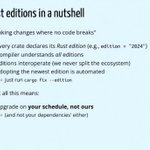
- Breaking changes where no code breaks? ✅ via Rust editions
- Helpful compiler messages for humans and agents? ✅
- Insanely dedicated ppl working on the lang / ecosystem? ✅
Rust is steadily spreading across the industry


ExeleroDev retweeted

I’m very motivated to prove the people making “jokes” about the Rust rewrite introducing security vulnerabilities wrong.

ExeleroDev retweeted
The last solid idea from JS is signals (fine-grained UI reactivity), an alternative paradigm to observables. It originated in Knockout.js (2010), was refined by Ryan Carniato in SolidJS, is now a Stage 1 TC39 proposal, & has spread beyond JS, e.g., to Rust Leptos and Dioxus.

A month ago, Michael Malis started rewriting PostgreSQL in Rust with AI. PG is 1.3M LOC. At 250k LOC, 1/3 of 50k regression tests passed in 2 weeks; a week later, 450k LOC passed 2/3. The goal wasn't just to find out if AI could pull it off, but also to improve on PG limitations.

- Running 20 agents maxed out a 14-core Mac.
- Git worktrees created isolated directories, eating 100GB+ of disk space (fixed via a globally shared target dir).
- Compiling the parser took 50% of time until isolated into a crate, leveraging incremental compilation (caching).
Interestingly, development accelerated as the codebase grew. AI knocked out micro-features once the foundation was laid. Rust’s compiler messages/safety rules and PG's test suite kept agents on track.
github.com/malisper/pgrust
p1: malisper.me/pgrust-rebuildin…
p2: malisper.me/pgrust-update-at…


Source of the quote: youtube.com/watch?v=7LC8D_D_…
Rust4Linux with Danilo Krummrich, corrode podcast, 11 Dec 2025


tokio::sync::mpsc uses Backpressure:
The sender suspends (await) when full.
👉 Prioritizes reliability (No data loss). But it's single-consumer
tokio::sync::broadcast uses overwriting:
The sender never waits, dropping old data.
👉 Prioritizes non-blocking behavior 7/8
Need more reliable fan-out (broadcasting)? Check out the async-broadcast crate. Unlike Tokio, it defaults to backpressure (overflow = false). 8/8
docs.rs/async-broadcast/late…

