

Software Architect | 18 yrs in Backend, AI & Data Systems | I explain Architecture, AI Engineering & real product building with simple visuals.
Islamabad
Joined May 2014
- Tweets1.8K
- Following2.4K
- Followers651
- Likes1.9K





A human can still click “Approve” while the AI has already shaped the evidence, framing and recommendation. The real question isn’t whether a human is in the loop—it’s whether independent human judgment still is. #AI #AIAgents #ResponsibleAI

A student spends hours writing an assignment, submits it, and hears: “This looks AI-generated.” That may be one of the strangest side effects of this new era. We spent years teaching people to write clearly, think logically, and present ideas well — and now doing those things too well can sometimes make your work look suspicious.
I think the real problem is becoming bigger than cheating. It’s trust. If every strong piece of writing has to come with proof that a human made it, we may end up creating a culture where people are judged less on the quality of their thinking and more on whether they can prove they weren’t helped by a machine. So here’s the uncomfortable question: what happens when your best work is rejected simply because it looks “too good” to be human?
#AI

The first sign of AI replacing jobs may not be a dramatic layoff email. It may be much quieter: someone leaves, their chair stays empty, and the company decides the rest of the team can absorb the work with AI. No headline. No announcement. Just one less person being replaced.
That’s the part I think many people are missing. AI may change employment first through smaller teams, slower hiring and higher expectations from the people who remain. The safest move is not to panic about AI — it’s to become the person who knows how to use it to do higher-value work. The real question is: when the next chair becomes empty in your team, will your company replace the person — or replace the role with AI?
#AI #developers

Tests can show that your code worked on the cases you tried. Formal proofs aim higher: proving certain failures cannot happen within defined assumptions. AI may finally make that practical at scale. #AI #SoftwareEngineering #Cybersecurity View article

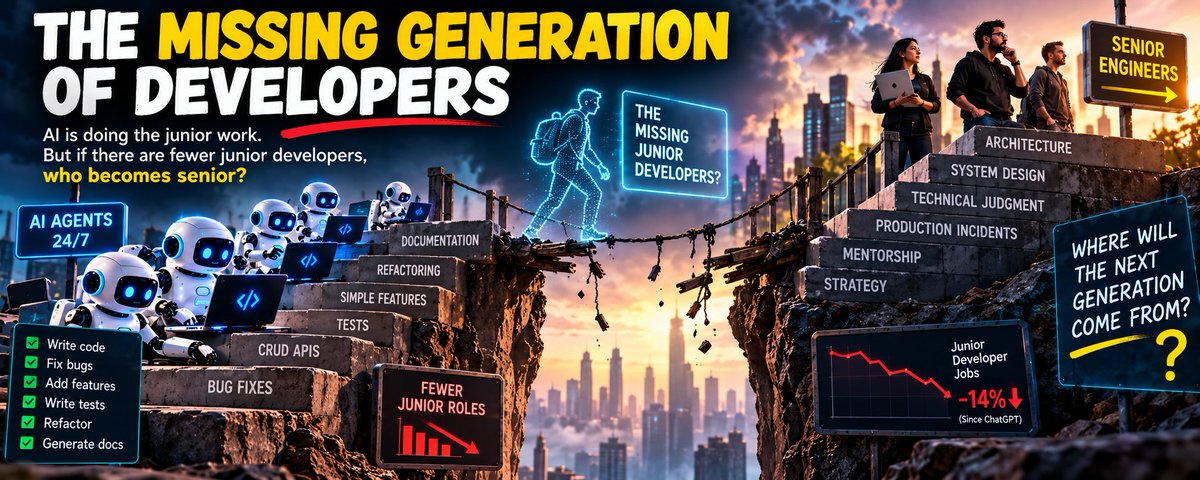
AI may not remove software engineers—but it could weaken the path that creates senior ones. If agents absorb junior work, we need a new apprenticeship model that builds judgment, not just output. #AI #SoftwareEngineering #Developers
Farrukh Naveed Anjum retweeted

THIS IS F*CKING INSANE
Claude Duet does the job of an $8,000/month chief of staff. Anthropic put it behind a waitlist of 300,000+ people
GitHub didn't wait. 140+ open versions dropped in 72 hours. the code is FREE and they run on a $20 Claude plan. 400x cheaper
every night these agents read 200 emails, draft every reply in your voice and prep tomorrow's meetings. you wake up and press yes
20 GitHub projects to open first:
01 Open Duet → the biggest one, 6,000+ stars. build a roster of named AI coworkers with their own memory and approvals. a lead agent hands work to specialists
github.com/Anil-matcha/open-…
02 OpenDuet → bots brief you every morning, watch your apps and wait for your OK before they send, post or pay. try the whole thing with zero keys
github.com/Studio1-OSS/OpenD…
03 Tandem → the Duet experience on a $5 server. morning brief, check-ins that stay silent unless something matters, and every byte of your data in one file
github.com/arjunkshah12345-h…
04 Covo → runs jobs end to end on your server, your PC or your phone. plug in your own Claude key or a local model and it does the rest
github.com/hmody1m/covo
05 openduet → an always-on work partner that learns the routines you teach it once and keeps running them long after you close the browser
github.com/ychampion/opendue…
06 hermes-duet → the same idea on the Hermes agent: one thread, a morning brief at the hour you pick and check-ins 3 times a day
github.com/DevvGwardo/hermes…
07 claude-chief-of-staff → the exact setup the CEO of Ada runs on Claude Code. it took his morning inbox from 90 minutes to about 5
github.com/mimurchison/claud…
08 Claudia → remembers people, not just tasks. say "I'll send that by Friday" once and on Friday morning she's already reminding you
github.com/kbanc85/claudia
09 Chief of Staff plugin → one install, one /chief-of-staff:setup, and Claude Code interviews you and builds your memory and daily brief by itself
github.com/loganhc-09/claude…
10 claude-code-cos → the blueprint for people who never wrote code: what connects to what, what each agent owns and where you keep the final word
github.com/jimprosser/claude…
11 chief-of-staff-2 → a full chief of staff living in plain markdown inside Obsidian. paste one file into your AI and it walks you through everything
github.com/jdpolasky/chief-o…
12 Morning Brief Kit → wake up to the 3 things that need you, the next step already prepared and what can wait. it never sends a thing on its own
github.com/onittindwani-ai/c…
13 Tacitus → reads your mail at 4 AM while you sleep. by breakfast every routine reply is written and waiting on a card with Send, Edit and Cancel
github.com/arpg/tacitus
14 Zyggy → lives on a tiny Linux server around the clock. every night it "dreams", cleaning and merging its memory so tomorrow it knows you better
github.com/zyggy-org/zyggy
15 Scout → cross-checks Slack, Gmail, Calendar, Linear and GitHub on a schedule, so nothing slips between your tools before your morning brief
github.com/Raven-Scout/Scout
16 NachtSchicht → queue tasks in the day, agents work them all night in isolated worktrees, and you merge what's ready over coffee
github.com/FlorianRiquelme/n…
17 agent-brief-me → your agents drop every question into one inbox instead of stopping. you answer them all in one sitting and they finish the job
github.com/RyanLeeYi/agent-b…
18 owl → approve or block Claude Code actions straight from Telegram while you're away, and let safe commands pass on their own
github.com/pkronstrom/owl-af…
19 claude-interact → lets Claude Duet itself start and steer Claude Code sessions on your own machines. no open ports, nothing exposed
github.com/ebarr24/claude-in…
20 Inbox → pulls only the invoices, letters and confirmations you care about, files them and asks before anything goes on your calendar
github.com/googlarz/personal…
start with one. give it a job with an obvious finish line: tomorrow's brief, 10 drafted replies or one prepped meeting
then check what you actually accepted. 3 agents you trust beat 20 you have to babysit
300,000 people will spend the next month on a waitlist for something GitHub already built for free
the full build, every file explained ↓


Imagine going to sleep after a normal coding session, then waking up to AI billing alerts you never expected. That’s the uncomfortable part of the OpenCode breach story: once an AI coding tool can reach your API keys, repositories, terminals and cloud services, compromising that tool can become far more expensive than compromising a normal editor.
We spent the last two years asking how much access AI agents need to become useful. I think the next question is more important: how much access should they ever be allowed to keep? The future of AI coding won’t just be about smarter agents — it will be about tighter permissions, short-lived credentials and much smaller blast radiuses when something goes wrong.

What caught my attention today is that one of the most important AI security lessons still looks very old-school: configuration mistakes. OpenAI recently described how a frontier research model exploited a misconfigured DNS resolver and briefly reached the live internet during a training run. That is a useful reminder that as agents get more capable, “the model was told not to do it” is not a security control. If the workload can execute code, inspect its environment and probe boundaries, I would treat it like an untrusted system process, not a polite assistant.
From my experience, this is exactly where AI safety starts looking like DevSecOps. Hard isolation, network policy, short-lived credentials, observability, kill switches and defense in depth matter more as the agent gets smarter. The funny part is that the failure was not some science-fiction jailbreak. It was basically infrastructure having a bad day. 😄 My takeaway is simple: the smarter the agent becomes, the harder the boundary must become. Your sandbox is only as strong as the dumbest misconfiguration around it.
#AI #AISecurity #AgenticAI #AIAgents #DevSecOps #AIArchitecture #CyberSecurity #SoftwareArchitecture #AIEngineering #CloudSecurity #FutureOfAI

What caught my attention today is that the next big jump in AI may not come from one “super model.” It may come from thousands of smaller agents exploring a problem in parallel. OpenAI recently showed this in biological research, where distributed agents worked across large datasets and scientific literature to surface stronger research leads. That feels very familiar from a software architecture point of view: split the problem, explore in parallel, combine the useful results, and let the best ideas rise to the top.
The interesting part is that once you move from one agent to thousands, the problem changes completely. Prompting becomes the easy part. Now you have orchestration, duplicated work, conflicting conclusions, provenance, cost control, aggregation, and deciding which result actually deserves human attention. Distributed systems were already hard when the nodes were dumb. Now imagine when every node can reason. 😄 That is why I think multi-agent AI will eventually become less about “more agents” and more about better coordination.
#AI #AgenticAI #MultiAgentSystems #AIArchitecture #AIResearch #ArtificialIntelligence #DistributedSystems #AIEngineering #SoftwareArchitecture #FutureOfAI

“It works on my prompt” may be the new “it works on my machine.” Passing visible examples is easy; understanding the real requirement is harder. The best coding agents won’t just generate fast—they’ll generalize. #AI #SoftwareEngineering #AIAgents

AI can generate code faster than ever, but review, testing and safe deployment don’t scale as easily. The new bottleneck isn’t writing code—it’s deciding what deserves to ship. #AI #SoftwareEngineering #AIAgents

Farrukh Naveed Anjum retweeted

this is the most DANGEROUS thing on internet today
someone built an AI that reads candlestick charts the way GPT reads English & released it for 100% FREE
i just connected it to my TradingView setup with opus 5.5 & now my AI trading system reads every candle & predicts the next market move BEFORE it happens (ACCURATELY)
first understand how KRONOS works:
> LLMs like ChatGPT or Claude turn words into tokens & predict the next word
> Kronos turns every candle into tokens & predicts the NEXT CANDLE
> it is pre-trained on 12 BILLION candles
here is how to build the full system for FREE:
1. open Claude Code with Sonnet 5.5 and ask it to clone the Kronos repo and set everything up, it handles the install for you
2. now switch to opus 5.5 and give prompt to load Kronos-small from Hugging Face, it runs on any normal laptop (i am running on my MAC M5 pro)
3. it will pull the same candles you see on TradingView from Binance’s free public API, any coin, any timeframe, open, high, low and volume, no account needed
4. ask Opus 5.5 to feed Kronos the last 512 candles and predict the next 24, exactly like asking an LLM to finish a sentence
5. set sample_count to 100 so Kronos draws 100 possible futures instead of one guess, the spread between them shows how risky next move really is
6. let Opus read the market regime from those futures, most paths pointing the same way means TRENDING, paths scattered both ways means CHOPPY
7. have Opus turn the forecast and the regime into clear entry, exit and stop rules, then backtest them on a year of history with real fees and slippage
8. then plot Kronos’s predicted path next to real candles using TradingView’s free Lightweight Charts library & watch it for a few days before you trust it
9. paper trade it first, then let Opus wire up Telegram bot so your phone pings the moment a high confidence trending setup forms
if you want to build an AI trading system from scratch, start with this article below:


AI coding agents don’t just need better prompts. They need strong tests, deterministic verification and a clear PASS/FAIL loop. Better feedback can make even imperfect agents far more reliable. #AI #AIAgents #SoftwareEngineering

I’ve been thinking about AI costs the same way I once thought about cloud costs. At the beginning, everything feels cheap. A few API calls, a little RAG, one agent, maybe a second agent to review the first one… and suddenly the monthly bill starts looking a lot less experimental. The funny part is that AI agents don’t have salaries, but they still have a cost every time they reason, call tools, search vectors, rerank results, or ask another model for help. 😄
For me, the next serious AI engineering skill is going to be cost discipline. Not “how many agents can we run?” but “where is intelligence actually worth paying for?” Can a smaller model do the job? Can we cache this? Does this need an LLM at all? Why is the agent calling the same tool five times? Why are we using a frontier model for a yes/no classification? The companies that win with AI won’t be the ones using the most tokens. They’ll be the ones turning the fewest expensive decisions into the most business value.
#AI #AgenticAI #AIEngineering #AIArchitecture #EnterpriseAI #CloudComputing #FinOps #GenerativeAI #SoftwareArchitecture #ArtificialIntelligence #FutureOfAI

Farrukh Naveed Anjum retweeted

WHOEVER LEAKED THIS HAS BIGGER BALLS THAN SENSE
someone turned $100 → $2,500 in 48 hours using Claude + QuantGPT for AI powered trading.
but most people focus on the AI and ignore what actually makes the system work.
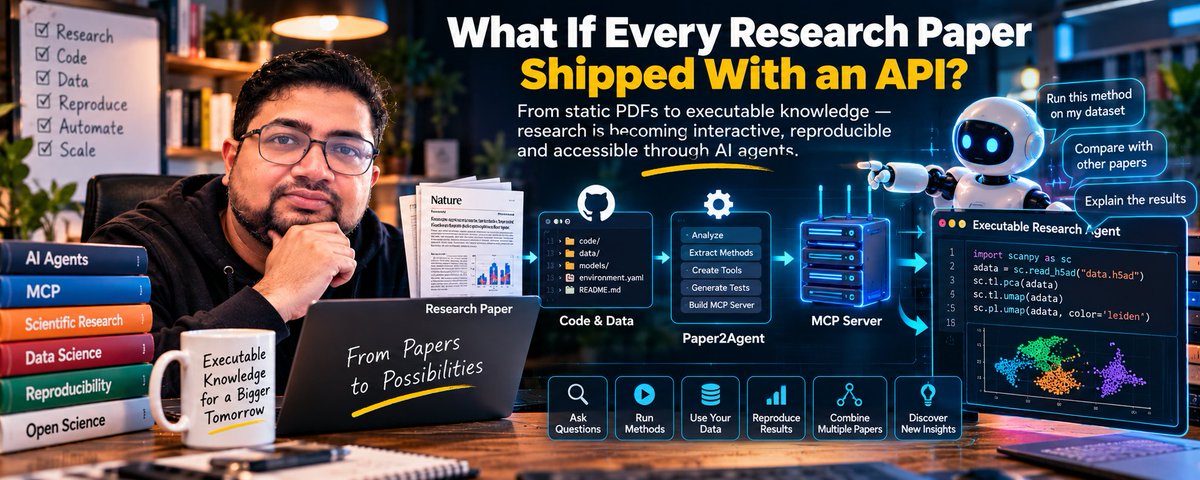
QuantGPT connects Claude to real trading infrastructure through MCP.
→ access historical market data
→ build and backtest trading strategies
→ test for overfitting and weak performance
→ paper trade before risking real capital
→ deploy strategies with a monitored execution runner
the AI proposes the strategy. the infrastructure tests it. risk controls help keep execution disciplined.
that’s the difference between asking AI for trading ideas and building a real quant workflow.
full breakdown on how to set it up below


Farrukh Naveed Anjum retweeted

REA + Opus 5.5 can take apart a million-dollar company in 15 minutes with one free repo, and it's f**king unreal
a friend of mine took apart Microsoft and Anthropic this way, built the same systems in his own business from scratch and saved over $100k
REA is a reverse-engineering agent: you give it a company name, and it finds everything that company has shipped on its own, the website, the desktop app, the phone app
then Opus 5.5 reads their code and figures out how everything works inside: login, payments, where the data is stored
you get a blueprint of a product hundreds of engineers spent years on, and next to every point is the exact place in the code where it's written
then Opus 5.5 writes your version from scratch, and a second agent keeps fixing it until it works like the original
save the repo before big companies get it taken down ↓


Farrukh Naveed Anjum retweeted
REA (Reverse Engineer Anything) is the MOST dangerous MCP for traders
i am literally SHOCKED...
REA (Reverse Engineer Anything) could crack apart any trading system from scratch & inspect its source code along with its binaries for completely FREE
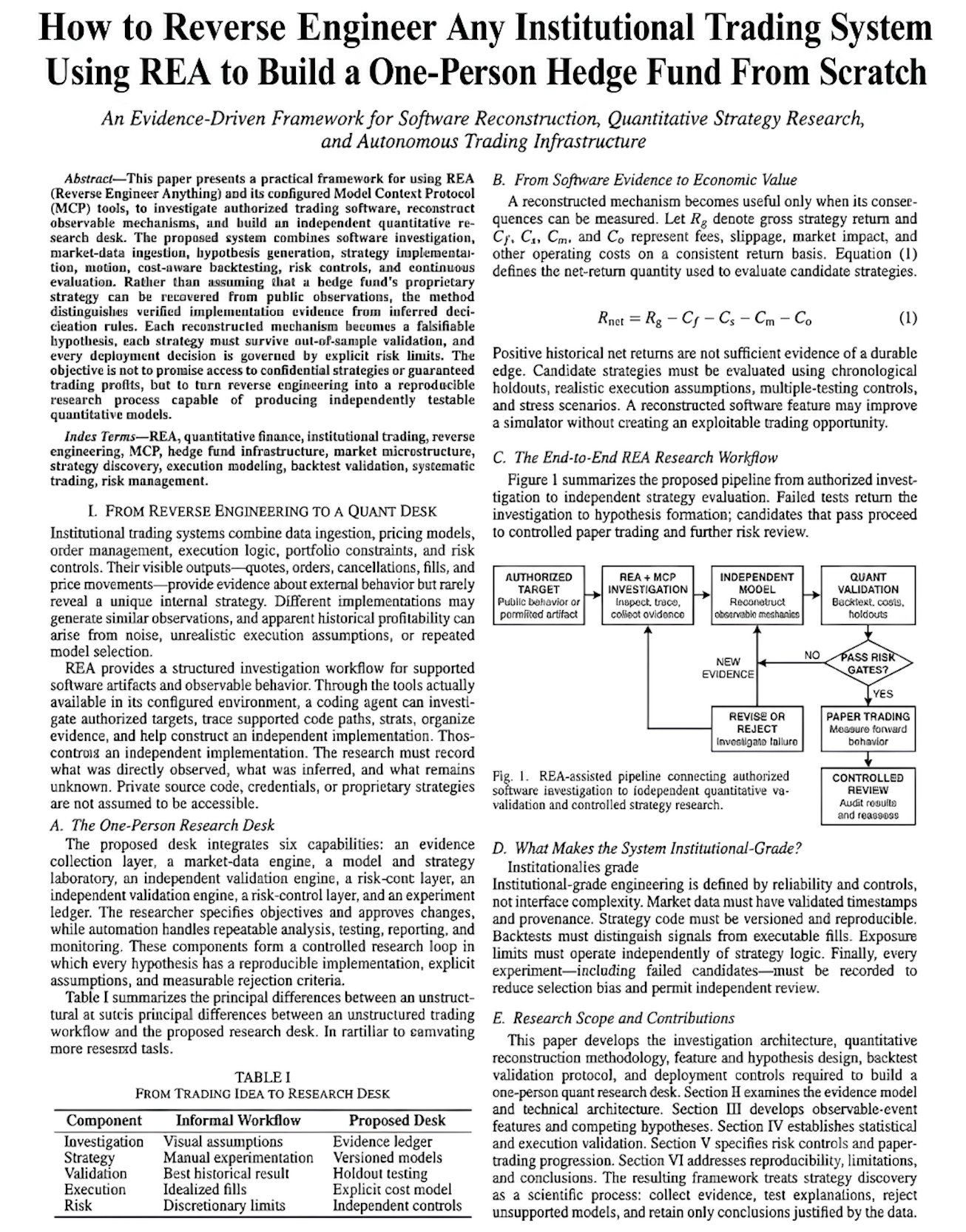
i wrote a 6-page research paper on using REA + Opus 5.5 to reverse-engineer trading mechanics & build your own trading agents in RUST
here is how you do it:
1. the REA workflow investigates application behavior, traces code paths, maps dependencies and reconstructs how trading systems operate
2. the source-code and binary analysis layer examines functions, recovers program structure, and traces implementation details in authorized targets
3. the behavioral analysis engine studies order submissions, cancellations, market-data updates and execution events to infer trading mechanics
4. the Opus 5.5 research agent turns findings into Python models, trading bots and testable strategy hypotheses
5. the backtesting engine evaluates strategies against historical data, fees, slippage, out-of-sample periods, and predefined validation criteria
6. the autonomous research loop logs experiments, investigates failures, monitors performance, and refines strategies under explicit risk limits
the full research framework is in my article below:
Farrukh Naveed Anjum retweeted

An Anthropic engineer just released a 12-page PDF that turns Claude Opus 5.5 into a reverse-engineering team with an AI memory stack
This is f*cking insane...
Send the PDF to Opus 5.5, give it one app and one feature to rebuild, and let it track the evidence across every session
Then read the article below for the exact team and memory-stack setup


I’ve been thinking a lot about what actually survives in the service industry as AI keeps getting better. My view is that trying to compete with AI on raw effort is a dead end. Drafts, routine research, basic code, summaries and repetitive support are all getting cheaper. If your value is mostly “I can do this task for you,” the market will keep pushing the price down. The safer place to build is around the things clients still want a human to own: judgment, domain knowledge, integration, trust, accountability and difficult decisions when there is no obvious answer.
So if I were building a service business today, I would use AI aggressively behind the scenes but I would stop selling hours. I would sell outcomes. If AI can do 80% of the work, I would not spend my energy defending that 80%. I would build the business around the remaining 20% where experience, context and responsibility actually matter. That is probably the real shift: smarter tools, smaller teams, faster delivery, but more value placed on the person who can still say, “This is the right decision, and I’m willing to own it.”
#AI #FutureOfWork #Consulting #ProfessionalServices #AITransformation #BusinessStrategy #SoftwareArchitecture #TechLeadership #DigitalTransformation #ArtificialIntelligence
