

hyperintelligence for humanity
San Francisco 🌁
Joined January 2024
- Tweets111
- Following5
- Followers215
- Likes138




Pinned Tweet
We're releasing RealCUA, the first computer-use dataset of open-ended work in evolving environments.
600+ hours (and growing!) of real multi-objective work with interleaved tasks across thousands of steps in realistic desktops.
11-hour sample & access: data.fig.inc/realcua
fig retweeted

@HarshSikka Harsh, this is awesome work! Generating high-quality, high-fidelity data in this way helps both, build better harnesses (to cover what is not in the models) and to build better models over time. Well done!
@figbrains
fig retweeted

What products launched today?
- @OpenAI introduces GPT-6 Cyber, a cybersecurity research model available to select Daybreak Red customers.
- @MistralAI previews managed agents and apps in Mistral Studio.
- @harvey previews fact graph, a tool for disputes, litigation, and investigations.
- @perplexity_ai launches Teammates, proactive personal AI agents.
- @reductoai launches r-1 mini, a document parser priced at $1 per 1,000 pages.
- @raindrop_ai launches the public beta of Simulations, a tool for testing AI agents against production scenarios.
- @arcjet launches Himalia 1, a model for detecting prompt injections.
- @Tiny_Fish launches TinyResearch and TinySet, tools for web research and dataset creation.
- @PatronusAI open-sources GlobeBench, a benchmark for LLM simulation of reinforcement-learning environments.
- @supermemory launches preprint, a tool exposing browser tabs as Markdown files.
- @distcog unveils VINCO, a reinforcement-learning model for 1v1 Catan.
- @figbrains introduces RealCUA, a dataset of 600+ hours of desktop work across 35 apps, available on request.
Follow tech industry news on Cosign: cosign.co/feed

2/ Full workspace video
Recordings cover the entire desktop with multi-monitor support, on persistent desktops. Every task starts in a workspace shaped by earlier work, and information moves across app and window boundaries.

Our latest writeup shares what hundreds of hours of real, open-ended work taught us about the learning signals missing from today’s computer-use data.
We'll be sharing new datasets and environments in the coming weeks, reach out for an early preview!
Join the Fig team tomorrow at Asilomar SSC!
Keep up with our research here: info.fig.inc/r/7RGXaZ
nitter.gq/Yangyue_Wang/status/21…

Headed to the Asilomar Conference on Signals, Systems and Computers tomorrow!
I'll be there for @figbrains and @ManifoldRG, presenting GUI-Perturbed.
If you're into agents, continual learning, memory, self-improvement, or multi-agent learning, come say hi. I'd love to grab a coffee and talk!
Poster TP8a2.24, Tue 1:30pm, Merrill Hall
Technical report: fig.inc/blog/domain-randomiz…
Paper: arxiv.org/abs/2604.14262
#Asilomar2026

fig retweeted

I'm really excited about the upcoming data technologies the Fig team is developing. We're systematically solving the open data problem.
𝗜𝗳 𝘆𝗼𝘂'𝗿𝗲 𝘄𝗼𝗿𝗸𝗶𝗻𝗴 𝗼𝗻 𝗮𝗽𝗽𝗹𝘆𝗶𝗻𝗴 𝗮𝗶 𝘁𝗼 𝗹𝗼𝗻𝗴 𝗵𝗼𝗿𝗶𝘇𝗼𝗻 𝗼𝗿 𝗼𝗽𝗲𝗻 𝗲𝗻𝗱𝗲𝗱 𝘁𝗮𝘀𝗸𝘀 𝗶𝗻 𝗿𝗲𝗮𝗹𝗶𝘀𝘁𝗶𝗰 𝘀𝗲𝘁𝘁𝗶𝗻𝗴𝘀, 𝗹𝗲𝘁'𝘀 𝗰𝗵𝗮𝘁!
Many frontier teams (including us) have run into this big hairy problem of extracting useful signal and building effective, expressive environments for the kind of work someone might do over the course of a full week in a high performance job.
We're building a science to solve this.
data.fig.inc/preview?utm_sou…
nitter.gq/figbrains/status/21136…


We're sharing early previews with teams ahead of our upcoming releases.
If you're deploying models into complex, open-ended environments, we want to work with you: data.fig.inc/preview?utm_sou…
The Fig team will be in Boston for the ARC Prize summit! Reach out to get a sneak peek at the next generation of intelligence we’ve been quietly building!

I’m attending & presenting @arcprize summit in Boston.
Will be around tomorrow & Saturday.
Dm / reply to me the most cracked people you know, i want to brain drain everyone (researchers, engineers, founders investors anyone)
I’ll let them brain drain me too, so it’ll be worth it
fig retweeted

Benchmarks hide serious gaps in model performance.
Last Friday, we learned the extent of this in "How Good Are Frontier Models, Really?"
@Yangyue_Wang from @figbrains dug into why model capabilities remain so jagged even as benchmark scores keep climbing.
Missed it? No problem! Watch the full talk here:
youtube.com/watch?v=59WZlXqH…

fig retweeted

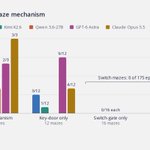
A study from the team showing Astra's and Opus 5.5's jagged reasoning behaviors in simple puzzles. More data points on frontier models' failure profiles.
nitter.gq/figbrains/status/21100…
fig retweeted

Cranking up reasoning doesn't solve all problems.
More thinking more may generate better text or artifacts, not necessarily actions.
That is the gap we care most about at Fig: systems that improve from the consequences of their own actions.
Next we put the same mazes in a 3D world and in plain language, with full history, to separate familiarity with the interface from understanding of the task.
Built with @ManifoldRG by Pranav Guruprasad, Sean Rivera, Helen Lu, Arushi Jain and Harsh Sikka.