

Art, Photograph, Design
Earth
Joined March 2009
- Tweets6.8K
- Following1.2K
- Followers1.1K
- Likes5.1K





Pinned Tweet
Every drawing teacher says the same thing: squint. Close one eye, half-close the other, and the values line up while the detail you were about to
draw wrong disappears.
I teach art. The trick only ever worked with your own face, so I built the digital version.
Painting Eye opens your camera and gives you 13 ways to look at one image: VALUE, TONE, EDGE, FLAT, DUO, STIPPLE. Not beautification filters — the
old studio checks. Value finder, reducing glass, contour tracing, limited palette.
Four more modes for figure work: ink in water, double exposure, drawing straight over the live view, matching a live pose.
Free. No account, no download. Open it in a browser:
yushihu.top/painting-eye.htm…
Which one would you actually use?


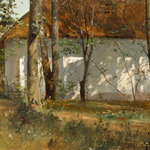
Gustaf Rydberg (1835 to 1933) was a Swedish landscape painter and a pioneer of plein air painting in Sweden. He was among the first to focus specifically on the plains of Skåne.
Born in Malmö, he studied at the art academies in Copenhagen and Stockholm before training in Düsseldorf from 1859 to 1864 under the Norwegian painter Hans Gude. Those years gave him solid compositional skills, but from around 1870 he found his true direction in his native Skåne, shifting from Düsseldorf romanticism to direct observation of the plains, farmhouses and watersides.
Rydberg is known for delicate light and color and a lyrical quality. He favored everyday scenes of the Skåne lowlands such as ponds, old mills, orchards and coasts, using cool greens and blues, with people or animals appearing as small color accents.


9


Caravaggio's The Calling of Saint Matthew | Who Is He Pointing At?
Two notes on wording, then a question. First, who is being called is genuinely open: most writers name the bearded man at the centre (the same face plays Matthew in the chapel's other two canvases), a newer reading says he points at the boy beside him, and some argue the ambiguity is deliberate — a 2021 article was devoted to the question, and in April 2025 the French Academy in Rome held two study days on this chapel. The film uses the safest formulation: the painter does not answer. Second, the claim that the painted light follows the chapel's real window comes from a 2025 art-historian essay in The Conversation, not from a museum record.
Now the question: which hand do you think is doing the calling — the one in the middle, or the one at the table turning on himself?
youtu.be/Zt6g2WHXuAY?si=Bb4x… 来自 @YouTube

1
19


Nymphs Dancing to Pan’s Flute,1920
Joseph Tomanek,1889—1974
During the Renaissance, the image of the god Pan experienced a revival in certain literary and artistic works. For example, in pastoral poetry and paintings, his figure was used to symbolize pastoral life and the beauty of nature.

27


Thomas Eakins's The Gross Clinic | Too Bloody for the 1876 Centennial
1) The patient. The museum's own text says only "a patient" and "the patient's left thigh." The age — often given as a boy in his teens — is scholarly inference, and the exposed flesh is not enough to determine sex. Our narration says "a young patient" and stops there.
2) The woman who turns away. The Philadelphia Museum of Art writes that she is "traditionally identified as the patient's mother" — tradition, not proof. We say "traditionally identified" and do not name her.
3) The refusal and the price. The painting was made in 1875 and shown at the 1876 Centennial; the art jury turned it down and it hung in the United States Army Post Hospital exhibit. The critic's sentence is from the Philadelphia Evening Telegraph of 16 June 1876, shortened in the film for reading aloud. Two sums get confused: two hundred dollars in 1878 (alumni, to the college) and sixty-eight million dollars in 2006 (trustees, to two museums). Our reading — that Eakins painted himself into the room as a witness — follows the museum's identification of the figure at the railing; it is our reading, not theirs.
youtu.be/q6btsgrUMMg?si=wfJo… 来自 @YouTube

104


Old Fisherman Smoking his Pipe,1835
Katsushika Hokusai,1760-1849
#fisherman #smoking #Japan #Japanese

32


