

Founder @loafmarkets To Trade the Physical World
Joined May 2026
- Tweets336
- Following37
- Followers310
- Likes289


Pinned Tweet
And so the journey begins!

One year on, Loaf V1 has reached stability. Foundational infrastructure to trade the physical world with unprecedented liquidity, settled on-chain in real time. What future versions will be built on. Alongside it, a breakthrough primitive for securitizing physical assets, pioneered by Loaf with leading global law firm Baker McKenzie: the Loaf Property DPA. A step toward realizing Robert Shiller's 1993 proposal of perpetual futures on such previously illiquid real assets.
A massive thank you to our earliest users, who put Loaf through its paces in private beta, many of them now testnet millionaires. Now, with a waitlist reaching the hundreds of thousands, we're entering our journey's next phase: Public Beta. And with it, a world-first event, announced 1st August. Stay tuned.
Loaf's mission is to build the open, on-chain infrastructure for all the physical world, to make the world's oldest asset class behave like the world's most modern, and to extend ownership of the real world to every person on Earth.
We just wrapped up Round 3 of League of Loaf trading comp, and I think it's been one of the most interesting experiments we've run so far.
The idea was to give traders a glimpse into what it could look like to participate in the entire lifecycle of a solar park, from its earliest development stages through financing, construction, and eventual operation.
We simulated the development of the Western Desert Energy Hub (WDEH), with traders reacting to developments that would influence the project's valuation in the real world.
Environmental challenges, grid constraints, financing agreements, regulatory approvals, and construction milestones all played a role in shaping price movements.
At one point, WDEH lost over 60% of its value from an earlier peak, yet by November 5, it was trading at nearly 7x its initial price. In reality, projects of this nature do often have 5-20x potential from its earliest phases where successful.
A solar farm's value evolves through every stage of development, as risks are introduced, resolved, and priced in. Today, most of that value creation is accessible only to a relatively small group of developers, financiers, and institutional investors.
Our vision at Loaf is to change that.
We want to build open, accessible markets for individual physical assets, allowing people to gain exposure from the earliest stages of development through maturity, participate in their potential upside, and trade as their valuations evolve.
And this extends far beyond solar farms. Data centers, energy infrastructure, and other traditionally illiquid assets represent an entirely new frontier for financial markets.
We're excited to keep building toward a world where access to the physical infrastructure powering human progress is no longer reserved for a select few.
The saving grace of losing 42% of your market cap overnight is almost always the fundamental value of your assets. Today, NextDC is up 45% at the open.
On 21 October, NextDC crashed 42% after power delays at its Melbourne campus pushed A$140 million of contracted revenue out of the year. At the low of A$5.32, the market valued the company roughly 30% below the net tangible value of its own assets.
Assets with hard physical utility (power capacity + land + connectivity) have true fundamental value. After all, data centres are powering the next decade of innovation and AI demand. Prices can certainly be volatile, or even gap on temporary operational issues, but informed capital treats the disconnect as an opportunity. Competitors, private equity, or the company itself (via buybacks) will eventually take these opportunistically.
The share price recovered more than 20% off lows, before Goodman and Digital Realty moved last night to buy almost 10% of the company at a 45% premium, lined up by JPMorgan: a signal of where informed capital prices the company, and likely still below what they believe it is worth. Those who underwrote the NAV gap made over 75% in two weeks.
This is the practical difference between assets with real economic substance and pure narrative. Speculation without substance has no floor. A data centre is worth something to humanity, for the compute it powers, its land, or its parts. The further price drifts from that value, the stronger the pull.
In a world of unbacked tokens and passing narratives, that floor is rare. Physical assets are the epitome of it, and @Loafmarkets is opening physical markets in assets like these, and in far more exciting ones that were previously gated.
*Not financial advice

Tokenization has been one of the most exciting themes of this cycle, yet I still think we’re barely scratching the surface.
So far we’ve mostly taken already-liquid TradFi assets and put them onchain, but the outsized potential lies in tokenizing the illiquid, even the physical, and making it both tradeable and composable with DeFi.
An example: Portfolio-margin style borrowing has traditionally been reserved for UHNW private bank clients. Tokenizing physical assets democratizes this. Imagine owning a fraction of a yield-bearing data centre with a hyperscaler tenant, posting it as collateral, and borrowing against its future cash flows to lever into the infrastructure being built on top of it.
Literal finance on steroids. What a time to be alive
Gavin.Loaf retweeted

Loaf Labs is hiring a Marketing & Community Lead.
You’ll join a team of 8 redefining the physical world as the next frontier of trading.
Loaf is creating physical markets for the 21st century's most important physical assets: energy, data centres, semifabs, compute, and beyond. We're a lean team with backgrounds in HFT, physics, and finance. This is our first dedicated marketing and community hire. You'll work directly with the founders and help shape an entirely new trading category.
If you understand crypto-native culture and thrive in a lean team where everything bears significance, you'll find this an exciting place. The bar is high and the role can be demanding.
Requirements:
• Strong operator who runs campaigns start to finish and sweats the details
• Biased toward action. Brings solutions, tests fast, doesn't wait for permission
• Social native with real taste, an instinct for what spreads, and knows how to build community
• Fluent in DeFi and trading culture, understands how to build movements
• Experience building or protecting a brand while growing it
• Comfortable owning metrics, ROI, and cutting what doesn't work
• Knows how to earn press and work KOLs, ideally with existing relationships
• You trade or have traded before
Location: APAC (in person). Full-time.
Apply below.
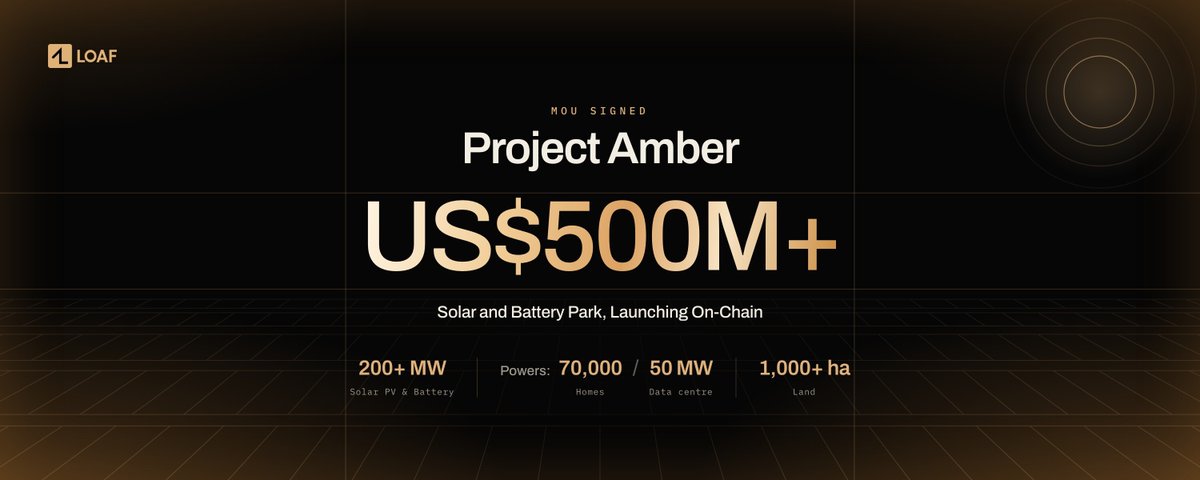
Over the weekend, our team signed an MOU with Fusion Source Energy and Consortia to bring Project Amber, a $500m solar park, on-chain.
Amber is set to become one of the Southern Hemisphere's largest hybrid co-located solar and battery parks, a 200MW+ project on over 1,000 hectares of land, with current fundraising expected to vastly increase its battery capacity. At scale, Amber will power over 70,000 homes or a 50MW data centre.
I believe physical assets stand to benefit the most from tokenisation, with the primitives of DeFi unleashed upon these assets that power humanity. Liquidity, composability, democratised access. Not incremental improvements, a genuine reconstruction of how real assets are owned and traded. @Loafmarkets is building brand new infrastructure to make physical markets a reality.
As I'll expand on in an upcoming paper, a project like this is by no means an individual effort. It takes the combined work of many. It's still early days, but I sincerely commend our friends at FSE for leading the charge. To our knowledge, Amber will be the largest energy asset brought on any public blockchain. I'm also grateful to Loaf's earliest users and testers for all your feedback. We've got you in mind.
P.S. I've been in Singapore for talks and meetings around TOKEN2049. Keen to connect with anyone interested in RWAs and physical assets on-chain. DM me.
Gavin.Loaf retweeted

A new category of tokenized assets is coming to Arbitrum One
> $500M in Australian solar and battery energy infrastructure
Congrats to @Loafmarkets on all their work in making this happen
Gavin.Loaf retweeted
Still far to go, but an important first step. Realizing the new primitive of physical markets can only happen with efforts of the collective - to breakthrough the inertia that is TradFi. Thanks to the @RWAFoundation_ for your support!

.@Loafmarkets announced yesterday that it has signed an MOU to bring more than US$500M of Australian solar and battery projects onchain.
The pipeline is led by Project Amber.

Gavin.Loaf retweeted
1/ Loaf has signed an MOU to bring more than US$500M of Australian solar and battery projects on chain, led by Project Amber.
We're partnering with Fusion Source Energy and consortium partners to make this a reality
Gavin.Loaf retweeted
Introducing Loaf Research.
A library of research and essays written by the quant team behind LLP, dedicated to the study and advancement of physical asset markets.
It publishes in the open, with a shared goal: bringing the world's most ambitious physical assets on-chain
You can find the introductory paper, and expect more to come.

Thanks Stacy 🙏

Real-world events are now getting priced in incredibly fast in proxy markets like oil, Treasury yields, stocks, crypto, etc.
The recent oil moves tied to Saudi Arabia halting several oil operations are a good example.
I tracked how the moves played out in @loafmarkets’ Ras Tanura market:
1. Two days ago, attacks halted Saudi energy operations and pushed oil close to $100 per barrel.
2. As it happened, Ras Tanura (the world’s largest oil export terminal) jumped 52.1% in market price. An hour later, it was up 113.2%.
3. Then, when oil crossed $100 per barrel, the market rose another 31.7%.
You can see the connection pretty clearly. When the oil backdrop changes, this market reprices fast.
Some people are saying that the bull case for prediction markets is to let people trade events without basis risk, but I'm not sure that I agree it applies to ALL events.
I’m honestly amazed at the breadth & efficiency of markets we can trade nowadays.

Exciting times ahead.
For the first time, we're seeing early glimpses of real-time price discovery in physical markets.
We've shared a price action visualisation of Saudi Arabia's largest oil refinery, Ras Tanura, trading on Loaf's testnet against the backdrop of the escalating Gulf conflict and Iran war.
The movements have been produced by 5,000 traders in Loaf's "Trade the News" competition round since it launched 72 hours ago.
Below is a high level on how one may approach pricingthe oil refinery & terminal.


Gavin.Loaf retweeted
An early look at how filings may look for assets listed on Loaf.
Few people have had exposure to an oil refinery, or to many of the physical assets that will trade here. The Form L-1 is a good place to start for traders interested in the underlying. In the way an S-1 sets out a company ahead of listing, Loaf's L-1 sets out the asset: what it is, how it works, what drives its value.
We've made a sample version below for Ras Tanura, which opens for trading in less than 12 hours. Good luck to all participants.

Gavin.Loaf retweeted
League of Loaf: Round 2
Trade the News
Asset: Ras Tanura Refinery (Saudi Aramco)
Objective: P&L
The countdown has begun:
Monday Sep 7th, 2am UTC.
Seats: 5000. Prizes to top 200.
Congrats to @Drb00w for solving round name and asset first. Check DM.

Gavin.Loaf retweeted
We've just upgraded referrals ahead of Round 2 countdown
+ You can now Link your X account. Activates 5X boost for referrals
+ Vastly increased referral cap in general
+ Estimated round entry now displayed
+ New news related UI upgrades (important for round 2)
We are continuously working to bring more users to testnet and beyond, and have now made it a possibility for many more beta users to get in sooner.
R2 Countdown begins in 2 days. Seats will be orders of magnitude more than R1, but still scarce.
PS. round 2 name yet to be solved. $100 still up for grabs.

For physical assets to become truly frictionless, everything in the design of @Loafmarkets had to be engineered from the ground up. While an extensive read, I think this eloquently captures some of the moving parts that form the foundation Loaf V1 has been built on and will continue to be developed from.
LLP and Loaf’s Property contracts deserve their own articles, which we expect to put out in due course.
Appreciate the deep dive @alphacyl

Research On RWA Genius Products/Engineering Episode 2:
Six Mechanisms Native to Loaf Markets(@Loafmarkets )
I. The Loaf Property DPA
Physical assets have resisted financial engineering for the same reason for centuries: the legal act of transferring ownership is expensive, slow, and jurisdiction-specific. Stamp duty. Land transfer tax. Notarial requirements. Title registry filings. Each one compounds when you try to build a tradeable instrument on top of a property. The friction is not a technical problem it is built into property law itself, which exists to make ownership transfers consequential and deliberate.
Loaf resolved this by reaching for a different legal object entirely.
(cite index=“33-1”>Each listing on Loaf is a regulated security rooted in a deferred purchase agreement. The contract gives full exposure to the asset’s economics capital movement and yields, paid in real time as a dynamic coupon. On the capital side it works like a future: a set time at which the contract resolves in cash, backed by a sale of the asset or a payout from its owner. Settlement is not a fixed price set upfront it tracks the underlying asset’s valuation at resolution, and the contract can be rolled and extended. It is backed 1:1 by a first ranking lien on the property’s official land title, issued under a financial services licensed entity.</cite>
The DPA is a derivative. It creates economic exposure to the asset’s value without requiring ownership to transfer. The property stays on the owner’s balance sheet. The holder receives full economic participation price appreciation and real-time yield through a contract structured under financial services law rather than property transfer law. That is not a marginal efficiency gain. It is a categorically different regulatory pathway, one that does not trigger the cascade of transfer-related costs that have made every fractional ownership model expensive to operate at scale.
The first-ranking lien is the security mechanism. It sits on the title itself ahead of other creditors, registered on the official land record. If resolution arrives and the owner fails to deliver the cash settlement, the lien provides recourse against the physical asset directly. The holder’s claim is not against a management entity that could become insolvent or mismanage the underlying property. It is against the land title, which the management entity does not control.
(cite index=“33-1”>The instrument follows Nobel laureate Robert Shiller’s 1993 perpetual-futures framework, opening price discovery, speculation, and real-time markets on illiquid assets such as property.</cite)
The roll mechanism built into the contract means resolution does not have to be final. A holder can extend exposure beyond the initial settlement window without liquidating and re-entering the optionality is embedded in the instrument’s structure, not an add on that requires separate legal documentation.
The problem this solves in real estate is obvious. The broader question is where the same legal architecture applies outside property. The DPA structure a derivative backed by a first-ranking claim against a non financial asset, with cash settlement linked to independent valuation rather than a continuously observable market price is applicable to any asset class where title or ownership transfer is the primary source of friction, and where an independent valuation mechanism exists to anchor the settlement. Infrastructure assets solar farms, toll roads, data centers carry the same ownership transfer overhead that property does, and face the same liquidity problem in secondary markets. (cite index=“62-1”>A DPA is a financial instrument which derives its value from the value of another reference asset. It is a financial contract between two parties where one party undertakes to deliver to the other some pre-determined delivery assets rather than cash at the maturity of the contract.</cite) The architectural leap Loaf made applying this legal structure to a single named property with a specific lien and a live exchange is transportable to other immovable or transfer-friction assets where the legal object of the instrument can be meaningfully separated from the operational management of the asset it references.
docs.loafmarkets.com/en/prop…
doi.org/10.1111/j.1540-6261.…
II. The Dynamic Coupon
Every continuous financial market has a mechanism for keeping its prices anchored to some reference. In equity markets, arbitrageurs continuously buy and sell to keep prices aligned with fair value estimates. In crypto perpetual futures, the funding rate periodic cash payments between longs and shorts pulls the contract price toward spot when they diverge. (cite index=“77-1”>Perpetual futures never expire. There is no settlement date where the market is forced to close the gap between perp and spot. The funding rate is the mechanism that prevents the perp price from drifting indefinitely away from the underlying.</cite)
All of these mechanisms share one requirement: a reference price that updates continuously, or at least frequently enough to give the anchoring mechanism something to anchor to.
Property does not have that. A luxury apartment gets independently valued a few times per year at most. Between valuations, the only price signal is whatever the CLOB generates through actual trading. The gap between last appraisal and current trading price can widen and persist without any external signal correcting it.
(cite index=“33-1”>The Dynamic Coupon is funding-rate-like, paid in real time to holders: when the trading price sits below the asset’s last independent public valuation, it steps up, and vice versa. The deeper the dislocation, the higher the yield paid to holders.</cite)
The mechanism works through economic incentive rather than forced settlement. A token trading at a deep discount to its last appraised value pays an elevated coupon. That carry differential attracts buyers who step in to capture both the price appreciation from discount to fair value, and the elevated yield while they hold. Buying pressure pushes the price back toward the appraisal. As the gap narrows, the coupon steps back down. No oracle is running continuously. No settlement mechanism is forcing convergence. The carry incentive does the work.
For the market maker sitting on an inventory position accumulated while quoting two sided prices, the same dynamic coupon changes the economics of holding that inventory. (cite index=“34-1”>Strategic exposure is made viable by each asset’s Dynamic Coupon: the carry for holding the asset changes as its price moves away from its most recent public property valuation.</cite) A position that is underwater relative to last appraisal generates elevated carry income while the market maker holds it. The dislocation that creates the largest book risk also generates the largest coupon income a natural offset built into the mechanism’s design.
The range of asset classes where this coupon architecture is applicable extends well beyond property. Any asset that has periodic independent valuations but no continuous reference price is a candidate. Private credit portfolios are independently assessed quarterly. Infrastructure assets are appraised annually. Art and collectibles are valued at auction intervals that may be years apart. In each case, the same gap exists between valuation events the same period during which a trading market, if it existed, would have no oracle to anchor against. The Dynamic Coupon’s design calibrating carry to the dislocation from last independent valuation rather than from a continuous reference provides an anchoring mechanism that functions precisely in the spaces where standard oracle dependent designs cannot operate.
III. The Fair Value Engine
(cite index=“34-1”>The FVE produces a live fair value estimate for every listed asset in real time, which the Market Making Engine quotes around. The estimate combines market action with a proprietary pricing model built for assets that have never had a live price: hedonic features and fundamentals read against decades of comparable sales, macro conditions, real-time news. Fundamentals anchor the price; market dynamics discovers it.</cite)
Every other on-chain trading venue for real-world assets imports price from somewhere outside the protocol. The FVE generates it from scratch, from four distinct input categories.
Hedonic features decompose the asset into measurable characteristics location, floor area, construction quality, amenity access and price each one against decades of comparable transactions. This is the methodology (cite index=“45-1”>Shiller proposed in 1993 for constructing indices that would settle perpetual futures: hedonic repeated measures indices based on infrequent measurements of nonstandardized items, controlling for quality change by following individual assets through time and accounting for measured quality variables.</cite) That academic methodology is now running in real time inside a live exchange.
Comparable sales provide empirical grounding. When a similar asset transacts nearby, the event carries information about what the market is currently willing to pay for assets with those characteristics. The FVE ingests that signal and updates its estimate accordingly.
Macro conditions feed in continuously. Interest rate environments, capital flow patterns, and broader economic sentiment all affect asset valuations even when the asset itself is unchanged. A property does not need to transact for its value to shift the FVE tracks that movement in real time rather than waiting for the next appraisal cycle to incorporate it.
Real-time news rounds out the input set. Infrastructure announcements, planning decisions, corporate relocations, local regulatory changes material events that arrive asynchronously and affect specific assets in ways that index level data cannot capture.
The FVE’s output is an estimate, not a price. It is the anchor that the Market Making Engine quotes around. The CLOB produces the actual price through trading. But without the FVE as the anchor, the market maker has no basis for calculating where to post bids and offers on an asset whose value has never been established by continuous trading and posting prices without that anchor is not market making, it is guessing with capital.
The broader application of this architecture is in any market where a trading system must operate on assets with no external reference price and no hedging venue. Prediction markets for binary outcomes approach this problem from one angle. Carbon credit markets, where the “fair value” of an offset is determined by the environmental methodology that produced it rather than by exchange trading, face it from another. Agricultural commodity spot markets in emerging regions where there is no futures curve and no organized exchange, but where price can be estimated through crop yield data, weather patterns, transport cost models, and regional demand indicators are a direct analogue. The FVE’s architecture combining hedonic fundamentals, comparable transactions, macro inputs, and live market action into a continuously updating fair value estimate is a general solution to the problem of pricing in markets where the reference does not yet exist. Loaf built it for property. The engineering is portable to any asset class with those structural characteristics.
docs.loafmarkets.com/en/prop…
IV. The Initial Property Offering
(cite index=“35-1”>Primary sales on Loaf, known as Initial Property Offerings, are events where properties are first offered to the public. A percentage of a property between 1 and 100% is tokenized and offered to wholesale investors. For smaller amounts, buyers can purchase on the market once the property is trading live.</cite)
The IPO is the mechanism through which a physical asset enters the exchange. A property owner tokenizes a defined percentage of the asset’s economics. That percentage is issued through a primary sale to qualifying wholesale investors. Once the primary sale closes, the tokens move directly onto the live CLOB with two sided quotes from the market maker already in place.
The structural difference from every prior tokenized property offering is that the IPO feeds into a market that exists from day one, rather than preceding it. In crowdfunding-based models, capital is collected first and the question of secondary liquidity is deferred often indefinitely. The secondary market develops, if it develops at all, from the organic behavior of holders who may or may not want to transact after the initial raise closes. The IPO on Loaf inverts this. The primary sale initializes the order book. The market maker quotes the moment trading begins. Liquidity is not a future hope it is a structural feature of how the offering is designed.
(cite index=“35-1”>Only accredited wholesale investors can purchase property tokens in primary sales, with a minimum purchase of 1,000 units required. For smaller amounts, buyers can purchase on the market once the property is trading live.</cite) The primary access layer is gated by investor qualification. The secondary market that follows is open to any participant who can interact with the CLOB. The offering structure routes institutional capital in first, at a size that establishes real positions, and then opens price discovery to the broader market.
The property valuation formula embedded in the token design connects the IPO to ongoing price signal: Property Value = (1 / % tokenized) × (PT price × Supply of tokens). As the CLOB produces prices through continuous trading, that equation produces a running implied valuation a price signal the underlying property market lacked between infrequent transactions.
The IPO primitive’s design is transferable to any illiquid asset class where primary issuance currently precedes secondary market development by months or years. Private fund interests, infrastructure project bonds, and fine art are all asset classes where capital is raised first and secondary liquidity is addressed or not addressed after the fact. Structuring each issuance event as a direct feed into a live order book with a standing market maker changes the liquidity profile of the asset from its first day of existence rather than at some undefined later point when a secondary market might develop.
V. The House Market Maker as Product
(cite index=“34-1”>The Loaf Liquidity Provider is Loaf’s in-house market maker. It supplies liquidity to the physical assets listed on Loaf Markets. LLP trades with Loaf’s own capital. Position limits, capital sizing, and the Reserve Fund are designed so that quoting continues through adverse dislocations.</cite)
The LLP is not a service contracted from an external party. It is a built component of the exchange itself Loaf’s own capital, Loaf’s own algorithms, Loaf’s own risk management operating as a permanent structural feature rather than a discretionary arrangement that can be withdrawn when conditions become difficult.
That distinction matters acutely in the context of assets that have never had continuous prices. An external market maker can withdraw quotes when a position becomes difficult to manage. It operates at its own discretion, with its own risk limits that have nothing to do with the exchange’s obligation to provide continuous liquidity. For assets with thin information environments where the market maker itself is the primary price signal withdrawal is not just a liquidity event. It is a collapse of the price discovery mechanism entirely.
(cite index=“34-1”>The MME quotes firm, two-sided prices on every listed market throughout the trading day, dealable the moment they are shown. Its strategies were built for markets with no reference price, no hedging venue, and no trading history. It is designed to stay on both sides of the book in conditions that would drive a conventional desk out.</cite)
The absence of an external hedge is the binding constraint. A conventional equity market maker hedges inventory in options or index futures. A conventional credit market maker hedges in CDS or rate swaps. There is no instrument that hedges inventory risk on a named physical property. The LLP carries real, unhedgeable exposure to every asset it quotes managed through the FVE pricing model and offset by the Dynamic Coupon carry that scales with dislocation. (cite index=“34-1”>Because no hedge venue exists, LLP does not hedge externally. Inventory is managed through strategies built on its pricing model and the carry on the Dynamic Coupon.</cite)
The Reserve Fund is the capital buffer that keeps quoting continuous when positions move adversely. Position limits cap the size of any individual asset’s book so that a single adverse move cannot threaten the LLP’s overall viability. (cite index=“34-1”>LLP has no access to user funds. Its trading capital, the Reserve Fund, and user assets are segregated at all times.</cite)
This design pattern an in-house market maker with a Reserve Fund, position limits, and dynamic carry income as inventory management is directly applicable to any exchange that needs to bootstrap liquidity in an asset class where no external market maker has inventory management tools. Early stage secondary markets for tokenized private credit, infrastructure bonds, or private equity fund interests all face the same cold start problem: without initial liquidity, no participant wants to be first, and without participants, no liquidity develops. An in house market maker with defined capital, defined limits, and an income mechanism tied to the dislocation it absorbs can break that loop as the LLP breaks it in property by guaranteeing standing two sided quotes from the first day of trading.
VI. The LLP Vault
(cite index=“34-1”>Coming soon: a vault through which users will be able to deposit alongside LLP and share in its market making returns and yield from carry. Details will be published ahead of its launch.</cite)
The LLP Vault extends the LLP’s architecture to external capital. A depositor’s funds are deployed alongside Loaf’s own market making capital, taking a proportional share of the book. The returns distributed by the vault come from two sources: the LLP’s market making profit and loss on its positions, and the Dynamic Coupon carry accruing on the inventory it holds.
The carry component is the one that behaves differently from any other vault structure currently operating in DeFi. Standard DeFi vaults stablecoin lending vaults, LP vaults on decentralized exchanges distribute yield that reflects credit risk, utilization, and trading fee income from assets with continuous prices and liquid external markets. The LLP Vault distributes yield that reflects inventory carrying risk on physical assets with infrequent external valuations. In markets where property tokens are trading at significant discounts to their last independent appraisals, the coupon steps up and vault carry income increases. In tightly-priced, calm markets, the carry component compresses. The yield profile moves with the market’s degree of dislocation from fundamental valuation not with DeFi rates, not with crypto sentiment, not with interest rate cycles.
This is structurally uncorrelated carry in a way that no purely crypto-native vault can replicate. The yield source is the gap between an on-chain trading price and an off-chain property appraisal a gap driven by property market dynamics, information asymmetry between local and global capital, and the liquidity premium of illiquid physical assets. None of those drivers have meaningful correlation with the factors that move stablecoin lending rates or AMM fee income.
The vault design is not limited in its application to property market making. Any in house market maker operating on illiquid asset markets with a dynamic carry mechanism could expose that carry to external capital through the same vault structure. A market maker running books on private credit secondary markets, on infrastructure token exchanges, or on any other asset class where the same coupon dislocation relationship holds would produce an equivalent vault with a similar structural yield profile. The LLP Vault is not just a funding mechanism for Loaf’s market making operations it is a template for how carry income from illiquid asset market making can be made accessible to external capital at scale.
Gavin.Loaf retweeted
We're back! Who's ready for R2?
Expect a series of exciting upgrades and updates to be rolled out over the coming weeks to our followers.
For those new, Loaf is holding a world first trading competition for physical assets. 5 rounds, 50k USDC to win.
First to guess the round name and asset before it's announced gets $100 and automatic spot in R2. We'll be checking all comments!
Hint: You'll want to piece together our upcoming posts.

Created a new account today to test a new feature we’re rolling out. And it hit me that we’re almost at 50k users on beta.
It’s a Friday night and I just wanted to thank each and every one of you for being here, early on our journey. For being a pioneer, and for being patient with us as we build toward this new exciting future!
Thanks again, and you can be sure we’re hard at work preparing for round 2 and all that’s beyond!
