
Belgium 🇧🇪
België
Joined September 2012
- Tweets9.3K
- Following3.5K
- Followers1.1K
- Likes88K




Pinned Tweet
- "Financial sovereignty is the bloodstream that sustains the entire architecture of comprehensive national power."
- "Economic statecraft transforms financial strength into national strength, and financial sovereignty into strategic autonomy."
- "Financial sovereignty is not simply an economic asset; it is the strategic bloodstream that sustains industrial capability, technological advancement, military preparedness and enduring national power."
- "Financial sovereignty is seldom created through isolated reforms; it is patiently engineered through decades of productive capability, institutional continuity, disciplined governance and strategic economic execution."
- "Economic statecraft succeeds when finance, industry, trade, technology and national strategy cease to function independently and begin operating as one integrated architecture of national power."
- "Economic influence is the outward expression of financial sovereignty, just as military power is the outward expression of industrial capability. Nations that command both increasingly shape the strategic architecture of the twenty first century."
- "The balance of power in the twenty-first century will increasingly be determined not merely by military strength, but by financial sovereignty, economic resilience and the strategic architecture of national capability. The strongest economies are not those that merely accumulate wealth, but those that systematically convert wealth into enduring national capability."
- “Financial souvereignty is not the destination of economic growth; it is the enduring capability that empowers a nation to shape its own future with confidence, resilience and strategic autonomy."
- "The destiny of nations will increasingly be shaped not by the wealth they accumulate, but by the productive capabilities they create, the financial sovereignty they preserve, and the strategic wisdom with which they convert both into enduring national strength."
c3sindia.org/post/c3s-issue-…

Why would China call for upholding “free trade” 🧐 ?
👇👇👇
APEC chair China calls for upholding free trade
straitstimes.com/asia/east-a…

“This change was driven by U.S. protectionist trade policies.”

South Korean Conglomerates Shift Bases from China to U.S.
Korean Large Companies' U.S. Affiliates Rise 3.3-Fold While China Share Falls to 10.7% As Tariffs and Supply-chain Concerns Reshape Overseas Strategy
The shift of South Korean conglomerates’ overseas business hubs from China to the United States is directly connected to the rapidly changing international situation. In the past, China played the role of the ‘world’s factory’ based on cheap labor costs, but as the strengthening of U.S. protectionism coincided with tariff and subsidy policies, local production in the U.S. and securing supply chains have emerged as major variables for companies.
According to the corporate data research institute CEO Score, the number of U.S. affiliates of 28 major domestic groups (excluding HMM and Coupang) increased 3.3 times from 394 to 1308 over the past 10 years. On the other hand, the number of Chinese affiliates decreased from 700 to 529. While China accounted for the largest share of all overseas affiliates at 23.1% 10 years ago, the U.S. rose to first place this year with 26.5%. The share of China plunged to 10.7%.
The number of U.S. affiliates of the top five groups, which include Samsung, SK, Hyundai Motor, LG, and Hanwha, increased by a massive 648 over the past 10 years, from 240 in 2016 to 888 this year.
businesskorea.co.kr/news/art…
Mercedes-Benz applauds Chinese cars: ‘Outstanding’
“What is obviously outstanding is the speed of developing in a way that the customer really… in terms of customer focus,” Mercedes-Benz chief technical officer Jorg Burzer told Australian media including Drive.
“Cost positions are interesting, but this close connection to the customers and also the Chinese ecosystem is one of the topics which is really standing out.”
The Mercedes-Benz executive also pointed to the Chinese brands’ level of semi-autonomous driving capability.
drive.com.au/news/mercedes-b…

Five Eyes partner on the job👇
US BYD military base ban won’t be copied by Australia
Australia’s Minister for Defence says Australia won’t follow the United States in banning BYD vehicles from military bases.
drive.com.au/news/usa-byd-mi…

Is this you ?


Our lengthy operation against Iran is a direct consequence of Trump surrounding himself with a cadre of yes-men. Americans are not happy to be in another seemingly endless war, and they are placing the blame squarely on Trump.
youtu.be/1QXNk3XbLF8?si

“open global trade” …… are no longer the foundation for a thriving EU economy...
Whocouldaknowed ?
@TheMichaelEvery


You cannot make this stuff up…
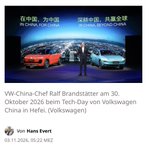
Der Hersteller will in China entwickelte Plattformen und Assistenzsysteme international vermarkten. Die Technologie könnte auch bei Modellen in Europa zum Einsatz kommen.


All the European politicians and eurocrats who keep preaching about “European strategic autonomy” approved this on the altar of “free trade and open markets”👇
How can we save the European automotive industry 🧐 ?
👉 selling one of the biggest European commercial vehicles manufacturers to India sounds like a great idea
Tata schließt Übernahme von Iveco ab
Mit der Übernahme der Iveco-Gruppe steigt Tata Motors zu einem der größten Nutzfahrzeughersteller der Welt auf. Der indische Konzern sichert sich damit auch Zugang zum europäischen Lkw-Markt.
automobilwoche.de/autoherste…
Taiwan becomes world’s largest importer of Russian naphtha as coal imports persist
“This rise in Russian imports is largely driven by the discount offered compared to other sources.”
energyandcleanair.org/public…

Do “Free Trade Advocates” ever wonder why China is their biggest supporter👇?
The Restructuring of the Global Industrial and Supply Chains and the New Landscape of The Global Value Chain
“The backlash against globalization and certain local supply‑chain contraction are but short‑term disturbances.
Globalization remains the underlying trend. The development of the global value chain may encounter headwinds from temporary uncertainty, but no fundamental reversal will happen. Living up to its responsibility as a major country, China will remain firm in supporting trade liberalization and economic globalization, and will not waver in this support because of short‑term gains.”
cpifa.org/Site/en/Uploads/ki…
To quote @GrayConnolly : “The decline in quality from George Kennan to Michael McFaul is both revealing and self-explanatory for the moment we are in.”👇

Watching Michael McFaul earnestly debate a man pretending to be Alexander Dugin is a rather wonderful spectacle.
The account has reportedly been operated by a Dugin admirer in Brazil. One might have expected a former American ambassador to Moscow, regarded by US media as a leading authority on Russian affairs, to know this.
We’re in the last quarter of 2026, and the Germans have discovered that geoeconomics and economic & diplomatic statecraft are important enough to create a new Directorate-General👇
Speech by Foreign Minister Johann Wadephul at the 5th Kiel-CEPR Conference on Geoeconomics
“Economic and diplomatic statecraft is essential.
That is why we established a new Directorate-General combining European Policy and Geoeconomics.”
auswaertiges-amt.de/en/newsr…
Smugglers Bypass U.S. Controls to Ship HBM to Huawei
Despite U.S. export controls on advanced semiconductors to China, High Bandwidth Memory (HBM) produced by Samsung Electronics and SK hynix is reportedly being smuggled into China. Smugglers are using a method of packaging HBMs with low-end server processors to bypass export regulations, and then detaching only the memory once in China.
According to the U.S. IT media outlet The Information on Nov. 2 (local time), smugglers who have recently been siphoning Korean HBMs to China are exploiting loopholes in export regulations.
They package the HBM with a low-end server processor on a board and export it to China. They target the fact that while exporting HBM alone is subject to U.S. regulations, packaging it with a server processor classifies the package as a server processor item.
Under U.S. export regulations, the total computing power of a semiconductor package is evaluated based on the server processor, not the memory chip. The packages are disassembled upon arriving in China. Local technicians apply heat to the board to melt the solder, detach only the necessary HBM, and discard the remaining server processors.
The separation process requires highly sophisticated skills. It is reported that the failure rate is high because applying heat too quickly or for an extended period can cause the memory stack to warp or crack.
Nevertheless, the smuggling continues due to the massive profits.
businesskorea.co.kr/news/art…

👇

Ik roep het al een tijdje. Nu concludeert de overheid het zelf ook: het overgrote deel (80%) van de 'klimaatwinst' door reductie van CO2-emissie in de NL industrie sinds 2021 is gevolg van productiedaling en is dus feitelijk slechts verplaatsing van emissies.
#grafiekvandedag

Gert Bollen retweeted

“The world is dependent on Chinese manufacturing, and in some cases, there are no viable alternative suppliers.”
An astonishing revelation from @nytimes. In 2026.
Now that we’ve made this "discovery", perhaps we can finally have an adult conversation about how to manage this reality—rather than pursuing policies that make things worse. 🦉
nytimes.com/2026/11/02/world…

KPMG: Key findings from the “Global Automotive Executive Survey 2026”
China’s rising leadership
48% of respondents expect that by 2035, six of the world's ten largest automotive manufacturers will be headquartered in China. This reflects the country's strength in electrification, software and digital innovation.
kpmg.com/pl/en/insights/busi…
So, that means banning VW’s from European military bases ?
@PixelPlatoon80 @Eurohans
China-Technologie: Volkswagen stellt mit Vega seine eigene Strategie infrage
Der Hersteller will in China entwickelte Plattformen und Assistenzsysteme international vermarkten. Die Technologie könnte auch bei Modellen in Europa zum Einsatz kommen.
automobilwoche.de/autoherste…
