

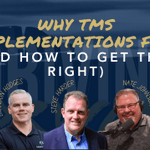




A new TMS can transform your operation. But a poorly executed implementation can bring it to a halt.
So what separates a successful TMS implementation from one that goes sideways?
🔁 We're bringing back a Driving Forward conversation worth revisiting! Listen in starting now below or @Fr8Nate

Why TMS Implementations Fail (And How To Get Them Right) nitter.gq/i/broadcasts/2LPXXadda…

A new TMS can transform your operation. But a poorly executed implementation can bring it to a halt.
So what separates a successful TMS implementation from one that goes sideways?
🔁 We're bringing back a Driving Forward conversation worth revisiting!
Nate Johnson is joined by Brandon Hodges of Mastery Logistics Systems and Steve Harder of Crane Worldwide Logistics (@CWWLogistics) to discuss what it takes to successfully implement a Transportation Management System (TMS), drawing on their experience from both the technology provider and customer sides.
They explore:
🔹 Phased rollouts vs. big-bang implementations
🔹 Change management, employee buy-in, and user adoption
🔹 Executive sponsorship and project management
🔹 Managing scope creep, timelines, and budgets
🔹 TMS integrations, APIs, and connecting your technology stack
Selecting the right software is only part of the equation. How you prepare your people, processes, and organization for change can make all the difference.
Whether you're preparing for a new TMS, evaluating your current technology, or managing a major implementation, this conversation offers practical lessons from professionals who've been through the process.
🎥 Tune in for this Driving Forward replay and learn what it takes to get a TMS implementation right.

🚨 Your TMS is down. Dispatch can't access critical systems. And someone just found a ransomware note.
Would your trucking company know what to do next?
A cyberattack can bring an entire operation to a halt. And having cybersecurity protections in place doesn't necessarily mean your team is prepared to respond.
Who makes the decisions?
Who do you call?
How do you keep freight moving?
Nate Johnson (@Fr8Nate) is joined by cybersecurity experts Ben Wilkens of the National Motor Freight Association (@NMFTA), Director of Cybersecurity at the National Motor Freight Traffic Association (NMFTA) and GLCS's Zach Barnhouse to discuss cyberattack prevention, incident response, and how AI is changing the threats facing trucking companies and freight brokerages.
🎥 Watch the full episode for more on protecting your operation before an attack happens.
Watch/Listen to the full episode on YouTube, Spotify, Apple Podcasts and more: glcs.net/drivingforwardpodca…

We’re live starting now on Driving Forward, talking about cybersecurity in trucking with Nate Johnson (GLCS), Zach Barnhouse (GLCS), and Ben Wilkens (NMFTA). Join the conversation and drop your questions or comments below. Watch below or @Fr8Nate
Cyberattacks In Trucking: Would Your Business Know What To Do? nitter.gq/i/broadcasts/1YxNrblQR…
If your trucking company experienced a cyberattack tomorrow, would your team know what to do?
Cybersecurity threats can quickly become operational problems, disrupting freight movement, exposing sensitive information, and putting customer relationships at risk.
Nate Johnson (@Fr8Nate) is joined by Zach Barnhouse of GLCS and Ben Wilkens, Director of Cybersecurity at the National Motor Freight Traffic Association (@NMFTA), to discuss what trucking companies and freight brokerages should be doing to protect their operations.
With backgrounds spanning trucking operations, technology, and cybersecurity, Zach and Ben bring industry experience to a conversation focused on practical preparation and response.
They'll explore:
🔹 Prevention: Where are trucking companies most vulnerable, and what steps can reduce their exposure?
🔹 Incident Response: What should your team do when a cybersecurity incident occurs?
🔹 Industry-Specific Threats: What risks should carriers and brokers be watching for, from compromised accounts to freight fraud?
🔹 Artificial Intelligence: How is AI changing cybersecurity threats, and what should companies consider as they adopt these tools?
Join us LIVE on Driving Forward Oct 29th @ 1pm CT as we discuss how to prepare for cyber threats, respond when something goes wrong, and better protect the systems that keep freight moving.

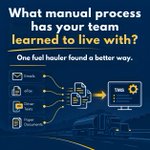
How many manual processes has your team simply learned to live with?
One fuel hauler received documents by email, eFax, driver texts, and paper, and employees still had to manually match each one to the right shipment in the TMS.
GLCS helped them evaluate the options, select the right solution, and manage the project through go-live.
Now, documents can be automatically processed and assigned to the correct shipment.
Sometimes the best automation opportunities aren’t huge projects.
They’re the repetitive tasks your team deals with every day.
Read the case study: glcs.net/case-studies/fuel-h…

Freight Tech Vendors sell features. Carriers need outcomes. 🚛
That impressive software demo might look great, but will it actually solve the problems your trucking operation is facing?
New features, AI tools, and automation mean little if they don't deliver real value.
Nate Johnson (@Fr8Nate), Robert Bain, Carl Williams, and Mike Solarz of GLCS discuss why choosing the right technology starts with understanding your operation, asking vendors the right questions, and knowing what you're trying to accomplish.
🎥 Watch the full episode of Driving Forward for more on vendor red flags, questions worth asking, and key considerations when selecting new technology for your trucking operation.
Watch/Listen to the full episode on YouTube, Spotify, Apple Podcasts and more: glcs.net/drivingforwardpodca…
The latest Driving Forward is available now on @Fr8Nate: a conversation about cutting through the tech and AI hype and investing in what actually delivers value for your operation.
Technology Overload in Trucking: What's Actually Worth It? nitter.gq/i/broadcasts/1yKAPwZEw…

From behind the wheel to behind the technology that keeps trucking moving. 🚛
Meet Jerry Brooks, Channel Solutions Manager at GLCS!
With over 20 years in transportation, Jerry has worn quite a few hats: truck driver, dispatcher, terminal manager, and now technology problem-solver.
At GLCS, Jerry works with customers, partners, and internal teams on software integrations, implementations, and troubleshooting, helping bridge the gap between technology and real-world trucking operations.
His favorite part? Solving problems and finding ways to make people's day-to-day work easier.
And despite his role in technology, Jerry still maintains his CDL and gets behind the wheel whenever he can! When he's not trucking or tackling tech challenges, you'll find him playing goalie on the ice or announcing drag races at his local racetrack. 🚛🏒🏁
Get to know Jerry and the experience he brings to the GLCS team in our latest Employee Spotlight!
What makes a driver want to stay with a trucking company?
Pay, equipment, home time, and benefits matter.
But so does something much harder to put on a recruiting ad: how you treat people.
Marina Ivanov of Apex Transit Solutions shares why trust, compassion, honest communication, and respect have become foundational to how she approaches driver relationships and retention.
Because filling a seat is one thing. Building a company drivers want to stay with is another.
🎙️ Listen to the full conversation on Driving Forward YouTube channel.
Watch/Listen to the full episode on YouTube, Spotify, Apple Podcasts and more: glcs.net/drivingforwardpodca…
We’re LIVE now! Nate Johnson is joined by Marina Ivanov of Apex Transit Solutions to talk driver recruiting, retention, career paths, second-chance hiring, and the people behind trucking. Streaming on @Fr8Nate
What Makes Drivers Stay? Rethinking Retention in Trucking nitter.gq/i/broadcasts/1wxWjlwoe…

What does being a “driver-friendly” trucking company really mean? 🚛
Better parking? More home time? Better benefits?
What about mental health support?
Jason Douglass shares how access to counseling helped a truck driver cope with the emotional aftermath of a devastating accident, and why post-accident mental health resources should be available to drivers.
Jeremy Reymer of Project 61 reminds us that driver health goes beyond physical fitness. Their Five Axles of Health focus on nutrition, movement, sleep, mental health, and preventive care.
Supporting truck drivers means caring for the whole person, both physically and mentally.
🎙️ Watch the full conversation on Driving Forward with Nate Johnson (@Fr8Nate), Jeremy Reymer, and Jason Douglass.
Watch/Listen to the full episode on YouTube, Spotify, Apple Podcasts and more: glcs.net/drivingforwardpodca…
Starting now! Tune in to @Fr8Nate for Nate’s conversation with Jeremy Reymer of @Project61health and Jason Douglass about driver health, safety, and helping drivers build healthier lives on and off the road.
Driver Health in Trucking: Why Fleets Need to Pay Attention nitter.gq/i/broadcasts/1qxoNYRaa…

What if driver health was treated as a safety issue, not just a benefits issue?
Trucking invests heavily in safer equipment, better technology, and reducing risk on the road. But the health of the person behind the wheel deserves a place in that conversation, too.
Nate Johnson is joined by Jeremy Reymer of Project 61 (@Project61health) and Jason Douglass for a conversation about the realities of driver health and what the industry can do to help drivers build healthier lives on and off the road.
They discuss Project 61’s whole-driver approach, including nutrition, movement, sleep, mental health, and preventative care, along with the challenges drivers face trying to prioritize each while spending long hours on the road.
Listen to real examples of drivers making meaningful changes, the role fleets can play in creating healthier environments, and why better driver health can have implications for safety, retention, healthcare costs, and quality of life.
The goal isn’t simply helping drivers stay behind the wheel longer.
It’s helping more of them enjoy the life they’re working so hard to build.
▶️ Watch the full episode of Driving Forward with Jeremy Reymer, Jason Douglass, and Nate Johnson – Thursday, Oct 8th @ 1pm CT!
Visit @Fr8Nate for the livestream!

How cyber-ready is your operation?
Cybersecurity in trucking reaches far beyond the back office.
Your TMS. Driver devices. Email. Customer data. Connected applications. Employee accounts. And now, the AI tools your team may be using every day.
A strong cybersecurity strategy means regularly checking the fundamentals:
✅ Audit your defenses. Review passwords, firewalls, antivirus protection, system settings, and other potential weak points.
✅ Back up AND test recovery. Having a backup isn't enough if you don't know whether you can restore it when you need it.
✅ Use MFA and control access. Limit administrative privileges and remove access promptly when employees leave.
✅ Train your entire team. Cybersecurity awareness shouldn't stop at the office. Drivers and other employees interacting with your systems should understand what to look for and how to report something suspicious.
✅ Have an incident response plan. Know who gets called, how your team communicates, and what happens if critical systems become unavailable.
✅ Use AI responsibly. Establish guidelines for approved AI tools, keep sensitive company and customer information protected, and verify AI-generated information before relying on it.
✅ Monitor, patch and maintain. Cybersecurity isn't something you complete once. Systems, threats, and the technology your business relies on continue to change.
Think of cybersecurity like preventative maintenance for your technology.
How many of these can your operation confidently check off today?
