





Pinned Tweet
In the heart of #Eritrea where the mountains kiss the sky and the valleys whisper tales of old, lies a village known as ግዝግዛ 👇👇that holds the essence of my ancestors. Its beauty is timeless, its spirit unyielding, and its people, a testament to resilience and grace.


Ezra Musa retweeted

Proud of the @UNinEritrea team, one of 7 winners of the 2026 UN Results Report Awards. Our 2025 report gives a clear account of our partnership with Government on health, food security, resilience and more, and concrete impact on people’s lives. @UN_SDG un-dco.org/stories/2026-un-r…

The @UNinEritrea team is one of seven winners of the 2026 UN Results Report Awards.
The 2025 report highlights results achieved with the Government on health, food security and resilience: immunization coverage above 95%, skilled birth attendance rising to 85%, nutrition support for more than 38,000 children, livestock assistance for 90,000 households, solar-powered water for around 250,000 people, and 992 villages declared free of FGM.
The report also provides clear accountability on resources and impact.
#Eritrea
un-dco.org/stories/2026-un-r…

Ezra Musa retweeted

Ethiopia’s PP manufactured this crisis in October 2023 with its brazen demand for “sovereign access to the sea.”
Three years of incendiary propaganda, military rearmament and open threats followed. Then came military operations in Tigray, declared a mere stopover on the march to the Red Sea.
The ultimate audacity? Taking this expansionist war agenda to the UN Security Council under the spurious pretext of “self-defence.”
The UN Security Council and African Union must uphold their own charters. Threats of aggression demand unequivocal condemnation and concrete deterrent measures—not diplomatic silence.
#Eritrea #Ethiopia #RedSea #UNSC #AfricanUnion

In the current international/diplomatic discourse regarding the imperative of adherence to, and respect of, foundational pillars of international law as well as the maintenance of regional peace and security, the following salient facts and sequence of events must be recognized, without any equivocation, as the kernel/principal causes behind the prevailing grave situation:
1. On 13 October 2023, the Potemkin Party willfully manufactured an unnecessary and avoidable crises between the two countries by formally and publicly declaring its hostile agenda of acquiring "sovereign access to the sea", apparently and ultimately through invasion and occupation of Eritrea's sovereign lands. This dangerous declaration constituted a flagrant violation of foundational pillars of international law as well as the Joint Declaration of Peace and Friendship signed between the two countries in Asmara on 9 July 2018.
2. This initial declaration was ramped up in subsequent years through relentless and incendiary media campaigns; associated saber-rattling, and massive rearmament. The scope of the PP's impending invasion was also broadened to include forcible incorporation of Eritrea's southern coastline (see attached map) for the establishment of "a sovereign naval force with strategic depth".
3. The war agenda was further ratcheted up and translated into an operational plan when the PP regime launched its military operations in the Tigray Administrative Region in mid-September this year. Indeed a couple of days after the eruption of the war, the PP's Deputy Chief of Staff announced that "Mekelle will be a mere stop-over... the main objective is to install our flag in the Red Sea".
4. And on 9 October last month, the PP regime went further to ominously "notify the UNSC" on the unleashing of its war of aggression against Eritrea under the spurious pretext of "self-defense".
The writing on the wall is thus crystal clear; eliciting, as it does, unequivocal condemnation as well as requisite deterrent measures in accordance with explicit provisions of the UN Charter and associated instruments.


Ezra Musa retweeted

nitter.gq/GermanyDiplo/status/21… Stability in the #Horn of #Africa is indeed vital. But stability cannot be defined exclusively through the lens of one country, nor can it be achieved by overlooking the sovereignty, territorial integrity and legitimate security concerns of its neighbours.
Preventing escalation requires more than calls for restraint. It demands addressing the underlying causes, and upholding the principles of the @UN Charter and international law. Threats, coercion and ambitions directed against the territorial integrity of neighbours cannot be normalized or overlooked.
Regional stability cannot be built on selective principles or strategic appeasement...and stability is not a licence for regional primacy, nor can it come at the expense of the sovereignty and security of neighbouring states.
There can be no durable regional stability without respect for sovereign equality, territorial integrity, mutual respect and adherence to international law

A stable Ethiopia is vital to the entire region. Any escalation in the #HornofAfrica must be avoided. Germany continues to support efforts to promote stability in northern Ethiopia. - @AussenMinDE in today’s call with @GHessebon .


Ezra Musa retweeted
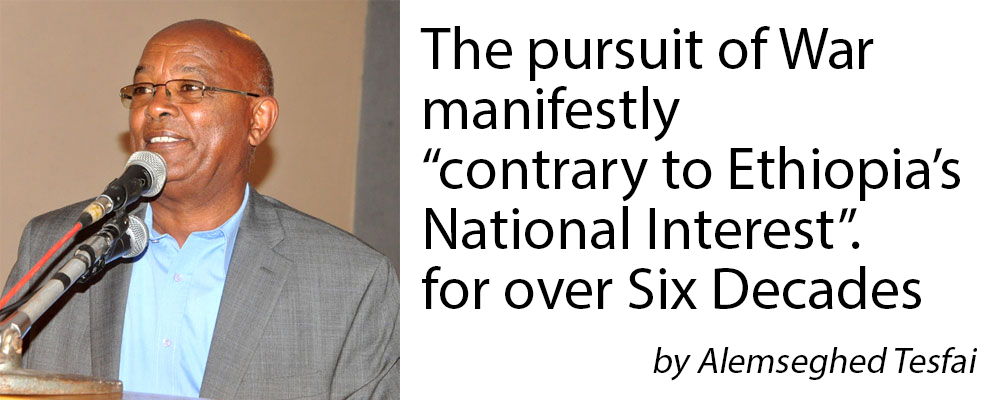
THE MARCH OF FOLLY
Haile Selassie. Mengistu. Meles Zenawi.
Three regimes, one fatal miscalculation: believing military force could bend Eritrea to their will.
Now Abiy Ahmed and his Prosperity Party risk repeating the same folly.
History warns those who refuse to learn from its wreckage.
#AlemsegedTesfai
#Eritrea #Ethiopia #AbiyAhmed #TheMarchOfFolly #HornOfAfrica #RedSea #EritreanHistory

Ezra Musa retweeted

Integrating Skills for Digitalized Future to improve Healthcare Service
By: Kidane Shimendi
Pharmacist Nuru Abdu Ahmed and computer engineer Bilal Adem Shelogay have developed an official offline Android app for the 8th edition of the Eritrean National List of Medicines (ENLM). The app gives healthcare workers instant, searchable access to the national medicines list, VEN categories, level-of-use guidance, and alternatives—even without internet—supporting rational prescribing and better continuity of care.
Built voluntarily by local experts and now nationally distributed, the ENLM app marks a practical step in digitalizing Eritrea’s health references. Future plans include digitizing the National Formulary Manual, Standard Treatment Guidelines, plus tools like drug-interaction checkers and pediatric dose calculators to further strengthen clinical decision-making at the point of care.
shabait.com/2026/11/04/integ…


Ezra Musa retweeted
Ethiopia’s war agenda against Eritrea is no longer concealed behind diplomatic language.
From Abiy Ahmed to senior military commanders, threats to seize Assab by force, redraw borders and dismantle Eritrea’s sovereignty have been made openly.
Their own words speak for themselves.
#Eritrea #Ethiopia #Assab #RedSea #AbiyAhmed #HornOfAfrica

ETHIOPIA’S OVERTLY DECLARED WAR AGENDA AGAINST ERITREA
(Verbatim Statements by Ethiopian Government Senior Officials regarding Eritrea’s Sovereignty)
Abiy Ahmed Ali, Prime Minister of Ethiopia
· "Sovereign access to the sea by any means necessary - through negotiations if possible and by force if necessary, Ethiopia would not remain a prisoner of geography."
· "Regarding the Red Sea, and speaking about it repeatedly, let me say it again to make my stance clear; why does Israel hold the Golan Heights? Israel holds the Golan Heights because it believes problems regarding national security, survival and its existence… People are born, grow, age and people die, this is natural. Red Sea access and Ethiopia are just like that."
· “We have found no document – in Cabinet, Parliament and other Government Archives - that asserts Eritrea's independence”. Taking their cue from the Prime Minister’s incendiary statement, Prosperity Party state media channels actively called on citizens to mobilize and ‘withdraw’ recognition of Eritrea's 1993 sovereignty, labeling it a ‘historical mistake’."
· "Adulis, located on the Eritrean Gulf, can be considered one option. Massawa and Assab can also be considered other options. We do not necessarily hold the position that it must be Assab or Massawa. What we seek is simply a breathing (sovereign) outlet, access to the sea."
· "As you know, five or six years ago we established a navy. Did we establish it so that it [the Navy] could swim around in this glass [container]? I am a million percent certain; Ethiopia will not remain landlocked-whether anyone likes it or not."
· "For Ethiopia, losing access to the Red Sea took about 30 years [Eritrea’s legitimate struggle for liberation] - after the 30 years’ war, Ethiopia lost it. Now, however, I do not think Ethiopia needs another 30 years to retake it".
· "Therefore, efforts will be made to resolve the issue and minimize losses. Whether it happens through peace or through force, it is inevitable".
· "If fighting breaks out, the outcome is clear. After that, crying and wailing will be of no use. If we enter [the war], the outcome is clear. We have sufficient and dependable capability. There is no force that can stop us. This must be clear”.
Field Marshal Berhanu Jula, Chief of Staff of the Ethiopian National Defense Forces (ENDF)
· "We will strengthen our army. We will accelerate our development. We will obtain access to the sea, whether through peace or through force; through negotiations if possible and by force if necessary - through Bale or Bole".
General Abebaw Tadesse, Deputy Chief of Staff of the ENDF
· "The offensive launched in Tigray will not stop there. Mekelle is a mere stop-over; our ultimate destination is Assab; our main objective is to raise our flag in the Red Sea".
Ethiopian Air Force Commander General Yilma Merdasa
· “The main goal is the recovery of sovereign sea access, particularly through the Eritrean port of Assab.”
Maj-Gen. Teshome Gemechu: Director-General of International Relations and Military Cooperation (ENDF)
· "Ethiopia is not a landlocked nation. We are not landlocked. Rather, we are an ocean-linked country. Ethiopia had it. And even though the matter hasn't been resolved yet, we are not landlocked".
· "We were created together with the water. We used to have water. The water used to be ours as well as the port. Because it is a special case, we have a double right to demand it".
· "The Red Sea belongs to Ethiopia. We will take it back at any cost! Assab is Ethiopia's Red Sea province".
· "The port of Assab, even its design was made in such a way that it only serves Ethiopia, or starting from the Afar region, focusing only on serving through that route - take this into account as well: in international law, it can serve for a dispute".
Military Commanders
· Public displayed, at the Inauguration of Military Recruits few months ago, of an official Map of Ethiopia that unlawfully incorporates the port city of Assab and Eritrea's southern coastal territories.
L. General Alemshet Degife, Advisor to the ENDF and Chief of Staff and Board Chairman of the Defense Engineering Industrial Corporation (DEIC)
· "We have entered a process about a territory we do not control, which connects [us] to other continents, could allow those whom we have historically regarded as our enemies to establish themselves directly within 60 kilometers of us without asking our permission".
Shimelis Abdisa, President of the Oromia Region
· " Irrecha [traditional Oromo celebrations] will be celebrated in the Red Sea (Assab), next year."
General Bacha Debele, Former Ethiopia's Ambassador to Kenya
· "When we say Assab belongs to Ethiopia, it is because it belongs to Ethiopia. What you [Eritrea] took by force, we will return by force".
· "Once war breaks out, there will be no such thing as the Government of Eritrea. This must be clearly understood. Geography will change. Governments will change. The borders of countries will also change. The border that exists between Eritrea and Ethiopia will cease to exist".
· "If the Eritrean Government ceases to exist, what could possibly happen? It will collapse on its own and it will be gone. Isn't this war? Once a war breaks out like this, there is no distinction between the rear base and front line. In modern warfare, there aren’t separate rear base and front lines. Any place becomes a front line. Asmara cannot remain a rear base area [no-combat zone], while Badme is the front line. Both are the front lines".
General Tsadkan Gebretensae, Military Advisor to the ENDF
• "I have begun raising the idea that we should correct the mistakes we made previously and seize Assab from them [Eritrea]".
• "At present, our relationship with Eritrea is not merely an issue of national security, nor merely about raising the question of ports or discussing the Eritrean government. I believe we must recognize, in light of history, that the manner in which we answer the Eritrean question is connected to our very existence”.
Ambassador Dina Mufti, Member of the Federal Parliament's Foreign Affairs Committee
· “Ethiopia's quest for sovereign sea access is non-negotiable”; and he proceeded to aggressively demand international pressure against Eritrea!
Daniel Kibret, Social Affairs Advisor to Ethiopia's Prime Minister
· "Once Ethiopia obtains access to the sea, the reason for Eritrea being Eritrea will cease!"
Adanech Abebe, Mayor of Addis Ababa City
· "Are we supposed to live forever with the question of our sea closed off to us? There is no young person who will accept living with it closed; at one time it was close to us and we lost it. But this generation will not accept that”.
Lencho Bati, Director General at MoFA of Ethiopia's Diaspora Service
· "The Ethiopian military that suffered in the deserts of Tigray, will not stop before taking off its shoes by the Red Sea and wash its feet on Eritrean Red Sea waters”.

Ezra Musa retweeted
Deconstructing Fictitious Claims to Eritrea’s Red Sea Coast
By Dr. Tsegai Medin @ERIHominin
Eritrea’s Red Sea coast is not up for debate.Ethiopian claims fail on every level:• Aksum was an ancient multi-ethnic empire — not a modern title to Eritrean territory (Adulis was in present-day Eritrea).
• The coast was under Ottoman/Egyptian control + local Afar Sultanates for centuries, independent of the Ethiopian highlands.
• Modern borders were set by colonial treaties (e.g. 1889 Treaty of Wuchale). Ethiopia never held the coast when they were drawn.
• 1950 federation → illegal 1962 annexation → 1993 referendum (99.8% for independence) → EEBC ruling confirmed the border.No amount of selective history or economic desire overrides international law.
Dr. Tsegai Medin is an Eritrean paleontologist, archaeologist, and heritage specialist.
facebook.com/share/p/1HfpZ1p…

Ezra Musa retweeted
Eritrea is not a pawn in the geopolitical ambitions of global powers.
Its strategic Red Sea coastline, decades of historical resilience, and independent diplomacy make it an indispensable sovereign actor in the Horn of Africa.
Geography gives Eritrea strategic importance. History forged its resilience. Sovereignty ensures it determines its own future.
Eritrea’s irreplaceable role in shaping the Red Sea’s future.
#Eritrea #RedSea #HornOfAfrica #EritrawiPodcast
shabait.com/2026/10/29/eritr…
Ezra Musa retweeted
Eritrea’s Coveted Geopolitical Location and Irreplaceable Strategic Role in the Red Sea and the Horn of Africa
Ministry of Foreign Affairs of the State of Eritrea
Research and Documentation Division
29 October 2026
Eritrea’s location along the Red Sea and near the Bab el-Mandeb Strait has long made it a vital crossroads linking Africa, the Middle East, and global shipping routes. Since the opening of the Suez Canal in 1869, its coastline has underpinned a major artery of international trade and energy flows. Today, as conflicts in Yemen, Sudan, Ethiopia, and Somalia threaten regional stability, Eritrea’s relative cohesion and independent foreign policy give it outsized importance for maritime security and regional order.
Eritrea’s strategic weight goes beyond geography. It stems from a consistent emphasis on sovereignty, resistance to external pressure, and support for littoral-state cooperation to secure the Red Sea. In a Horn of Africa marked by state fragility and competing external interests, Asmara’s posture—acknowledged by partners including Egypt, Sudan, and Somalia—positions it as a stabilizing actor whose choices affect security and commerce well beyond its borders.
shabait.com/2026/10/29/eritr…

Ezra Musa retweeted

Thank you, Ambassador @FaqiAlis for the words of wisdom & statesmanship which the Ethiopian PM conspicuously lacking.
@AbiyAhmedAli ’s pursuit of “sovereign” sea access through threats of #aggression is unjustifiable and contrary to international law. #Ethiopia has never been denied commercial #maritime access through peaceful agreements. Threatening to invade #sovereign neighboring countries serves neither the Ethiopian people nor regional peace, but the #UAE and its enablers’ #expansionist agendas across the #HornOfAfrica.
#EritreaPrevails
#Somalia
#Sudan


The Horn of Africa has been in conflict for decades. Fighting continues inside Ethiopia, and Somalia remains fragmented and politically unstable.
Ethiopia's claim of real economic concerns does not legally justify seeking sea access by force through Eritrea's Assab port or through any other port in the neighboring countries. Any such war will fail. It will only destabilize the region, cause massive human loss, and force many to flee their homes.
Under UNCLOS, landlocked states must negotiate access bilaterally. No country has the right to take a portion of the sea by force.
The 1998 to 2000 war between Ethiopia and Eritrea was disastrous and solved nothing.
War has never brought a permanent solution and should be avoided at any cost. A conflict in the Red Sea would be very costly, as it could spread to the entire region.
The countries of the Horn of Africa should unite to maintain their strategic relevance. Only with peaceful coexistence can these countries prosper.

Ezra Musa retweeted
Eritrea’s foreign policy is grounded in sovereignty, recognised borders and diplomatic cooperation. Ethiopia’s increasingly confrontational posture raises serious questions about the future of the Horn of Africa.
From the 2024 Somaliland MoU and demands for Red Sea access to threats of military force, the distinction between commercial cooperation and territorial control is becoming central to regional tensions.
The diplomatic breakdown is equally revealing:
From May 2026, Ethiopia reportedly curtailed communications with Eritrea’s Foreign Ministry. On 8 August, its remaining diplomats departed Asmara without formal notification. On 1 October, Ethiopia expelled 10 Eritrean diplomats, including representatives accredited to the AU and UNECA.
The 2002 Eritrea–Ethiopia Boundary Commission decision remains final and binding.
Economic necessity does not create territorial entitlement. Commercial access can be negotiated. Sovereignty cannot be bargained away.
If economic necessity becomes a justification for territorial expansion, whose sovereignty will remain secure?
#Eritrea #Ethiopia #HornOfAfrica #RedSea #Sovereignty #InternationalLaw #AfricanUnion #Somalia #Somaliland #Diplomacy
Contrasting Eritrea’s Sovereign Foreign Policy with Ethiopia’s Expansionism in the Horn of Africa
The geopolitical landscape of the Horn of Africa has once again reached a dangerous crossroads. At the heart of this unfolding crisis lies a fundamental confrontation: on one side stand the core principles of national sovereignty, territorial integrity, and sovereign equality; on the other lies an aggressive political agenda, driven by UAE led axis that is increasingly centered on maritime entitlement, historical revisionism, and the projection of regional power. This clash of visions has been brought into stark relief by the sharp deterioration of relations between Eritrea and Ethiopia. The escalation reached a critical threshold on October 1, 2026, when Ethiopia decided to close its embassy in Asmara and expel ten Eritrean diplomats, a move swiftly followed by Eritrea’s decision to take reciprocal decision and severe diplomatic relations entirely.
In mainstream Western and corporate media discourse, the complex friction points of the region are frequently flattened into a generalized narrative of mutual intransigence. However, drawing upon regional policy analyses and investigative perspectives a vastly different reality emerges. This analysis explores the fundamental dichotomy between Eritrea’s consistent foreign policy of defensive sovereignty, regional partnership, and non-interference, and Ethiopia’s historical and contemporary trajectory of destabilizing expansionism, internal volatility, and projection of external grievances.
This crisis cannot be understood solely as a diplomatic disagreement over port facilities or commercial access to maritime routes as main stream media would have you believe. It must be examined against the increasingly forceful rhetoric emanating from Ethiopia’s political leadership concerning sovereign access to the Red Sea, historical rights, Ethiopia’s former maritime position, and the strategic importance of the Eritrean coastline. The central question is whether Ethiopia’s declared objective is confined to securing reliable commercial access through negotiated arrangements or whether influential elements within its political and military establishment envisage a more ambitious transformation of the regional territorial order.
Ethiopian Prime Minister Abiy Ahmed and the leadership of the ruling Prosperity Party (PP) have repeatedly described sovereign sea access as an existential national necessity. At various points, they have also tried to cloak their warped ambition in the language of peaceful negotiation, mutual benefit, and respect for neighbouring states’ sovereignty. They must be examined alongside statements invoking historical entitlement, the alleged inevitability of maritime access, the possible use of force, and the security of the Red Sea extending toward Eritrean ports. It is the tension between these positions, not any single statement in isolation that demands serious regional and international scrutiny.
Eritrea’s position is fundamentally different. Its foreign policy rests on the defence of sovereignty, territorial integrity, political independence, and the principle that no state, regardless of population or economic weight, possesses a superior entitlement to another nation’s territory. From Eritrea’s perspective, Ethiopia’s landlocked status may constitute an economic and logistical challenge, but it cannot serve as a legal justification for coercion, territorial revisionism, or the unilateral alteration of internationally recognized borders.
This position is further reinforced by the historical record. Even following the outbreak of the Eritrea–Ethiopia border war in May 1998, Eritrea did not block or obstruct Ethiopia’s access to its port facilities at Assab and Massawa. Rather, it was the Ethiopian government that voluntarily chose to boycott Eritrean ports and redirect its maritime trade through Djibouti. Claims that Ethiopia’s landlocked status constitutes an existential condition imposed by its coastal neighbours are therefore contradicted by Ethiopia’s own historical experience. At various points, Ethiopia has also explored or pursued alternative maritime access arrangements involving Port Sudan, the port of Tadjoura in Djibouti, and Kenya’s Lamu port, underscoring that its maritime options have never been confined exclusively to Eritrea.
I. Eritrea’s Sovereign Foreign Policy and the Principles of International Law
Eritrea’s foreign policy has been profoundly shaped by its protracted liberation struggle and an enduring determination to preserve national independence against external domination. Since achieving independence in 1993, Eritrea has consistently maintained that the viability and legitimacy of a sovereign state do not depend on its physical size, population, or strategic resource endowments. Rather, sovereign viability rests on the fundamental rights of its people, the inviolability of its territorial integrity, and its capacity to conduct independent international relations based on mutual respect and sovereign equality. In the immediate post-independence era, Eritrea actively participated in regional institution-building, notably contributing to the revitalization and development of the Intergovernmental Authority on Development (IGAD). Its diplomatic approach emphasizes regional economic cooperation, structural complementarity, and the peaceful settlement of disputes, principles that are vital in the Horn of Africa, a region historically burdened by external interventions, geopolitical rivalries, and structural fragmentation.
Eritrea’s commitment to regional peace and diplomacy is reflected in its sustained engagements across the Horn of Africa over three decades. In July 1994, Eritrea played a central early role in diplomatic efforts to resolve the Sudanese conflict, contributing significantly to the formulation and signing of the IGAD Declaration of Principles on Sudan.
When conflict erupted between 1998 and 2000, on a putative border dispute, Eritrea sought a definitive resolution grounded in international law. On 12 December 2000, the parties signed the landmark Algiers Agreement, establishing a binding legal framework to end hostilities and resolve outstanding issues. Pursuant to this treaty, the Eritrea-Ethiopia Boundary Commission issued its final and binding delimitation decision on 13 April 2002 under applicable international law, an enduring legal record formally published in the Reports of International Arbitral Awards.
For Eritrea, this process extended beyond frontier demarcation; it embodied the imperative principle that territorial disputes must be resolved through agreed legal procedures rather than unilateral assertions of historical entitlement or political hegemony.
Leveraging its diplomatic mediation capacity, Eritrea hosted and facilitated peace negotiations in Asmara that culminated in the Eastern Sudan Peace Agreement in October 2006, ending years of armed conflict in eastern Sudan. In May 2007, Eritrea hosted contact group meetings that successfully de-escalated tensions and normalized relations between Chad and Sudan. Later that same year, in September 2007, Asmara convened the National Reconciliation Conference for Somalia, bringing together key political stakeholders to deliberate on state reconstitution and national unity.
In the following decade, Eritrea broadened its multilateral engagement in human security and regional reconciliation. In 2014, Eritrea became a founding core member of the African Union–Horn of Africa Initiative on Countering Smuggling of Migrants and Trafficking in Persons (the Khartoum Process), ultimately assuming the Chairmanship of the initiative in 2019. Furthermore, between 2018 and 2019, Eritrea facilitated critical peace agreements between the Ethiopian federal government and various armed opposition movements, enabling their peaceful return to Ethiopia to foster national reconciliation and broader regional stability.
Eritrea’s posture regarding the Red Sea is governed by these same principles of international law and sovereign equality. The Red Sea must function as a secure international corridor for trade, maritime transit, and peaceful economic communication, rather than an arena for geopolitical competition or territorial encroachment. Maritime security and jurisdiction in the Red Sea rest on cooperation among its legitimate coastal states in strict accordance with established international law. A landlocked state cannot convert its demographic size, economic ambition, or lack of direct maritime access into a special legal entitlement over the sovereign territory, coastline, or security arrangements of its coastal neighbors. Regional stability cannot be built on unilateral claims or strategic coercion, but must rest firmly on mutual respect, territorial integrity, and the sovereign equality of all states.
II. Historical Revisionism and the Ideological Construction of "Sovereign Access"
Ethiopia’s pursuit of maritime trade and logistical access is, in principle, a standard economic objective. Landlocked states possess well-defined rights of transit and access to maritime routes applicable to appropriate bilateral agreements under international law. However, a legal and strategic controversy arises when a state deliberately blurs the distinction between commercial port usage and the assertion of territorial sovereignty over foreign coastlines, a revisionist position supported by neither international legal precedent nor treaty law.
Under the leadership of Prime Minister Abiy Ahmed, this conceptual distortion has become a central pillar of Ethiopian state strategy. The PP has increasingly deployed arguments rooted in historical nostalgia, demographic weight, and existential geographic disadvantage to construct a legal pretense for territorial overreach.
• Early 2023: Normalizing Irredentist Claims
Beginning in late 2022, Ethiopian strategic discourse shifted from routine trade logistics toward asserting a "natural and historical right" to the Red Sea. By framing maritime access in terms of historic entitlement and regional dominance, narratives that are both historically unfounded and legally invalid, the PP laid the ideological groundwork to contest Eritrea’s sovereignty. From Eritrea’s perspective, this signaled a clear transition: Ethiopia was no longer merely seeking negotiating commercial access, but preparing political conditions to challenge international borders.
• 13 October 2023: Deploying "Existential Necessity" as Coercive Strategy
Prime Minister Abiy Ahmed’s address to parliament on 13 October 2023 marked a formal escalation in this campaign. By branding Ethiopia a “prisoner of geography” and elevating Red Sea access to an “existential imperative,” the ruling party framed its landlocked status not as a geographical reality to be managed through bilateral trade, but as an existential injustice to be rectified.
While official media later sought to qualify these statements by referencing peaceful negotiations, the strategic damage was already done. Weaponizing the concept of "existential necessity" creates a dangerous precedent, implying that a state's economic ambitions or demographic size can supersede the territorial integrity of its neighbors.
Core Principles of State Sovereignty:
1.Geographical land-lockedness creates no legal right to foreign territory.
2.Demographic size confers no superior entitlement under international law.
3.Nostalgic mythmaking and manufactured historical narratives confer absolutely zero legal authority to alter recognized international borders. Attempts to deploy such narratives are doubly invalid here, as the historical claims being peddled are factually absurd and demonstrably false.
Historical narratives confer no authority to revise recognized international borders, especially when, as in this case, the narrative itself is factually baseless.
14 November 2023: Tactical Reassurances amid Creeping Destabilization
In November 2023, Prime Minister Abiy Ahmed publicly dismissed concerns that Ethiopia intended to violate Eritrean sovereignty, claiming his party sought maritime access solely through legal mechanisms, commercial deals, and economic concessions like equity in Ethiopian Airlines or the GERD. While presented as a peaceful diplomatic overture, this assurance functioned as a tactical effort to neutralize regional alarm while laying the groundwork for more aggressive postures. The stark contrast between these formal reassurances and Ethiopia’s subsequent rhetoric, which reframed sea access as a non-negotiable historical destiny, reveals a calculated strategy to normalize expansionist ambitions under the guise of economic cooperation.
2023: Symbolic Expansionism and Irredentist Signal-Sending
Concurrent with diplomatic disclaimers, regional and military actors within Ethiopia began actively projecting expansionist symbolism toward the Red Sea throughout 2023. Declarations by the President of the Oromia Regional State asserting that the 2024 Irreechaa festival would be celebrated on the Red Sea coast, within the sovereign territory of a neighboring state, served as a deliberate ideological provocation. Compounded by Ethiopian military officials displaying maps that absorbed Assab and Eritrea’s southern coastline into Ethiopia, these actions demonstrated that rhetoric surrounding maritime access was backed by irredentist signaling designed to contest established international borders.
The "Two Waters" Concept: Strategic Ambition and Regional Instability
A central driver of Ethiopia’s increasingly destabilizing regional motives is the emerging “Two Waters” doctrine, a framework that geopolitically links the Nile Basin to the Red Sea. While presented under the guise of economic integration and maritime access, the concept serves as a broader strategic vehicle for projecting Ethiopian hegemony across the Horn of Africa.
Rather than fostering genuine economic cooperation, this dual-water strategy functions as a pretext to undermine the territorial integrity of neighboring states. Although public declarations stop short of explicitly codifying an official plan to annex Eritrean territory, the doctrine’s strategic implications are unmistakable: it systematically conflates commercial access with historic rights and security domain authority. Ultimately, regional strategic narratives must not serve as a cover for eroding state sovereignty or disrupting the precarious stability of the Horn of Africa and the Red Sea corridor.
III. From Negotiated Access to Historical Entitlement: The Developments of 2024–2025
1 January 2024: The Ethiopia–Somaliland MoU as a Catalyst for Regional Instability
Ethiopia’s unilateral Memorandum of Understanding with Somaliland on 1 January 2024 significantly escalated regional tensions, directly challenging Somalia’s sovereignty and setting a dangerous precedent across the Horn of Africa. While focused on Somaliland, the agreement sent a clear signal to neighboring states, including Eritrea, that Ethiopia was willing to bypass established international law to secure maritime footholds. The crisis underscored how Ethiopian strategy dangerously blurs the boundary between legitimate commercial port leases and unilateral attempts to alter sovereign territorial arrangements, threatening to ignite competing jurisdictional claims across the Red Sea corridor.
2024: Codifying Maritime Ambition as an Expansionist Imperative
Throughout 2024, Prime Minister Abiy Ahmed elevated sea access from an economic ambition to an existential, generational objective. By framing maritime access as a core element of Ethiopia’s strategic identity, it signaled that its geopolitical drive would not be constrained by existing international borders. For Eritrea and the broader region, this shift confirmed that Ethiopia was not merely seeking commercial port access, but was laying the ideological groundwork to demand sovereign rights over coastal territories, a revisionist proposition that directly undermines regional stability.
August 2025: The Prosperity Party’s Rhetorical Escalation: From Access to "Historical Rights"
In August 2025, the ruling Prosperity Party Council formally institutionalized this aggressive trajectory, adopting resolutions that declared access to the Red Sea a “natural and historical right” necessary to restore Ethiopia’s regional dominance. Moving beyond the Prime Minister’s rhetoric into formal party doctrine, this shift transformed a practical trade issue into a revanchist political claim over neighboring territories. However, historical narrative cannot override contemporary state sovereignty, nor does prior historical association grant a landlocked state an enforceable entitlement to annex sovereign Eritrean territory.
September 2025: Peaceful Rhetoric as a Means of Normalizing Revisionist Demands
At the launch of his book The Medemer State in September 2025, Prime Minister Abiy Ahmed reiterated his characterization of Ethiopia as a “geographical prisoner,” asserting that the country would not remain landlocked. While invoking peaceful negotiations and economic dialogue, the statement framed landlockedness as an existential injustice that must be rectified. Under the guise of peaceful engagement, this strategy systematically forces coastal states into negotiating away sovereign rights under the implicit threat that Ethiopia's ambition will be realized regardless of diplomatic consent.
27 October 2025: Categorical Rhetoric and the Escalation to Maximalist Claims
Rhetoric escalated sharply on 27 October 2025 when Abiy declared he was "a million percent certain" that Ethiopia would secure Red Sea access. This shift to absolute certainty signaled a refusal to accept the geopolitical status quo, converting a policy objective into an unyielding national mandate. By adopting such an unequivocal position, the ruling party risked narrowing the space for conventional diplomacy, which depends on negotiation, mutual consent, and respect for sovereignty in securing commercial access, in favour of mounting pressure on coastal neighbours to accept arrangements that could entail concessions over sovereign rights.
7 November 2025: General Bacha Debele and the Normalization of Military Coercion
The discourse took a dangerous turn in November 2025 with statements surrounding Ambassador General Bacha Debele, which introduced the posture of pursuing sovereign access "through negotiations if possible, and by force if necessary." Whether framed as explicit official policy or calculated psychological warfare, circulating the threat of military force against a sovereign nation violates Article 2(4) of the UN Charter. By allowing threats of military action against Eritrean territorial integrity to enter mainstream debate, Ethiopia has deliberately destabilized the Horn of Africa and normalized military coercion as an instrument of statecraft.
IV. Historical Revisionism and the Escalation of Military Rhetoric
Late 2025: Revisionist Rhetoric and the Delegitimization of Eritrean Sovereignty
In late 2025, Prime Minister Abiy Ahmed directly challenged the historical foundation of Eritrean statehood, alleging during a parliamentary address that no official documentation exists to explain how Eritrea’s separation from Ethiopia transpired. By attempting to erase the well-established historical reality of Eritrean statehood, rooted in the colonial treaties of 1900, 1902, and 1908, forged through a thirty-year liberation struggle, and sealed when Eritrea gained Independence in 1991, Ethiopia crossed a dangerous threshold. This rhetoric signaled a deliberate shift toward historical revisionism, seeking to frame contemporary international borders as mere political accidents and laying the ideological groundwork to contest Eritrean sovereignty.
Late 2025: The Golan Heights Analogy and Unilateral Territorial Seizure
The Prime Minister’s revisionist narrative was further reinforced by reported parliamentary references to Israel’s annexation of the Syrian Golan Heights as a precedent for Ethiopia’s maritime pursuit. Invoking forcible annexation as a model for resolving landlocked status represents an explicit rejection of international legal norms. By equating economic desire with territorial entitlement, the PP signaled that it views unilateral territorial acquisition as a viable policy option, a stance that directly violates the United Nations Charter.
January 2026: Normalizing War as a Means for Coastal Acquisition
Rhetoric escalated to explicit belligerence in January 2026, when the PM declared: “If we have to fight, it has to be for a good cause, and the Red Sea cause is a good reason”. This statement stripped away remaining diplomatic ambiguities, explicitly framing the forcible acquisition of sovereign maritime access as a casus belli. Transforming an economic topic into an explicit justification for war completely dismantled prior peaceful assurances and exposed an aggressive, expansionist doctrine targeting coastal neighbors.
3 February 2026: Demographic Entitlement and Specific Territorial Demands
Addressing the House of Peoples’ Representatives on 3 February 2026, Abiy asserted that Ethiopia and the Red Sea are “inseparable entities” and specified a demand for approximately 50 kilometers of coastline. By contrasting Ethiopia's 130-million population with the smaller populations of Eritrea, Djibouti, and Somalia, the PP deployed a doctrine of demographic entitlement to subvert international law. Demanding a specific coastal strip while cloaking it in talks of land swaps or joint use does not alter the underlying threat: it represents a coercive demand for sovereign territory, forcing neighbors like Eritrea to defend their recognized borders against expansionist pressure.
22 February 2026: Unilateral Security Claims and Military Overreach Toward Massawa
At a Special Forces ceremony in Hawassa on 22 February 2026, Prime Minister Abiy Ahmed asserted that Ethiopian military power would secure the Red Sea corridor extending from Somalia to the Eritrean port city of Massawa. By unilaterally projecting a military security mantle over the sovereign territory and coastlines of neighboring sovereign states, specifically Eritrea and Somalia, Ethiopia laid claim to extraterritorial security authority. This declaration marked a dangerous evolution in Ethiopian policy: shifting from demands for commercial access to asserting a right of military dominance and intervention across foreign maritime jurisdictions without international mandate or host-nation consent.

Ezra Musa retweeted

Ethiopia’s biggest threat is not Eritrea. It is the ticking time bomb within its own borders: a deep-rooted identity crisis, unresolved ethnic tensions, and a political system struggling to reconcile its diversity.
As H.E. Yemane Gebreab explains, Ethiopia must confront these structural problems rather than avoid them or redirect attention toward Eritrea. The path forward is clear: respect Eritrea’s sovereignty, abandon threats, and pursue peaceful dialogue.
Ethiopia’s future depends on making peace with its neighbours and, above all, addressing the crisis within itself.
#Eritrea #Ethiopia #HornOfAfrica
RT @AmbStesfamariam: Held discussions with H.E. Mr. Fu Cong, Permanent Representative of the People’s Republic of #China to the @UN. In add…
Ezra Musa retweeted
Ambassador Estifanos (@AmbassadorEstif ) shared with young Japanese students from the Africa Culture Seminar at Seisa International High School’s Tachikawa Learning Center—who visited the Eritrean Embassy—a powerful model for building people-to-people bridges: Eritrean musician and soldier Major Ghirmay Hadgu, who served in the Korean War (1951–1953).
Major Ghirmay brought the Japanese genre Enka home to Eritrea and Ethiopia—deeply sentimental ballads rooted in traditional Japanese music—and blended it with local modern music throughout his career. Through music, he built a living bridge connecting #Eritrea, #Ethiopia, and #Japan.
Ambassador Estifanos was inspired to attend and learn from the presentation by SEISA International High School students on building similar cultural bridges between Japan and Eritrea.


Ezra Musa retweeted

ETHNIC CONFLICT SPREADS TO THE SOMALI REGION
ETHIOPIA ― Fresh ethnic conflict is now threatening to engulf the largely stable Somali Region as heavy fighting between Oromo and Somali regional forces resumes in the border town of Moyale, forcing terrified civilians to flee across the Kenyan border in search of safety.
What began on October 18 as a dispute over raising the Somali Regional State flag has escalated into armed clashes, raising fears of civilian casualties, mass displacement, and a wider ethnic conflict.
With civilians fleeing for their lives and armed forces trading fire, the risk of this local dispute spiraling into a broader regional crisis is becoming increasingly alarming.
Additional reporting from Reuters: reuters.com/world/africa/hun…
Ezra Musa retweeted
It was an honor to receive H.E. Mohamed Hamdy El-Molla, Ambassador of the Arab Republic of Egypt to the #UnitedStates.
We had a productive discussion on the excellent bilateral relations between #Eritrea and #Egypt, as well as developments across the #RedSea Basin and the #HornOfAfrica, with a focus on advancing bilateral and multilateral cooperation to achieve our shared goals.
We also agreed to strengthen our coordination and joint efforts to deepen understanding among relevant #US government officials, lawmakers, and other stakeholders, encouraging constructive engagement and a positive role in promoting #peace and #stability in our region.
#EritreaPrevails


