

mea culpa, mea culpa, mea maxima culpa 🇻🇦
Joined February 2024
- Tweets1.9K
- Following198
- Followers530
- Likes13.6K




Gojo Calderón retweeted

Réquiem ætérnam dona eis, Dómine: et lux perpétua lúceat eis: Cum Sanctis tuis in ætérnum: quia pius es.
Comemoração dos Fiéis Defuntos.

Gojo Calderón retweeted

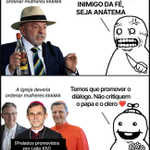
Aos católicos que estão pensando em votar nulo...
Vejam como o pessoal do Lula trata a Santa Igreja Católica sem eleições...
Peço que mudem o voto e cravem, mesmo sem admitir publicamente, o 22 nas urnas do dia 25.
Católico NÃO vota em socialista.

Gojo Calderón retweeted

Uma sociedade que expulsa Cristo de suas leis não se torna livre de Deus, torna-se escrava dos erros que escolheu colocar em Seu lugar.
🤖 Made with AI


Gojo Calderón retweeted
Falar disso tudo é falar de Cristo, porque nada disso existe sem Ele:
Eucaristia: O próprio Cristo.
Maria: Mãe de Cristo.
Papa: Vigário de Cristo.
Padres: Sacerdotes de Cristo.
Pais da Igreja: Sucessores dos Apóstolos de Cristo e guardiões da Fé ensinada por Ele.
Instituição: A Igreja de Cristo.
Tradição: O depósito da fé de Cristo.


Gojo Calderón retweeted

O que a morte de Rick nos REVELA sobre o juízo particular?
A morte do cantor foi noticiada em todo o país. Refletimos sobre esse momento decisivo que todos nós passaremos em nossas vidas.
Assista ao vídeo completo no YouTube: youtu.be/fi3z9oXj_wo?si=sZb0…
Gojo Calderón retweeted

Modern Rome tries to paint Archbishop Lefebvre as a criminal, and the SSPX as a rogue order of "Lefebvrists." But people forget that +Lefebvre was, as Pope Benedict XVI supposedly said, probably the most influential Bishop of the 20th Century:
1932-1946 - Missionary in French speaking Africa, Rector of the Seminary in Gabon. Personally trained countless native African priests, some of whom became Bishops (Bishops François Ndong, Jean-Baptiste Adom, Félicien Makouka).
1947 - Appointed Vicar Apostolic of Dakar
1948 - Appointed Apostolic Delegate of French-speaking Africa (the highest ranking prelate in the region)
1952-56 - Archbishop of Dakar, ordaining countless African leaders, including Hyacinthe Thiandoum, Cardinal Archbishop of Dakar
1962 - Elected Superior General of the Holy Ghost Fathers (over 5000 priests, brothers, seminarians)
1960s - Appointed to Central Preparatory Commission for Vatican II, Council Father at Vatican II, President of the Traditionalist faction, the Coetus Internationalis Patrum
1970-1988 - Founder of the Society of St. Pius X. During this time, he was the only prelate in the Church ordaining traditional priests in the traditional rite. SSPX was also the only fraternity in the Church offering the Traditional Latin Mass. During this time, he ordained many traditional Priests, including all the founding Priests of the Fraternity of St. Peter.
1988 - Archbishop Lefebvre consecrates Auxiliary Bishops Bernard Fellay, Alfonso de Galarreta, Bernard Tissier de Mallerais, and Richard Williamson, ensuring the survival of the SSPX.


Gojo Calderón retweeted

Como assim, o ECUMENISMO = NOEÍSMO, condenado por Papas, sendo a Mortalium Animos, de Papa Pio XI, tão clara?
Como assim rezar pela “paz” se os judeus mataram Nosso Senhor Jesus Cristo e O rejeitam até hoje, se Ele não é o Deus dos islâmicos, nem dos hindus, nem dos budistas, nem dos taoístas, e demais seitas?
“EU SOU A PAZ! EU VOS DOU A MINHA PAZ”
CRISTO É DEUS!
CRISTO É REI ✝️🇻🇦👑
Gojo Calderón retweeted
I know someone who converted to Roman Catholicism at 30, was ordained at 36, and consecrated a Bishop at 48.


Gojo Calderón retweeted

La FSSPX construit une nouvelle église près d’Atlanta (Géorgie, États-Unis).
sspxatlanta.com


Gojo Calderón retweeted
Todos pelo Tiba!
youtu.be/nltXWGNTaz8?is=S5lK…

Gojo Calderón retweeted
Católico, busca el Santo Sacrificio de la Misa y deja de ir a la misa moderna, es una misa protestantizada. Le quitaron todo lo católico para hacerla similar a un servicio protestante.
Católico, regresa al santo sacrificio de la misa.

Gojo Calderón retweeted


Leo XIV , General Audience
The Motivations of the Liturgical Reform
Dear brothers and sisters,
In this final catechesis on the Constitution Sacrosanctum Concilium, today I would like to look at the reasons why the Council Fathers sought to promote a reform of the liturgy. In this regard, the third Letter from the Council, which Cardinal Giovanni Battista Montini, then archbishop of Milan, sent on 28 October 1962 to the faithful of his Church, is particularly enlightening. The liturgy, he wrote, “is a sincere expression of both the divine and the human. It is language. On the one hand, it is a vehicle for divine teaching; on the other, it is a voice in dialogue with God. It is clear that it cannot renounce its didactic function, nor can it fail to offer faith and piety the opportunity to be expressed with spontaneous intelligibility”. [1] Motivated by these convictions, the future Pope Saint Paul VI affirmed that the faithful “cannot and must no longer remain silent and passive. Their physical presence cannot be reconciled with their spiritual absence”. [2]
The similarity between these statements and those which would appear in no. 48 of the Conciliar Constitution is evident: “The Church … earnestly desires that Christ’s faithful, when present at this mystery of faith, should not be there as strangers or silent spectators; on the contrary, through a good understanding of the rites and prayers they should take part in the sacred action conscious of what they are doing, with devotion and full collaboration. They should be instructed by God’s word and be nourished at the table of the Lord’s body; they should give thanks to God; by offering the Immaculate Victim, not only through the hands of the priest, but also with him, they should learn also to offer themselves; through Christ the Mediator they should be drawn day by day into ever more perfect union with God and with each other, so that finally God may be all in all”. These words express a renewed awareness of the value of the liturgy. Through the Church’s ritual actions, whilst the memorial of the work of salvation is celebrated, the opportunity is provided to experience a true relationship with God, coming into contact with the salvific event. Since the gestures, the words of the sacred liturgy are critical to realizing this experience, the participation of the faithful cannot be passive.
The Conciliar reform, by placing at the centre that which constitutes the heart of the ecclesial experience, was intended to allow the liturgy to shine forth as “the primary source of that divine exchange in which the life of God is communicated to us”. [3] From this conviction arose the need to make the richness of the biblical texts and prayers more accessible to all the faithful, and to streamline the order of the celebration compared with that set out in the liturgical books then in use.
Indeed, since the liturgy is a living entity, throughout the centuries it has always been subject to developments and changes. The Magisterium adapted its forms to the needs of different eras. It is therefore not surprising that the Second Vatican Council too, with the utmost respect for the heritage of tradition, and precisely in order to make it more accessible, considered it necessary to revise the liturgical books.
The aim that the Fathers had in mind is explained in no. 21 of the Constitution Sacrosanctum Concilium: “In order that the Christian people may more certainly derive an abundance of graces from the sacred liturgy, holy Mother Church desires to undertake with great care a general restoration of the liturgy itself. For the liturgy is made up of immutable elements divinely instituted, and of elements subject to change. These not only may but ought to be changed with the passage of time if they have suffered from the intrusion of anything out of harmony with the inner nature of the liturgy or have become unsuited to it. In this restoration, both texts and rites should be drawn up so that they express more clearly the holy things which they signify; the Christian people, so far as possible, should be enabled to understand them with ease and to take part in them fully, actively, and as befits a community”. The distinction, within the liturgy, between divine, immutable elements, and human elements, which instead “admit of various modifications, as the needs of the age, circumstance and the good of souls may require, and as the ecclesiastical hierarchy, under guidance of the Holy Spirit, may have authorized”, dates back to Pope Pius XII’s Encyclical Mediator Dei (Acta Apostolicae Sedis 39, 1947, 541–542).
Moreover, the desire for a “general reform” did not come about suddenly, but had been evident in the actions of successive Popes since the beginning of the twentieth century, in keeping with the demands of the Liturgical Movement. The assertion that the faithful should not attend celebrations “as strangers or silent spectators” had already been raised in Pope Pius XI’s Apostolic Constitution Divini Cultus. Furthermore, one may recall Pius XII’s interventions regarding the ordering of the rites of Holy Week, which he rescheduled to the hours corresponding to the events of Easter, after they had for centuries been brought forward to the morning hours. Nor should it be forgotten that Saint John XXIII regarded it necessary to simplify the rubrics of the Breviary and the Missal, approving this with the Motu proprio Rubricarum instructum of 25 July 1960, in which he referred the proposal of fundamental principles for a reform of the liturgy.
The liturgical reform promoted by the Second Vatican Council is thus firmly rooted in the living tradition of the Church. A correct understanding of it also enables us to reject the abuses that occurred in certain sectors of the Church during the post-Conciliar period, and which, unfortunately, still occur from time to time today, where some of the principles underlying the reform itself have been taken to extremes or misunderstood.
In this regard, it is worth recalling that the Conciliar Constitution affirms that “Liturgical services are not private functions, but are celebrations of the Church, which is the ‘sacrament of unity’, namely, the holy people united and ordered under their bishops. Therefore liturgical services pertain to the whole body of the Church; they manifest it and have effects upon it” (Sacrosanctum Concilium, no. 26).
It is therefore the primary responsibility of pastors, of bishops but also of each individual priest, to safeguard and promote a liturgy which, while respecting liturgical norms, shines with noble simplicity (cf. no. 34) and thus manifests the one, holy, catholic and apostolic Church. Such a liturgy will also be a fundamental vehicle for evangelization, the instrument of grace through which, as the Council teaches, we may learn to offer ourselves and, through Christ’s mediation, be perfected in unity with God and amongst ourselves (cf. no. 48). vatican.va/content/leo-xiv/e…


Gojo Calderón retweeted

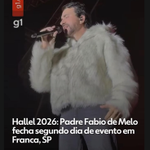
QUANDO A DEVOÇÃO TRANSFORMA-SE EM ESPETÁCULO
A Quaresma de São Miguel virou moda e tudo que vira moda, se corrompe. Há uma onda avassaladora de exibicionismo em torno desta devoção. Ora, Jesus disse que devemos orar no interior do nosso quarto, sem o estardalhaço dos fariseus. – at Itaquaquecetuba, Brasil
