








Interesting product and intro, but no fucking way Jobs would show a black product with his black turtle neck in the background. You can’t even see the product on the giant screen.

2
87
On the first look, I thought a human is mocking a cleaning robot 😳

Today, we’re launching Tau’s humanoid cleaning service in San Francisco at $30 per hour.
Access is initially invite-only as we scale operations. If you don’t have an invite yet, join the waitlist at tau-robotics.com.
All footage is shown at 1× speed. Each humanoid is jointly controlled by a human operator and AI.
53
Very much this for pre-AI companies. Processes need to evolve to match dev speed. PMs need to evolve. Feedback loops need to be shortened to hours, not days and weeks.

AI closed 90% of your support tickets. you released 10 new features this month but barely have any usage metrics yet to validate them. what now?
the bottleneck is now the organizational culture. most orgs are now sitting on an unexpected surplus of capacity, and don't know what to do with it yet.
a lot of the software org culture is still based on "the old days", when work was slower, planning took weeks and development took months. so culture was optimized to do things as fast as possible, as close as possible to "right" on the first try.
the immediate response from orgs to AI, in most cases, has been to keep the exact same approach and processes - just do the same thing, faster!
the problem is planning can't catch up. work planned for the whole quarter is done by the first month, and planning for the next quarter is still half baked.
a lot of people, myself included, have asked: "so... where is all the new software that AI is building?"
I think this question is mostly answered by the fact that most organizations, so far, aren't producing much more software. they're just producing the same thing, faster. so the remaining time they are either wondering what's up, doing internal politics, or just cutting half the engineering team because it's "superfluous".
the culture in software must adapt and switch mindsets. the edge is not anymore in producing the same with a smaller workforce. the edge is in leading the same workforce to produce MORE.
2
59
Gaurav Sharma 🤷♂️ retweeted

I still don't think ppl realize what an amazing deal locking in a 3% mortgage in 2020 has been for homeowners
Inflation has averaged 3.9% this decade
It's now back above 4%
You're basically borrowing for free
This was the deal of a lifetime

Gaurav Sharma 🤷♂️ retweeted

new model for engineering team structure in 2026:
2 people only
one pirate and one architect
the pirate's job is to move as fast as possible to develop valuable, shipped product features by vibe coding.
the architect's job is to turn the product surface discovered by the pirate into a reliable, structured machine—also by vibe coding, but at a slower, more well-reasoned pace.
every product needs a pirate but most product's only need an architect once they some form of PMF, and in that case they usually don't need one full-time. architects can work across many codebases and solve interesting technical challenges. pirates go hard on a product that they own end-to-end.

Can someone confirm if this is prompt injection on Apple’s new call screening feature? This is on iOS 26 beta.

2
143

…or you can get the answer in three clicks on @tradingview or one of the many free stock scanners 🤷♂️

Is there an LLM version of yahoo finance?
“Tell me all the companies with over $10b in revenue and a 10% growth rate and sort them by P/E ratio”
1
81
1. “The AI Admaker” and IG story screenshot explained the service in an instant.
2. Line below the heading validated understanding.
3. $39/mo showed it is affordable.
4. Download Mac app button showed service targeted to power users.
Didn’t have to look any further.

No idea about the product or team.
But I bet a lot that this site converts super well.
No shade to brett (he seems cool)…but in general I think if a landing page has 1) lots of copy 2) a designer calls it ugly…it will convert well.
I think I could use just a google doc and copy that converts better than most all flashy websites.
58
Took me a minute to find where to put the domain name. The page needs some love from UI/UX folks at Cloudflare. FYI @eastdakota

39
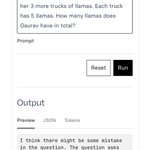
#llama3 70B.
Did a good job with the “wrong question”, but rounded the number instead of rounding up (ceil) in the second question.
It is good with JSON output in my limited testing. Looking forward to the benchmarks!


129


They say @ScottWu46 IS Devin! Lurking in the shadows, fixing your bugs even before you write your code.

In case you were wondering just how cracked the team @cognition_labs is...
This was the CEO (@ScottWu46) 14 years ago.
63

Huge, if true! arxiv.org/abs/2402.17764
If this works out, LLMs will use a lot less compute resources and we can run high parameter count models on laptops and phones very easily!
I easily run 7B and 13B models on a M2 MacBook Air, 16GB RAM. This will enable me to run a 70B!
56
Started using Google AdSense in November 2003. It was a game changer!
Launching products time boxed is exhausting at the moment, but is usually exhilarating in the hindsight. Most of my work that I’m most proud of was time boxed.

TIMEBOXING FOR PRODUCT LAUNCHES
In March 2003, we presented the launch plan for Google AdSense to Sergey Brin. I was proud of our well fleshed out plan, with a well designed product featuring self-serve sign-up, ad management, and reporting, supported by metrics and testimonials from beta partners who were already seeing success from it. We proposed a launch date of mid September.
Sergey’s succinct feedback: “No”.
“Sergey, what do you mean? We’re pretty confident we can launch an awesome, differentiated product.”
“The product looks great but it’s taking far too long. Launch it in June.”
“June?! That’s less than three months away!”
Sergey reiterated: “Team, I need this launched by June. I will support you and help you cut through any bottlenecks. I know you can do this.”
Fast forward to 3am on June 18, 2003. Our tech lead pushed code to production and formally launched Google AdSense. The launch was incredibly successful, resulting in one of the fastest growing Internet products to date.
To get the product launched within three months, Sergey employed a technique called timeboxing, imposing a hard deadline (3 months) as a constraint on product launch. At Amazon, Jeff Bezos employed the same technique, telling a SWAT team in late 2004 that he wanted them to launch Amazon Prime before Amazon’s earnings in February.
Why did two of the most consequential advertising / commerce products - ever - both launch through timeboxing? Because it works.
Timeboxing works for three primary reasons. First, it leads to improved prioritization. By limiting the time for a project, it forced us to decide what was most important to work on. I remember cutting large swathes of features and flows in one fell swoop to make the deadline. Ironically, many of those flows later proved redundant and were never built out. And this brings up the second reason - product editing. Cutting features leads to launching a simpler, leaner, better product. This process made me a staunch believer in the power of editing to build great products. Finally, timeboxing creates a sense of urgency, increasing efficiency. Since the launch date was fixed in stone, we couldn’t procrastinate; all timelines were clearly laid out working backwards from the launch date.
In order for timeboxing to work, you need four conditions to hold true.
1. Committed Leader: Sergey backed his talk and adopted our project (as did Bezos at Amazon, I’m sure). He (and Susan Wojcicki, my boss) attended our team meetings, unblocked decisions and helped funnel resources to our team. They came to our war room the night of the launch and stayed with us till the launch at 3am. Timeboxing needs these kind of leaders, who are willing to be in the trenches with the team, invaluable in high pressure situations.
2. Empowered team: Our team had the right skill sets to launch the product. We had the full spectrum of necessary skills, were able to unblock ourselves and were not gated by other teams. If a timeboxed team has to spend a chunk of time waiting for other teams, it’s not going to work.
3. Seemingly unrealistic but not irrational timeline: The timeline that Sergey pulled out of thin air - 3 months to launch - seemed unrealistic, but on closer examination, it wasn’t crazy. A lot of the complex back-end ad targeting and serving work was close to complete, and most of the remaining work was productizing the flows. It did force us to focus on the essential features, the ones that REALLY mattered, which ultimately proved to be a good thing.
4. Sparingly used: The 3-month sprint to launch was exhilarating but also exhausting. The technique needs to be used judiciously and carefully, in high stakes situations.
tl;dr CEOs and leaders: Timeboxing can be an incredibly powerful tool in your arsenal to drive motivation, energy, clarity and to get things done. However, you need a committed leader, an empowered team, a rational (if unrealistic) timeline for it to be effective, and you need to use it thoughtfully.
Go out there and timebox!
1
70
Gaurav Sharma 🤷♂️ retweeted

🙏Thank you. Your tweet led me to try ‘character sketch’ and then ‘character study’ in the prompt and now… 💥
A much simpler prompt. A much simpler scene. Very consistent characters.
The hit rate is still not great but still… 🤩
Prompt in ALT

ALT a 3 panel stack of studio photo portraits that are a character study of a [subject] shot from the left, right and centre. Shot on 35mm Kodak ektachrome film using an Olympus OM1 --ar 9:16 --v 6.0 --style raw --s 50


