

Applied ML Developer | Building practical prediction tools and data-science SaaS products.
Joined October 2024
- Tweets714
- Following135
- Followers253
- Likes3.5K







Pinned Tweet
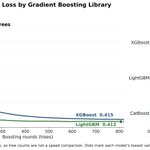
🤖 XGBoost vs LightGBM vs CatBoost on the same customer churn data (7,043 customers).
Test ROC-AUC:
XGBoost 0.847
CatBoost 0.848
LightGBM 0.838
Basically a tie. Tuning moved the score far less than I expected.
#MachineLearning #ChurnPrediction #XGBoost

ALT Training and validation log loss for XGBoost, LightGBM and CatBoost.
5
4
65
My feed is usually ML + data science.
Today: a side quest 🎧
Phonq v1.1.0 is live — my hobby project for free, open-source phonk streaming. 500K+ CC tracks, no ads, and recs from listening history.
Built after hours, for fun 👇 phonq.vercel.app

ALT Screenshot of the Phonq v1.1.0 app: a dark phonk-purple music player with a track playing, live waveform visualizer, playback queue and search/library navigation — free, open-source phonk streaming.
10
3
94
It's MIT-licensed and open source. Fork it, audit it, deploy your own instance, or just steal the waveform idea. github.com/hexsyro/Phonq

1
5
What I learned: most "bugs" were data plumbing — stale caches, negative-cache poisoning, race conditions on quota reservation. The UI was the easy part.
Music sources: Jamendo is the default (direct audio, no quota). An optional YouTube key fills genre gaps via the IFrame player, with quota tracked in Redis. ccMixter is a keyless CC fallback with license + attribution links.
1
Stack, for the nerds 😉: Next.js 16 (App Router + Turbopack), TypeScript 5.9, Tailwind 4, Auth.js v5, Neon Postgres via Prisma 7, Vitest. Deployed on Vercel.
1
5
The part that feels closest to my day job: recommendations. They're built from your listening history, favorite subgenres and similar artists. No big model — just careful data plumbing.
favorites, playlists and listening history, synced across devices with Google OAuth 2.0. Artist/album pages include discographies, bios and similar artists.
1
Discovery mixes live trending phonk charts, fresh drops from the API, and genre radios. Search covers tracks, artists, albums, tags and BPM.
1
The player is real: waveform visualizer (Web Audio API), persistent queue with drag-to-reorder, shuffle, repeat, volume. Built for listening, not just browsing tiles.
3
Phonq streams the Jamendo catalog — 500K+ Creative Commons tracks — legally, in full, forever free. The catalog is cached in Postgres, with a static snapshot fallback if an upstream API is down.
4
Why phonk? It's high-energy, CC-licensed, and wildly under-served by the big streaming apps. I wanted a place where you could play it loud, full-length, without ads or a paywall.
7


Heshan Sanjuka retweeted

Whoa, great and even excessive Marin Mochi (535B-A23B) checkpoint drop (in a good way!)
Comes with great tech report btw with insights into why / how components were picked (for training stability and GPU throughput).
Short fact sheet:
1) Latent MoE with an extra RMSNorm on the latent that made latent MoE actually work (better)
2) Classic 3:1 sliding-window/global gated GQA, partial RoPE (local) and NoPE (global)
3) Adding short convolutions on keys, attention output, and MoE output
4) Exclusive self-attention (XSA) -- I guess the end-of-the year architecture roundup this year won't be boring 😅


We’re releasing all 57 intermediate checkpoints from Marin “Mochi” 535B-A23B pretraining, including 10 from long-context extension. 18.2T tokens, about 61 TB of weights.
huggingface.co/open-athena/M…
Blog: openathena.ai/blog/marin-moc…

ALT Mochi training loss over 18.2T tokens. Colors mark the 4K, 16K, 65K, and 262K context phases, and circles mark the 57 released checkpoints. The annotation marks the data mix transition near 5T tokens. The lower panel zooms in on the final context extensions.
Heshan Sanjuka retweeted

Interesting approach. Models can't output freeform text but can choose from a set of predefined values. Could be useful for data labeling and tasks with a fixed list of possible actions.
Unclear how reasoning would work though, but it's super cheap (output tokens are free!)


After co-inventing ChatGPT, I kept asking myself: why have superhuman chat models not led to AGI?
I’ve spent the last 2 years in stealth building a new way to train models (RLCD), and a new type of frontier AI model that we are releasing today: Jev
• 20-200x faster
• 40-400x cheaper (w/ output tokens free)
• Frontier composable intelligence optimized for decisions
AFAICT the shortest path to AI-based economic revolution
Heshan Sanjuka retweeted

Our own @johnschulman2 sat down with @sarahdingwang to talk all things RSI: how AIs accelerate progress, how we measure it, and where human taste and intuition fit in the picture.

For decades, the idea of AI improving itself was just a thought experiment. Today, AI is already helping researchers at frontier labs run experiments, write code and test ideas faster. So how far are we from AI that can do the research on its own?
In our first episode of Working Theory, a16z General Partner Sarah Wang explores recursive self-improvement with two leading AI researchers: Mark Chen, Chief Research Officer at OpenAI, and John Schulman, co-founder and Chief Scientist of Thinking Machines Lab, and co-founder of OpenAI.
They cover what RSI actually means, why research taste is so hard to teach, and why AI may be one of our best tools for solving alignment.
00:00 The last invention
01:58 What is RSI?
03:21 How far are we?
05:56 Getting to full RSI
10:57 Aligning RSI
15:08 Working theory
YouTube: youtu.be/h_aA1-R70E8
@markchen90 @johnschulman2 @sarahdingwang
Heshan Sanjuka retweeted

we wrote a detailed post on our NVFP4 training, worth a read!

Training with fewer bits is faster, but quantization error can interfere with learning.
Today on Connectionism, we detail how we trained Inkling 2 Small with a native 4-bit forward pass from the first step of pretraining through the final RL rollout.
thinkingmachines.ai/blog/end…

Heshan Sanjuka retweeted

Earlier this week Tristan published his top YouTube channels:
thume.ca/2026/11/01/youtube-…
Which looked excellent so clearly I had to turn it into TristanTube:
karpathy.ai/tristan-tube/
47K super nerdy videos +TV mode for laid back watching. (One-shotted with Claude Code in 3 minutes)

Weekend hack: HackerTube. I was annoyed with YouTube's recommendations so I had Claude filter down 43M comments over 20 years of HN to 6,454 videos that keep being recommended. *Significantly* better viewing experience, ~2 hours with Opus 5.5:
hackertube.org/
- Excellent recs without any logins (state is kept in local browser session)
- Thumbnail is a representative frame from middle of the video instead of the super duper A/B test hyper-optimized user uploads
- Underlying data from the comment analysis as one zip file, point your Claude at it and ask for your own version
- HackerTube Longs ✊
A bit more on the process:
I use Claude Code (desktop app for Mac), Opus 5.5 on Medium effort as my default. I only talk to Claude and have it do everything, the only "manual work" I helped with in tandem was in the browser (reminiscent of MenuGen): 1) I had to create some kind of API key from Google Cloud UI to query YouTube for video metadata, 2) I booted up a VPS box for serving and 3) I bought the domain name. Once the box was up I gave Claude the IP and told it update, secure, harden, deploy and optimize the code, and it did the whole thing.
Many awesome projects that would have normally taken weeks/months even can now be few-shotted for breakfast. What else are we not thinking of.

Heshan Sanjuka retweeted

It was pretty obvious at the time -- the early 2026 market panic about SaaS was BS

Fascinating data from Stripe on the "SaaSpocalypse."
"SaaS equity prices have since returned to roughly pre-SaaSpocalypse levels."
And: "recent SaaS revenue growth has remained strong and even accelerated."
This echoes what we're seeing across @tinyseedfund’s 217 SaaS portfolio companies.
It doesn't mean AI won't reshape SaaS. It will. No one knows how much. And times of massive change throw off confusing signals like these.
Growth is strong for many, yet some companies have been devastated. M&A multiples are down because no one can price long-term viability.
All of these things are true.
Link to the Stripe article below👇

Messy data? 😩 HonestyPipeline v0.2 runs 8 audits in one command, then hands you a traceable, documented package. 🧾
New: run.json manifests, result schema 1.1, CI regression gates, SHA-256 checksums + PROV-O provenance.
Open source: github.com/hexsyro/HonestyPi…

7
4
51
Getting started takes 3 lines ⚡
git clone --recurse-submodules github.com/hexsyro/HonestyPi…
cd HonestyPipeline
pip install -e .
No new runtime deps. Python ≥3.10.
1
5