

Investment banking associate who builds products. I take deals and filings apart in plain English. Newsletter: Capital Decisions
India
Joined February 2015
- Tweets43K
- Following83
- Followers865
- Likes21K



Pinned Tweet
Most people judge a company by its revenue. I start somewhere else: how much of that revenue already turned into cash.
A short thread on how I actually read a business.
1
69
Two $40B+ deals in two days. Same size. Totally different money.
And the type of money tells you more than the headline number.
Monday: CrowdStrike agrees to buy Zscaler for about $43.9B. All stock. Zscaler holders get 1.135 CrowdStrike shares for each share they own. That works out to about $260.41 a share, a 34% premium to the Nov 20 close.
Tuesday morning: Sanofi agrees to buy Insmed. $175 a share, $41.0B total. All cash, paid with debt plus cash on hand, financing already committed.
Here's the part nobody puts in the headline...
Cash is a price. Stock is a partnership.
If you own Insmed, $175 is $175. Sanofi stock can tank the next day and you don't care. Sanofi carries the whole risk that it overpaid.
If you own Zscaler, that 34% premium is written in CrowdStrike shares. Fixed ratio. If CrowdStrike stock slides before closing, your premium slides with it. And closing is expected in the second half of CrowdStrike's fiscal 2028. That's a long time to be holding someone else's stock price.
But you also keep upside. Zscaler holders end up with about 15.9% of the combined company, CrowdStrike holders keep 84.1%. If the targets show up (about $1B of yearly revenue synergies within 30 months, $500M of cost savings within 18 to 24 months) Zscaler holders get a slice of that.
Insmed holders get no slice. Clean exit, check cleared, bye.
So the payment choice is kind of a confession.
Sanofi is basically saying: we like this so much we'll borrow to pay you, and we keep every dollar of upside.
CrowdStrike is saying: let's share the ride... the risk and the reward.
Neither one is wrong. Paying in stock is like buying a house partly with your startup's equity. Great for you if your shares are pricey. Great for the seller if your shares keep running.
One more detail I'd circle. Jay Chaudhry and his affiliates, about 34% of Zscaler, already signed voting agreements backing the deal. A third of the vote is locked on day one. That's not a cliffhanger, that's a formality with lawyers.
Question for the deal folks: if you were advising the Zscaler side, would you have pushed for a collar or some cash in the mix, or just take the stock and ride it?
14
If the only way to buy your product is to get on a call with you, you don't have self-serve yet. You have appointments.
A calendar full of demos can feel like momentum. It's also a cap. Your sales volume is whatever your throat and your time zones can handle, and the product never has to get clear enough to be bought in the middle of the night without you.
I wouldn't ban calls. I'd count how many people paid after touching only the site. If that number is close to zero, the next bit of work isn't another deck. It's making the thing understandable without you in the room.
What's the longest your product has gone from signup to paid without you hopping on a call?
15
Nvidia lost its CEO on Nov 11 and got him back on Nov 22.
11 days.
Everyone's talking about the comeback. I read the filings and the more interesting part is what the board did NOT close.
Quick banker read 👇
1
21
Kind of like a star QB who gets suspended, the team keeps winning, and he's reinstated before the league finishes its review.
Probably the right call. Still a review.
The 11 days showed the machine runs. The probe decides if the key-man discount ever goes away.
1
2
The most valuable thing Applied Digital signed today isn't a building. It's a tenant.
Two press releases this morning, 15 minutes apart.
7:45 AM ET: a $300 million bridge loan. 364 days, SOFR plus 3%, secured by the assets of Delta Forge 1, their AI campus in Louisiana that's backed by a long-term lease with an investment-grade hyperscaler.
8:00 AM ET: a new 18-year lease with a tier-one investment-grade hyperscaler. 150 MW, about $5.4 billion of base-term revenue. And the capacity isn't even scheduled to start delivering until the first half of 2028.
So why do lenders keep showing up? Because they're not really lending to @APLDdigital. They're lending against the tenant. An investment-grade hyperscaler promising 18 years of rent is about as close to a bond as a building gets.
And we've seen this exact movie before. Last round there was also a $300 million bridge, at SOFR plus 2.75%. Then in June they sold $1.59 billion of 7% senior secured notes out of a project subsidiary and paid the bridge off.
Sign the lease, bridge the gap, refinance with bonds. Repeat. This new bridge is 25 basis points wider than the last one, which in this market feels pretty cheap, honestly.
My favorite detail... rent is going up. On a straight average, the new lease works out to about $2.0 million per MW per year. The 210 MW Delta Forge 2 lease from June was $5.2 billion over 15 years, about $1.65 million. About 21% more per MW per year (simple math, it ignores escalators).
Now the number I'd ignore. The release says "approximately $100 billion" of lease revenue if every renewal option gets exercised. Just over $41 billion of that is base term. The other roughly $59 billion is renewal options, and the tenant holds those options, not Applied Digital. If I were the lender I'd count the $41 billion and smile politely at the rest.
For scale, last quarter the whole company booked $341.9 million of revenue. Contracted base-term rent is about 120x that.
The fine print I'd actually watch: drawing on the bridge needs, among other things, state commission approval of electrical rates. Your tenant can be investment grade. Your power bill still needs a regulator to say yes.
If you were the lender, would you give any credit for those renewal options, or only the 18 years?
11
The platform you rely on just raised its price. Your margin took the hit this month, not next year.
Maybe it's an API bill. Maybe it's the app store or payments cut. You didn't choose the timing. You do choose the response... raise your own price, eat it, or quietly ship less of the feature that runs on them. Waiting until the next billing cycle to think about it is also a choice. It just means you fund their increase for a while.
I'd rather move my price, or my costs, in the same month the bill changed. Slow reactions look calm. They're usually just late.
If it happened tomorrow, would you raise your price, or just eat it and cut somewhere else?
21
Oracle just denied a news story that hasn't been written yet.
Friday it put out a statement saying it has all the money it needs for its OpenAI contract. Then this line:
"Any media reports that will come out and say the contrary are incorrect and wrong."
Will come out. Future tense. That's not PR, that's a pre-emptive strike lol.
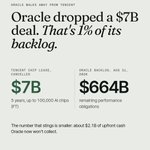
But "fully funded" is only half the story. The other half is what the money cost. And Oracle told us that too, back on Nov 2.
It raised $20 billion in one shot.
86,206,897 new shares at $116. That's about $10 billion of stock, so every existing owner now holds a slightly smaller slice.
Plus $10 billion of bonds in 5 pieces, with coupons from 7.000% all the way to 8.650%.
Now put that next to Uncle Sam on the same day.
The US Treasury was paying 4.65% for 3 year money. Oracle's 2029 notes pay 7.000%. That's 2.35 points extra.
Go longer and it gets louder. 20 year Treasury: 5.31%. Oracle's 2046 notes: 8.650%. That's 3.34 points over.
Add up the coupons and Oracle owes roughly $777 million of interest a year on these bonds alone. About $2.1 million a day. Every day. Full data centers or empty ones.
And when does the cash show up to pay for all this? Oracle's own statement: positive free cash flow in the second half of FY2028, and more than $30 billion of it in FY2029.
Think of it like a kid opening a giant lemonade stand for one huge customer. He borrowed for the stand at way more than the government pays, and the stand only starts throwing off real cash in its fiscal 2028.
"Fully funded" is true. "Cheap" is not.
My take: the bond market reviewed this deal on Nov 2, weeks before Oracle said a word about media reports. The spread is the honest review. The statement is the marketing.
If you were the lender, would 3.34 points over Treasuries be enough for you to wait until FY2029?
46
Down 90% means you now need a 10x just to get back to even.
And SOXL targets 3x the chip index per day, not per year. Daily resets in a choppy fall eat you alive.
Leverage doesn't just make the drop bigger. It makes the climb back way steeper.

US technology ETFs are seeing massive wave of deleveraging:
The 3x leveraged long Semiconductor ETF, $SOXL, is down -90% from its June peak, to its lowest since September 2025.
This marks its 2nd-largest drawdown since the fund's inception in March 2010, surpassed only by the -91% decline during the 2022 bear market.
By comparison, the fund dropped -89% during the July 2024-April 2025 period.
Meanwhile, the 3x leveraged long Nasdaq 100 ETF, $TQQQ, is down -53% from its June peak to its lowest since early April.
Since October 5th alone, the fund has dropped -51%.
For perspective, $TQQQ fell -61% during the February-April 2025 drawdown.
Leveraged tech funds have experienced a historic liquidation wave.

44
Korea's stock market rescue fund is about $8 billion of promises.
That's not a scandal. That's the design.
Sunday afternoon in Seoul, the finance minister sat down with the Bank of Korea governor and both market regulators for an emergency meeting. KOSPI had closed Friday at 4,869.96, down more than 5%, as the US chip and AI selloff landed in Asia.
Move number one: get the Securities Market Stabilization Fund ready to switch on depending on market conditions. Not switched on. Ready.
And the way this fund works is very Wall Street.
When Seoul built it in March 2020, it was KRW 10.7 trillion (around $8 billion at the Fed's 1,336.58 won per dollar) committed by 5 financial holding companies, 18 leading financial firms, the Korea Exchange and a few other market bodies. Committed, not paid in. Money only moves through capital calls, and it invests in the KOSPI 200 index. First call was planned at about KRW 3 trillion.
So basically it's a private equity fund. Banks are the LPs. Government decides when to call.
My favorite detail... in 2020 regulators eased risk-weight capital rules on whatever the banks put in. The people funding the lifeboat are the same people who'd sink with the market, and they get capital relief for rowing.
Korea last actually deployed a stabilization fund in 2008, 515 billion won. The 2020 version is almost 21x that size, and per Korean press it hasn't been used since.
My take: the announcement is the product. A fund that's "ready" puts a floor in every trader's head without a single won leaving a bank. The day you make the capital call, you're admitting the floor wasn't holding.
The quieter move might matter more. From Nov 24, for 3 months, listed companies get a looser daily cap on buyback orders. Corporate cash becomes the first buyer, and the government money stays as backup.
Would you trust a rescue fund more if it actually bought stock, or if it just stayed "ready"?
56
Your first customers will be kinder than the market will ever be.
Friends, ex-colleagues, people who already wanted you to win... they'll forgive a clunky onboarding and still pay. That's a gift. It is also a terrible forecast. Their conversion, their patience, their "this is great" messages will not show up in the same way when a stranger arrives from a tweet.
I'd keep those early people. I'd just stop using their behavior as the plan. The first complete stranger who pays is the start of the real cohort.
When did the first complete stranger pay you, and did they behave anything like the early group?
1
20
The US tried a harder version in Sept 2008: SEC banned shorting 799 financial companies outright.
A NY Fed staff paper later found those bans did little to stop the slide in stock prices, and liquidity got pricier.
You can ban the sellers. Not the reason they're selling.
BREAKING: Taiwan announces new restrictions on short selling after its stock market falls -18% in one week, its worst weekly decline in 35 years.
Effective Monday, regulators will ban short sales below the previous closing price and raise margin requirements to 150%.
Taiwan’s $15 billion stock stabilization fund has also been buying shares to support the market.
Authorities are intervening to contain selling pressure.
41