
Vibe formal verification won't get you far! Always check that your spec correctly models the verification target. The same for its properties. Then you can let the agents freely write the proofs for you.

The plot thickens.
"We show that the formalised Lean proof does not correspond to the [written paper] proof of blow-up of solutions to the Navier-Stokes equations."
arxiv.org/abs/2610.08144

2
68

Are formal methods finally becoming mainstream?

I used Opus 5.5 to formally verify the Claude Agent SDK using Lean. A couple short prompts = 16 PRs fixing various bugs and race conditions. Video attached.
TLA+ also works well. I sometimes combine Lean and TLA+ to look for issues around data flow, concurrency, and state mgmt.
I don't know either language well, but Claude is excellent at both. This approach is super useful for formally modeling your code and finding bugs that a human probably wouldn't have spotted.
Is formal verification the future of coding (or at least, bug finding)?
3
44
The Tendermint protocol now has a formal, machine-checked proof of termination in TLA+!
Not just model checked on a finite instance. A complete proof, for any number of nodes in the network.
Until recently, liveness proofs like this were considered extremely hard, even with AI.
1
5
228
Proving safety properties such as consensus agreement is much easier today. Just ask @konnov about his recent blog post: protocols-made-fun.com/tende…
In my proofs, AI even found new inductive invariants, which is the hardest part when writing safety proofs.
The gap between high-level formal specs like TLA+ and their implementations is well known. Nothing new here. Also, the article does not mention that there are formal techniques to close that gap, like model-based testing or proofs by refinement, or even program verifiers.

This is a cool blog post:
antithesis.com/blog/2026/fin…
The basic result is that running Antithesis on a bunch of Raft implementations still finds bug, despite formal verification at the protocol level.

1
5
1,550
Just the beginning

Arc is designed as the Economic OS for the internet and reliability is at the center of that vision.
Behind the scenes, our teams pushed Arc to its limits before opening testnet:
→ Chaos-testing entire networks with Quake
→ Saturating block gas with Guzzler
→ Stress-testing throughput with Spammer
The goal: make Arc settle flows with predictability that institutions can trust, at speeds that builders can rely on.
Every block targets 500ms, finalizing with regularity across a globally distributed validator set.
And we’re just getting started.
As we march toward mainnet in 2026, Arc is evolving toward four-nines uptime capability and seamless upgradeability for a settlement layer where you can build and coordinate real-world economic activity.
arc.network/blog/technical-i…

2
25
Want to know a bit more about how's Arc inside? 👇

1/ Circle announced @arc a few weeks ago
Here's a brief technical update with some of the main decisions we've taken so far, and what we've been cooking since then 👨🍳


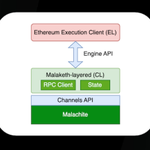
What if you could run EVM smart contracts with sub-second finality while still being able to use Ethereum's existing dev tooling? That's Malaketh-layered, our second MVP where we connect Malachite consensus to Reth (or any execution client) via Engine API. nitter.gq/JTremback/status/19002…


mempool not dead🤘
Announcing DOG protocol, an improvement to the @cometBFT mempool gossip sub-system.
The Dynamic Optimal Graph (DOG) protocol slashes bandwidth use, improves performance, and speeds up transaction confirmations. 🧵
Very excited to release the new gossip protocol for @cometBFT's mempool. The DOG protocol massively reduces network bandwidth and improves latency, block production, and resource usage.
Kudos to my colleagues Sergio and @m__yasmina at @informalinc for this joint work.
Announcing DOG protocol, an improvement to the @cometBFT mempool gossip sub-system.
The Dynamic Optimal Graph (DOG) protocol slashes bandwidth use, improves performance, and speeds up transaction confirmations. 🧵
Check out this blog post for more details on the protocol
informal.systems/blog/a-new-…

1
16