

The official X account of the Hydroclimate Impact lab of the University of Tennessee–Knoxville, lead by @dim_herrera.
Knoxville, TN
Joined May 2024
- Tweets17
- Following3
- Followers12
- Likes51

Hydroclimate Impact Lab (HydroCLIMP) retweeted

🌍 We’re hiring a tenure-track Assistant Professor in climate extremes and their impacts on the environment and/or human communities.
🔗 Link to apply + full description is in our bio!

Hydroclimate Impact Lab (HydroCLIMP) retweeted

I am honored and humbled to have been selected as an author for the @IPCC_CH AR7. I look forward to learning from and contributing to Chapter 7 ("Projections of Regional Climate and Extremes") alongside my colleagues.

The #IPCC has announced the authors selected for the Seventh Assessment Report.
664 experts from 111 countries have been invited to participate as Coordinating Lead Authors, Lead Authors, & Review Editors.
🌍 51% from developing countries
🚺 46% women
bit.ly/AR7AuthorsPR


Hydroclimate Impact Lab (HydroCLIMP) retweeted
I have just obtained an original copy of the book Introduction to GIS Programming from my colleague, @giswqs. I am pleased to collaborate with highly skilled scientists such as @giswqs at @UTKGeography! The book is available here shorturl.at/OyBRr.

Hydroclimate Impact Lab (HydroCLIMP) retweeted
Where can you find UTK at #AAG2025 next week? Click the 🔗 below to check out some of the papers, posters, and panels we’re part of at the annual meeting in Detroit starting March 24!
canva.com/design/DAGhWAZEKAc…

Our very own Karson Holliday presenting @UTKGeography GeoSym 2025, where she won the "best use of graphics and design" award. This was the first time Karson presented a poster. Congratulations! We are so proud to have you in our HydroCLIMP group!

Hydroclimate Impact Lab (HydroCLIMP) retweeted

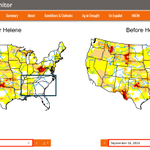
Finally Hurricane Helene. Rainy weather set the stage for the historic flood in eastern parts of Tennessee, with record crests on several streams & rivers. A long road to recovery is now underway & our hearts are with all affected. TN Climate Office story: tinyurl.com/3mm9zcx3
We are proud to be Vols, and even prouder to be part of this amazing team! @UTKGeography


Hydroclimate Impact Lab (HydroCLIMP) retweeted
The Dominican Republic from the air, showing the highest peaks in the Caribbean, Pico Duarte, La Pelona, and La Rucilla, with over 3,000 meters (~9,843 feet) AMSL.


You can also find updates from our group on BlueSky! @hydroclimp.bsky.social
Drought conditions were ameliorated in the southeastern US by Helene. Drought area reduced from ~54% to 20% in less than a week. We have analyzed the role of TCs in modulating drought variations in the trop. Americas here: researchsquare.com/article/r…

Hydroclimate Impact Lab (HydroCLIMP) retweeted

Nearly 8 percent of the global land area experienced extreme drought in 2023—a new record.
Drought and heat waves contributed to massive wildfires around the globe, including in Canada, Australia, and Greece.
#StateoftheClimate2023
More highlights: climate.gov/sotc2023

ALT This map shows global drought status in 2023 based on a scale called the Palmer Self-calibrating Drought Index. Areas experiencing the most extreme drought are darkest brown; places that were extremely wet over the year are colored dark blue green.
Hydroclimate Impact Lab (HydroCLIMP) retweeted

surface water, and groundwater connectivity, with implications for paleo-reconstructions of storm events in the geological record: tinyurl.com/yc2yz5xf @HydroTracers

Hydroclimate Impact Lab (HydroCLIMP) retweeted

The second video in "The Climate Engine Backpack" video series is now live! 🥳
Learn about "Producing near real-time #drought maps using the Climate Engine app" using #ERA5 to calculate SPI and SPEI for any location on the planet ☀️🌧️
📽️ youtube.com/watch?v=Zt3bfOmJ…
@ClimateEngOrg

Hydroclimate Impact Lab (HydroCLIMP) retweeted

Authors (Carrillo and Muñoz-Arriola) explore #rainfall #predictability in the #GreatPlains. They linked the low-level and upper-level #atmosphere using the classic American #LLJ (low-level jet) and the #CGT. doi.org/10.3390/atmos1507085… #MDPI @Atmosphere_MDPI #Peru #Lima #ElNino

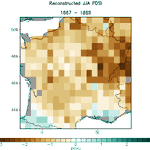
It was indeed a dry period (especially the summer of 1887) in France and parts of Europe, according to the Old World Drought Atlas.
Source: drought.memphis.edu/OWDA/
Publication: science.org/doi/10.1126/scia…


