

⛏️Transform sleep into value 💪Link health and 🪙wealth in the new Web3 era 🌐https://nitter.gq/t.co/KzDg9kvNku
Joined September 2024
- Tweets352
- Following23
- Followers5.7K
- Likes45




Hypnus Research Notes — Where Biology Meets Engineering
A wearable EEG device faces a challenge that rarely appears in product advertisements: maintaining stable electrical contact with human skin.
Dry electrodes make everyday use more practical, but they also introduce engineering trade-offs.
Skin impedance changes. Contact pressure shifts. Movement creates artifacts.
A sensor may be technically precise while the signal it receives remains unreliable.
That's why the physical interface matters as much as the electronics behind it.
For Hypnus Band, the ambition is to bring signal stability and overnight comfort into the same design.
Because a device cannot understand a night it cannot measure reliably.
#Hypnus #BCI #Neurotech

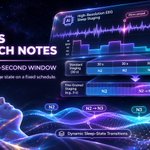
For decades, sleep researchers have divided the night into 30-second segments to classify sleep stages.
But the brain doesn't necessarily change states on a 30-second schedule.
Transitions can be gradual. Arousals may last only seconds. Important physiological events can occur inside a single scoring window.
Recent research in high-resolution AI sleep staging is exploring how to represent these shorter changes without losing the broader structure of the night.
For Hypnus, this reinforces a fundamental research direction:
Sleep intelligence shouldn't be limited to producing a hypnogram.
It should eventually help us understand the dynamic processes behind it.
#Hypnus #AI #EEG

Hypnus Research Notes — Even Experts Disagree
Sleep staging is more complex than assigning a label to every 30 seconds of EEG.
In a multicenter study, 10 sleep specialists independently evaluated the same recordings. Complete agreement was reached in only 48% of scored segments.
The challenge was particularly evident in N1, the transition between wakefulness and sleep.
This reveals an important limitation of sleep AI: even the reference labels used to train algorithms contain uncertainty.
At Hypnus, we believe the future of sleep intelligence should embrace that complexity rather than hide it behind a confident-looking score.
Scientific reliability begins with understanding where certainty ends.
#Hypnus #EEG #SleepScience

Hypnus Research Notes — Beyond Passive Sleep Monitoring
What if sleep technology could eventually do more than observe?
Researchers have explored a technique called Targeted Memory Reactivation (TMR), where sounds or other sensory cues associated with earlier learning are presented again during sleep.
A meta-analysis of 91 experiments found that TMR could improve memory performance under certain conditions, particularly during NREM sleep.
The science is still evolving, but the implications are fascinating.
For Hypnus, research like this points toward a longer-term opportunity in sleep technology: moving from understanding neural states toward carefully validated, personalized interventions.
First, understand the signal.
Then explore what science can responsibly do with it.
#Hypnus #BCI #SleepScience

7
6
5,735
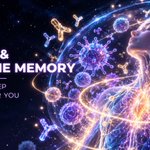
Sleep does more than support cognitive recovery.
It also plays a role in how the immune system responds to challenges.
A 2023 meta-analysis published in Current Biology found that objectively measured short sleep was associated with a weaker antibody response following vaccination.
The findings suggest that sleep duration may influence important aspects of immune function, although individual responses vary.
For Hypnus, research like this reinforces a broader principle: sleep intelligence should extend beyond a nightly score.
Understanding sleep may help us understand its relationship with health across multiple biological systems.
#Hypnus #SleepScience #DigitalHealth

7
8
5,173
Some nights are made for mystery. 🌙
While the world is chasing ghosts, we're celebrating the quiet magic of sleep.
A little less fear, a little more dreaming.
From all of us at Hypnus, may your night be filled with sweet dreams, peaceful rest, and just a touch of Halloween magic. 🎃✨
Happy Halloween! 👻
#HappyHalloween #Hypnus #SweetDreams

7
7
5,016
Ever wondered why sleeping in an unfamiliar place feels different?
A study published in Current Biology found that during the first night in a new environment, one hemisphere of the brain can remain more responsive to unfamiliar sounds than the other.
It's a fascinating reminder that sleep isn't complete disconnection from the outside world.
Even at rest, the brain continues to monitor its surroundings.
At Hypnus, this is why we believe understanding sleep requires more than measuring duration. Neural activity, environmental context, and individual adaptation all contribute to the bigger picture.
The sleeping brain is never truly disconnected.
#Hypnus #Neuroscience #SleepScience

7
4
5,308
Hypnus Research Notes — The Timing of Memory
In neuroscience, timing can be as important as intensity.
During NREM sleep, slow oscillations and sleep spindles interact through precisely coordinated neural activity.
Research published in Neuron found that the timing of this coordination was associated with overnight memory retention — and that age-related disruption of this coupling was linked to poorer memory consolidation.
This reveals something important about EEG interpretation.
A signal's value isn't determined by amplitude or frequency alone.
The relationships between neural events matter too.
At Hypnus, we see this as part of the scientific motivation for looking beyond isolated metrics toward richer interpretations of sleep architecture.
#Hypnus #EEG #Neuroscience

Hypnus Research Notes — The Creative Edge of Sleep
Some of our most interesting ideas may emerge just as consciousness begins to fade.
A study published in Science Advances examined N1, the transitional stage between wakefulness and sleep.
Researchers found that participants who briefly entered N1 were significantly more likely to discover a hidden mathematical rule than those who stayed awake.
The effect disappeared when participants entered deeper sleep.
At Hypnus, findings like these remind us that sleep isn't simply divided into being awake or asleep.
The transitions between states may carry scientific significance of their own.
Sometimes, the most interesting discoveries happen at the boundaries of consciousness.
#Hypnus #Neuroscience #SleepScience

4
5
5,757
Stress doesn’t always prevent sleep.
Sometimes it changes the sleep you get.
A person may still spend enough hours in bed while experiencing more awakenings, altered stage balance, or a greater sense of unrest.
That’s why “I slept 8 hours” and “I recovered well” are not always the same statement.
At Hypnus, we’re interested in the difference between duration and recovery — and how longitudinal signals can help explain it.
Sleep quality lives in the pattern beneath the hours.
#Hypnus #Neuroscience #SleepScience

You don’t need to cross time zones to experience jet lag.
When weekday and weekend sleep schedules drift far apart, the body can end up operating on two different clocks.
That mismatch is often called social jet lag.
The interesting part is that total sleep time can still look reasonable while timing becomes unstable.
At Hypnus, we believe sleep intelligence should capture not only how much you sleep, but how consistently your biology is being asked to shift.
Rhythm is data too.
#Hypnus #CircadianRhythm #SleepScience

6
5
5,803
Hypnus Research Notes — Sleep Debt
Sleep loss doesn’t always disappear after one long night.
When sleep is repeatedly shortened, the effects can accumulate across attention, mood, reaction time, and recovery.
A weekend sleep-in may help, but it doesn’t necessarily erase the pattern that created the debt in the first place.
At Hypnus, this is why we care about trends across nights — not isolated scores.
Recovery is cumulative.
So is disruption.
#Hypnus #SleepScience #Recovery

13
2
5,525
Hypnus Research Notes — Regularity Matters
Sleep duration gets most of the attention.
But regularity may tell us something duration alone cannot.
If sleep and wake timing shift dramatically from day to day, the body has to keep readjusting its internal timing signals.
A consistent rhythm gives the circadian system a more predictable framework to work with.
At Hypnus, we think better sleep intelligence should ask more than:
“How many hours?”
It should also ask:
“How stable was your rhythm over time?”
#Hypnus #SleepScience #Recovery

Hypnus Research Notes — Why Shift Work Is So Hard on Sleep
The body can stay awake at almost any hour.
The circadian system is less flexible.
Night work can create a mismatch between when life demands alertness and when biology expects recovery.
That mismatch can affect sleep timing, continuity, and how restorative a sleep period feels — even when total hours look “enough.”
At Hypnus, this is why sleep cannot be interpreted without context.
The same 7 hours can mean very different things depending on when they happen.
#Hypnus #CircadianRhythm #SleepScience

12
4
4,007
Hypnus Research Notes — Deep Sleep Changes With Age
Deep sleep is not a fixed quantity across a lifetime.
As people age, slow-wave activity and the proportion of N3 sleep often change — which is one reason sleep architecture can look very different at 25, 45, and 65.
That also means a “good” sleep profile should not be judged against one universal standard.
At Hypnus, we believe sleep intelligence needs age, baseline, and longitudinal context.
The goal is not to compare everyone to the same ideal night.
It’s to understand what healthy recovery looks like for each individual.
#Hypnus #SleepScience #EEG

8
7
6,338
Hypnus Research Notes — Why Wake Time Matters
Most people focus on bedtime.
But your wake time may be just as important for maintaining a stable sleep rhythm.
A consistent wake time gives the circadian system a reliable daily anchor — helping synchronize light exposure, activity, and the timing of sleep pressure across days.
That doesn’t mean everyone needs the same schedule.
It means consistency matters.
At Hypnus, we believe better sleep intelligence starts with understanding rhythm — not forcing everyone into one universal routine.
#Hypnus #CircadianRhythm #SleepScience

Hypnus Research Notes — Waking Up at Night
Waking briefly during the night does not automatically mean your sleep is “bad.”
Human sleep is dynamic.
We move through stages, transition between cycles, and sometimes experience short awakenings that are barely remembered by morning.
What matters more is the pattern:
How often does it happen?
How long does it last?
How easily does sleep resume?
At Hypnus, we care less about a single interruption and more about the stability of the night as a whole.
Sleep quality is a pattern — not a perfect line.
#Hypnus #SleepScience #Neuroscience

16
95
8,999
Sleep is closely tied to thermoregulation.
As bedtime approaches, the body typically begins shifting heat away from the core — part of the physiological transition toward sleep.
That’s one reason room temperature, bedding, and even a warm shower before bed can influence how easily some people settle into the night.
At Hypnus, we think sleep context matters because the brain never operates in isolation.
Environment shapes physiology.
Physiology shapes sleep.
#Hypnus #SleepScience #Recovery

15
56
4,172
“Don’t use your phone before bed” is usually reduced to one explanation: blue light.
The real picture is broader.
Light exposure can influence circadian timing, but content matters too.
Emotional stimulation.
Novelty.
Notifications.
Endless scrolling.
All of these can keep the brain engaged when it should be transitioning toward sleep.
At Hypnus, we think sleep context matters as much as the signal itself.
Sometimes the problem isn’t the screen.
It’s what the screen is asking your brain to do.
#Hypnus #SleepScience #CircadianRhythm

7
57
4,918
A nap can restore alertness.
But timing matters.
Wake up from lighter sleep and you may feel refreshed.
Wake up from deeper sleep and you may experience sleep inertia — that heavy, disoriented feeling where the brain hasn’t fully transitioned back to wakefulness.
This is why a longer nap isn’t automatically a better nap.
At Hypnus, we look at sleep as architecture, not just duration.
Even 30 minutes can mean very different things depending on where the brain is when you wake.
#Hypnus #SleepScience #Recovery

12
92
6,805