

✺ Spicy half to @astralwave. Sensible ∩ friendly tech.
Joined July 2011
- Tweets380
- Following463
- Followers210
- Likes2.8K







Pinned Tweet
I’d like to see a cultural counterpoint to Black Mirror, but today’s smart creative optimists don’t write fiction when they can work in tech directly.
Leaving anti-tech low-agency romantics to fill speculative pop culture with silly cynical dystopia porn or naive solarpunk.

Modern pop culture is so brainrotten wrt tech. “Robots = Terminator” is such a woeful lack of imagination and taste.
Figure’s marketing team thinks bad sci-fi dystopia vibes is the way to sell robots, which says a lot about them and their investors and audience

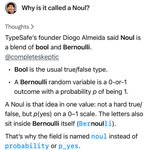
yes-man ❌
p(yes)-man ✅


After co-inventing ChatGPT, I kept asking myself: why have superhuman chat models not led to AGI?
I’ve spent the last 2 years in stealth building a new way to train models (RLCD), and a new type of frontier AI model that we are releasing today: Jev
• 20-200x faster
• 40-400x cheaper (w/ output tokens free)
• Frontier composable intelligence optimized for decisions
AFAICT the shortest path to AI-based economic revolution
I’m actually surprised this isn’t more common by now. It’s so intuitive to assign agents roles by specialism/domain expertise (plus a “Chief of Staff” main bot coordinator), and interact within a Slack-style chat interface. It’s such a familiar mental model for work.
You don’t heavily supervise or micromanage your coworker’s tasks, but you can dive deeper if needed. Mostly you just talk to them.
I’m so glad Grok Bot’s taken this direction, with great organic appeal and user adoption. Looking forward to seeing more good design from this team!
(Compare this to the utter crickets around the poorly-thought-out ChatGPT Work. Even Chat could benefit from domain/role-based “agent” division, imo)

Crazy that it’s only been 3 weeks since we launched Grok Bot.
Here’s a look at how we designed v1, and a glimpse of where we’re headed next.
x.ai/news/designing-grok-bot


Angel Chen ▄ ▀ retweeted

In 1843, Elizabeth Barrett Browning wrote to a friend after seeing her first daguerreotype: “The very shadow of the person lying there fixed for ever! … I would rather have such a memorial of one I dearly loved, than the noblest artist’s work ever produced.”
Our lives and homes are filled with things that once inspired similar awe. I tried to collect those feelings, in quotes like the one above, from people for whom what is now ordinary was brand new. A friar who met the inventor of eyeglasses, a founding father on the new smallpox vaccine, a woman in Iowa on her family’s first indoor bathroom. To look at a modern apartment through their eyes: ordinaryabundance.com

This is the right answer. ChatGPT’s “Chat/Work” distinction is unnecessary and confusing.
My work should move fluidly along an agentic continuum:
discuss → plan → inspect → execute → review → revise → execute (again)
That’s how people naturally work.
It’s bad UX to make us decide upfront which “pocket” a nascent piece of work belongs in, then leave the conversation stuck there forever.
“Chat” already handles agentic tasks via apps & tools.
“Work” shares the limited Codex/agentic usage pool. Presumably because agentic execution is expensive.
If so, then just meter the expensive execution, rather than tying usage to an arbitrary Chat/Work distinction.
Is there some underlying architectural, safety, or operational constraint behind the split?
Why can’t the same conversation fluidly shift to the heavier “Work” agent runtime as needed, then back to the lighter “Chat” mode?

Angel Chen ▄ ▀ retweeted

For most of the last century, companies hired serious designers, illustrators, and artists for the most boring document they published: the annual report.
I built an archive of 3000+ of them, spanning 1945-1991.
Angel Chen ▄ ▀ retweeted
No no you don’t understand, if they scrub this knowledge from the models, how would they be able to sell these very same models as the _defense_ to such attacks?
Release the poison, sell the cure…
tvtropes.org/pmwiki/pmwiki.p…


Annoying things about @Figma Make I noticed today:
- it can't move binary files like PNGs between folders, and you can't even do it manually—dragging in the Files ui doesn't work, and re-uploading with the “Upload file” button doesn't let you control destination. So images are forever stuck wherever they first landed/wherever the model decided
- it renames GitHub repos from my input kebab-case-name to Sentencecasename *shudder*
The first is a dealbreaker
(for the second I just renamed the repo in GH, and in Figma Make it's still connected but shows the stale name)
I'll continue the project in Codex

“You can see the computer age everywhere but in the productivity statistics.” - Robert Solow, 1987
“Many observers of recent trends in the industrialized economies of the West have been perplexed by the conjecture of rapid technological innovation with disappointingly slow gains in measured productivity.
…
My aim here simply is to convince modern economic analysts (whether perplexed by the productivity slowdown, or not) of the immediate relevance of historical studies that trace the evolution of techno-economic regimes formed around general purpose engines.”
The Solow paradox explained in The Dynamo and the Computer: An Historical Perspective on the Modern Productivity Paradox (American Economic Review, 1990)
h/t @hamiltonulmer


But what is the next phase for a sphincter logo?
My least favorite:
- OpenAI “Aperture Science” sphincter
- Anthropic “Art Attack” sphincter
- Perplexity “TIE fighter” sphincter
All worse than free stock vectors


people who brag confidently about their superior cogsec are sus
excusatio non petita, accusatio manifesta
A quick mockup of what “bringing beauty to billions” will probably look like:

1/ Today we’re proud to announce a partnership with @midjourney, to license their aesthetic technology for our future models and products, bringing beauty to billions.
Original screenshot: nitter.gq/Yuchenj_UW/status/1956…


Mr Beyer lacks empathy and it shows. The terms “discoverable” and “web search” aren’t easily understood by non-tech folks, as @simonw and others note. The distinction between publishing a “public” link to share it with known recipients (privacy via obscurity) vs TOTALLY PUBLIC to the whole world (search engine indexable) isn’t clear. My mom would’ve been confused!
Possible UX improvements:
- explicitly offer Option A vs B, akin to Figma’s sharing selector
- use plain layperson language, with first-class priority in the UI hierarchy (techies can infer from layperson lingo, but not vice versa)
- show illustrative search engine result preview for indexing option, a la Notion (speaks a thousand words + extra helpful if you want to avoid mentioning Google)
- display prominent banner on shared chats, which also lets users manage sharing settings, a la Notion: “This chat is public via chatgpt(.)com/share/688bc” or “This chat is visible to anyone on the internet via web search”
- use danger semantic colors
(the list goes on...)
We can always do better. Do better.


