

I would rather die of passion than of boredom - V. van Gogh.
Join Impressions Readers 👇
Joined October 2020
- Tweets5K
- Following1.8K
- Followers196K
- Likes23.6K
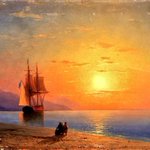




Sunset by Ivan Aivazovsky
Aivazovsky painted over 6,000 seascapes, and almost none of them were painted outdoors.
He did it all from memory.
Underrated?

What would you do differently if money didn't matter?
Klimt had a double life.
In Vienna, he painted gold-covered portraits for wealthy clients. There were deadlines, pressure to deliver, and public scandals.
But every summer, he went to Lake Attersee to relax and paint the landscape. No gold leaf. Just water, trees and quiet villages.
Do we become different people when we're free from obligations?


Gustav Klimt, On Lake Attersee, 1900
Klimt spent his first summer at this Austrian lake in 1900.
Away from Vienna, he could take a break from commissions and paint what he wanted. No gold. Just nature and the freedom to experiment.
Did Klimt paint some of his best work when he was painting for himself?
Impressions retweeted
In 1877, Monet was far from famous.
Two young children, money problems and a seriously ill wife. Camille died just 2 years later.
Monet needed to sell paintings to support his family.
He threw himself into Gare Saint-Lazare. Smoke, steam, light. He became obsessed.
Painting gave him something to focus on while life outside the studio was hard.
He sold several station paintings within months.
Was painting his refuge, his best chance to earn a living, or both?


Monet’s Iris sold yesterday for €50 million.
Art or speculation?
Art is treated as a financial asset, bought and sold for profit.
Is that fair?

Schiele vs Kandinsky
Two ports, two different styles.
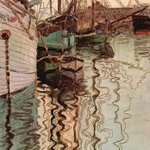
Egon Schiele’s Harbor of Trieste has the lines and forms of Austrian Expressionism.
Kandinsky’s Odessa Port (1898) is still figurative, years before his move towards abstraction.
Same subject, different artistic worlds.
Which do you prefer?

This doesn’t look like a typical Egon Schiele.
He was only 17.
Harbor of Trieste, 1907, shows a different side of the artist. No twisted bodies or raw portraits. Just boats and reflections on the water.
Even here, you can see him searching for his own style.

Japanese Bridge by Monet
Same bridge. Same painter. More than 20 years apart.
1899 vs. 1922
In 1912, doctors found cataracts in both of Monet’s eyes.
Researchers believe they helped push his greens and blues toward reds and oranges.
He painted what he saw.


Monet vs Van Gogh: Poppy Fields
Monet paints poppies in Argenteuil, with his wife and son strolling through the summer landscape.
Van Gogh uses stronger colours and brushstrokes to give his poppy field a different feel.
Same flowers, different eyes.
Monet or Van Gogh?


Gustave Caillebotte, Sunflowers on the Banks of the Seine
Everyone knows Monet created the gardens at Giverny.
Few know who fueled that obsession: his best friend, Caillebotte.
Caillebotte was loaded and turned his property into a botanical paradise.
The two spent hours debating soil, seeds, and fertilizers.
Caillebotte’s home inspired Monet to create Giverny years later.

Konstantin Korovin, Paris Boulevard.
When Korovin first visited Paris in 1885, Impressionism was a revelation.
He later wrote that he had found in the Impressionists everything he had been criticised for back in Moscow.
He didn't just paint Paris. He made it move.

Renoir, The Umbrellas, 1881–86
Renoir started it as an Impressionist.
Then came a creative crisis and a trip to Italy. The Renaissance changed how he saw art.
Four years later, he returned to the canvas with a more classical approach and echoes of Japanese art.
Impressionism, Renaissance and Japonism, all in one painting.

Edward Hopper, Hotel Lobby, 1943.
Modern loneliness?
Hopper made ten studies before settling on the final scene. In the sketches, the older couple were talking. In the painting, the silence says it all.
Three strangers sharing a room, each lost in their own world.

In 1877, Monet was far from famous.
Two young children, money problems and a seriously ill wife. Camille died just 2 years later.
Monet needed to sell paintings to support his family.
He threw himself into Gare Saint-Lazare. Smoke, steam, light. He became obsessed.
Painting gave him something to focus on while life outside the studio was hard.
He sold several station paintings within months.
Was painting his refuge, his best chance to earn a living, or both?
In 1926, Kandinsky's "Dance Curves" turned a dancer’s movements into geometric lines.
Even after going abstract, he kept pushing limits.

Kandinsky vs Kandinsky
Early: real landscapes.
From 1910: dropped reality entirely. Shapes, visual music.
He stopped painting what he saw and started painting what he felt.
Which era do you prefer?


Irises by Van Gogh
Monet and Van Gogh both painted irises. The results couldn't be more different.
Monet painted them in his garden at Giverny.
Van Gogh painted his in the asylum at Saint-Rémy. He wrote to Theo about the flowers. Painting helped him get through life there.
Same flowers, different worlds. Each tells us something about the man who painted it.


Claude Monet, Irises
Monet was losing his eyesight.
He was 70 years old. Cataracts made colours harder to tell apart.
He even labelled his paint tubes to avoid mixing them up.
He is believed to have painted over 300 works in his later years despite his eyesight problems.


Paul Signac, Capo di Noli, 1898
He walked 100 miles from Saint-Tropez just to paint this cliff.
Signac used Pointillism, placing thousands of dots side by side so our eyes blend the light.
Up close, it’s just a mess of color. Step back, and the coastline glows.

Camille Pissarro, Le Pont-Neuf, 1902
Same bridge. 30 years apart.
Renoir focused on the people of Paris; Pissarro on light.
Renoir or Pissarro?

Auguste Renoir, Le Pont-Neuf, 1872
Edmond Renoir delayed pedestrians with fake questions while his brother Auguste painted from a second-floor café window.
Renoir wanted to capture the recovery of Paris after the Franco-Prussian War.
He ignored the recent trauma, painting everyday life to show a city reborn.
Can you notice the beauty of daily life?
