

Built https://xitter.cf/t.co/AZUc58mfyO (50k users) ✨ 700k+ subs on YT | https://xitter.cf/t.co/t0GS1tzxSt | Praise Indra ⚡️
Asia
Joined May 2019
- Tweets6.6K
- Following714
- Followers251K
- Likes10.7K






Pinned Tweet
Missed a heartbeat seeing this! Thank you so much @narendramodi sir for appreciating my idea - UPI is truly a revolution that the whole world today is taking notice of.
This pat on my back will keep me going for years, thank you so much!
🇮🇳✨✨

I’ve spoken about UPI and Digital Payments quite often but I really liked how you’ve used the sound of money transacted through data sonification to effectively convey the point.
Very interesting, impressive and obviously informative! @indiainpixels


India in Pixels by Ashris 🔱 retweeted

Gurbani is similar, we don’t ask for Moksh
ਅਨਾਜੁ ਮਗਉ ਸਤ ਸੀ ਕਾ ॥
I ask for plentiful, good-quality grain.
ਗਊ ਭੈਸ ਮਗਉ ਲਾਵੇਰੀ ॥
I ask for a milk-producing cow and buffalo.
ਇਕ ਤਾਜਨਿ ਤੁਰੀ ਚੰਗੇਰੀ ॥
I ask for a fine mare.
ਘਰ ਕੀ ਗੀਹਨਿ ਚੰਗੀ ॥
I ask for a good wife for my household.

I was listening to Guru Randhawa’s song Sirra and it struck me how much Punjabi pop has in common with… Rigveda.
Not the theology ofcourse but the attitude and the spirit. It is the same celebration of pride, power, land, wealth, rivals, and desire, all celebrated without the slightest embarrassment or garnish of the typical obsession to be small and insignificant and disguised as intellectual spirituality.
Read some of these lyrics in English and they could almost pass for verses from a hymn to Indra.
Tusi Jithe Vi Jaane O, Sira Karo
Wherever you go, you establish your supremacy.
Kinni Aa Paili Ni Minti Ni Koyi
So vast are our lands that none can measure their extent.
Har Din Da Masla, Chak Ke Asla
Each day brings a new conflict, and we take up our arms.
Pange Kyun Paune O? Pange Kyun Paune O?
Why do you provoke us? Why do you seek a quarrel?
Eh Taan Sadi Hundi Sardari Nakhro
Such is our lordship, O beautiful one.
And then comes my favourite:
Leerhe LV De Pakki Aa Garaari Nakhro
My heart is firmly set upon garments of Louis Vuitton, O beautiful one.
Replace Louis Vuitton here with horses, cattle and gold ornaments, and we’re back in the Bronze Age with songs of Indra.
I think we often forget just how worldly, physical and materialistic the Rigveda is. We’re so used to associating ancient Indian religion with renunciation, detachment and the pursuit of nonsense like Mukti and Moksha that the Rigveda can feel almost blasphemous to the average Indian.
There are hymns asking the gods for wealth, cattle, horses, sons, victory over enemies and long lives. Poets praise kings and patrons for their generosity, sometimes going into great detail about the gifts they received. Indra drinks enormous quantities of Soma, defeats his enemies, wins cattle and distributes wealth to his worshippers. He is not particularly interested in teaching you to overcome your desire for worldly things. Quite often, he’s the god you approach to get more of them.
Punjabi pop feels so familiar with that context. The land, the weapons, the beautiful women, the expensive possessions, the pride in one’s family and the constant reminder that nobody should dare challenge your sardari.
I’m not suggesting that Punjabi pop is somehow descended from Rigvedic poetry. But I do find it fascinating that two poetic traditions separated by thousands of years can sound so similar when talking about what makes a man great.
If you want to imagine the real spirit of a hymn to Indra, don’t picture a sage sitting silently in a forest meditating or doing yoga. Picture a Punjabi rapper arriving in a convoy, showing off his wealth, challenging his rivals and announcing to everyone that nobody does it better than him. That is closer to the Vedas than Puranic bhajans fetishising smallness.


India in Pixels by Ashris 🔱 retweeted

A trippy tribute to the OG…
India in Pixels by Ashris 🔱 retweeted

Goosebumps
Was transported to some other universe, some other space 🤐
India in Pixels by Ashris 🔱 retweeted

Wow just wow, ati Sundar!
On the eve of Mahalaya, I am happy to present Tomar Aloy (In your light), an experimental Bengali metal song dedicated to Indra and his Aindric philosophy.
Shubho Mahalaya 🦁 The Devi paksha begins tomorrow. May Indra's light and protection of Maa Durga be with you.


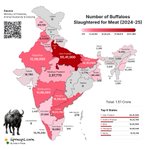
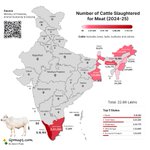
India’s Basic Animal Husbandry Statistics 2025 estimates that 22.7 lakh cattle and 1.51 crore buffaloes were slaughtered for meat in 2024–25, roughly 6.7 buffaloes for every cattle animal.
Cattle here includes cows, bulls, bullocks (castrated males) and calves. Buffaloes are a separate category. These figures cover 1 March 2024 to 28 February 2025, rather than calendar year 2025.
The two maps reveal very different geographical patterns. Kerala and Tamil Nadu together account for about 62.5% of cattle slaughter, with Meghalaya contributing another 14.7%. For buffaloes, Uttar Pradesh alone accounts for roughly one-third of the national total, at 50.41 lakh animals, followed by Andhra Pradesh, Bihar, Telangana and Kerala. Kerala features prominently in both categories, while Tamil Nadu’s buffalo slaughter estimate is comparatively small.
This distinction matters when discussing beef in India. Cattle and buffalo meat are treated differently under many legal frameworks. India’s export policy prohibits cattle beef exports while allowing boneless buffalo meat under specified conditions.
State slaughter laws also differ. For example, Tamil Nadu permits eligible animals to be slaughtered subject to certification. These maps show estimated slaughter within each state, rather than residents’ consumption or a breakdown by religion. The estimates draw on survey and administrative information. A reported zero does not establish that no unrecorded slaughter occurred.

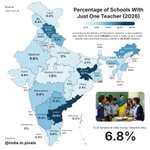
According to UDISE+ 2025–26, India has 1,00,843 such schools, serving about 29.1 lakh students, that is 6.88% of all schools nationwide. Andhra Pradesh has the highest share at 26.88%, followed by Jharkhand at 22.14% and Himachal Pradesh at 18.33%. These figures include government, aided and private schools.
Having one teacher makes a school heavily dependent on a single person. Where children are spread across different grades, that teacher must manage several lessons alongside administrative responsibilities. Illness or leave also requires someone else to provide cover. However, a small school can provide essential access in a remote village, where closing it could mean a difficult journey for young children.
The percentage therefore needs to be read alongside student numbers. Andhra Pradesh’s single-teacher schools average about 14 pupils each, while Bihar’s average about 81 even though Bihar has a much lower share of these schools, at 2.11%.
The map highlights dependence on a single teacher. It does not, by itself, rank education quality or reveal how crowded those schools are.
Not quite.
Taittriya Samhita (Krishna Yajurved) 2.5.1 tells the origin story of Indra killing Vishvarupa, son of Tvashtr, and incurs brahmahatya. He offloads a third of the guilt each onto the earth, the trees, and women. The women's share becomes menstruation.
The text then applies the practical rule (Translation by Keith, TS 2.5.1.5)
"Therefore one should not converse with a woman with stained garments, nor sit with her, nor eat her food, for she keeps emitting the colour of Brahman slaying."
This gets codified later in Manu 4.57 many centuries later. So Manu isn’t working from scratch here. Although yes we do not see any reference in the Early Vedic layer in Rigvedic times. Later Vedic layer has a more complex society as its subject, and thus is more gray.

Vedas were never practiced, it's Dharmasastras who were enforeced even if they went against the Vedas. 👇
"Untouchable, pig, cock, dog, menstruating woman must not look at him while they eat" - Manu 3.239
"in whose houses menstruating women sit, they become Sudras" - Vasishta 5.9
"He shall not converse with a woman in her courses" - Manu 4.57
All such inhuman treatment started in Dharmasastra like Manusmriti, Vashista etc, not in Vedas (Samhita).