






ingruc retweeted

𝗗𝗶𝗲 𝗞𝗿𝗲𝗱𝗶𝘁𝗺𝗮̈𝗿𝗸𝘁𝗲 𝘀𝘁𝗲𝗹𝗹𝗲𝗻 𝗱𝗶𝗲 𝗞𝗜-𝗥𝗮𝗹𝗹𝘆 𝗮𝘂𝗳 𝗱𝗶𝗲 𝗣𝗿𝗼𝗯𝗲 | 𝗕𝗼̈𝗿𝘀𝗲𝗻𝘄𝗲𝗹𝘁 𝗞𝗼𝗺𝗽𝗮𝗸𝘁
𝗭𝘂 𝗚𝗮𝘀𝘁: 𝗜𝗻𝗴𝘃𝗮𝗿 𝗥𝘂̈𝗰𝗸𝗲𝗺𝗮𝗻𝗻
📉 Entwicklung der Kreditmärkte und Zinsen
📈 Auswirkungen der Zinsentwicklung auf Aktien und Unternehmen
🤖 Risiken und Chancen bei KI-Investitionen
🗳️ Bedeutung der Midterm-Wahlen für die Märkte
📊 Wichtige Kennzahlen bei Unternehmenszahlen wie SpaceX, Tesla und Meta
🎬 𝗬𝗼𝘂𝗧𝘂𝗯𝗲: youtube.com/watch?v=jJBwICSp…
🎧 𝗣𝗼𝗱𝗰𝗮𝘀𝘁: omny.fm/shows/verstehen-inve…

🎙️ New podcast episode: State of the markets during renewed AI-capex fears, higher interest rates, and ahead of the US midterms.
As always, a very nice conversation with @maxwi_etoro ! I think we covered a lot of ground in this conversation, check it out if you like!
The key takeaways:
📉📈 Markets have moved sideways since summer. Investors are in wait-and-see-mode.
❗ $CRWV is a good example of what’s on the market’s mind: Financing costs have increased, and the market is asking (again) whether the AI build-out is sustainable.
👉 My view: It is not a sign of an immediate downturn. It looks more like an orderly process. Higher financing costs push companies to pursue only their best projects.
🔄 Excess is being washed out of the market, without causing a negative chain reaction so far.
🤖 At the same time, demand for compute is still practically limitless. That clashes with higher financing costs, and might lead to higher costs for end users of AI over time.
📊 KPIs to watch, especially in AI:
🔹 Revenue growth
🔹 Debt
🔹 Capex for AI
🔹 And increasingly: free cash flow. At some point, the massive spending has to be justified.
🇺🇸 US midterms on 3 November: Volatility is likely. But almost any result tends to be good for markets, because it reduces uncertainty. The vote could even become a positive catalyst for a solution in the Iran war.
✅ Potential positive surprises: A solution in the Iran war, and with it less inflation uncertainty around the globe.
💼 Hyperscalers still dominate the indices. Many investors’ portfolios could do well with diversification beyond tech, for example into consumer staples.
🎧 Full episode: youtube.com/watch?v=jJBwICSp…
Thank you as always for your trust!
Ingvar
$SPX500 $NSDQ100 $CRWV
1
89

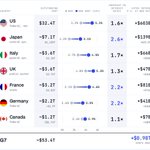
🧐 $1 trillion more in interest, every year.
That’s how much the G7 countries would have to pay extra just on the currently outstanding debt, if they had to refinance it all at current levels.
This is why governments watch their bond yields so closely.
📈💰 In absolute terms the problem is biggest in the US, simply because of the sheer amount of debt ($32 trillion). But even though the headlines focus on US borrowing costs, countries like Japan, France, Germany actually face the biggest jump in rates relative to what they are currently paying (>2x).
🔄 Of course, not all of this has to be refinanced right now. Much of the debt will roll over gradually in the next 5-10 years (even longer in the UK). But if rates stay at these levels (or go even higher), that $1 trillion extra interest bill will become reality.
❗Why I am watching it, and why I think it is important for every investor:
We need to consider the scenario that the era of low interest rates since the Great Financial Crisis (2008) is coming to an end.
The best solution would be to reduce debt. But governments will have a hard time to do that, because the required spending cuts are politically difficult.
So, countries will likely (try to) address this issue with a combination of
1️⃣ “growing out” of the debt: grow the economy so debt shrinks relative to GDP
2️⃣ accepting higher inflation: this increases nominal tax revenues, which makes it easier to pay interest on existing fixed-rate debt
3️⃣ maybe even central bank bond buying, which would help to bring down interest rates.
Points 2 and 3 are not great solutions. But nonetheless they are likely to play a role, simply because the cost of those are more hidden and thus less likely to meet resistance among voters and decision makers.
The takeaway for stock investors:
In that environment, owning real businesses becomes even more important. Good companies grow with the economy and can pass inflation on through their prices. Companies with pricing power, strong free cash flow and little debt are best placed.
Have a nice weekend!
Ingvar (ingruc on @eToro )

4
25,696
🤔 What's going on in the bond market - and why do stock markets not really care?
This topic has intensified this week: Bond yields are rising around the world, most notably for the largest debtor in the world, the United States.
📈 The important US-10-Year Treasury yield shot up from 4.8% to almost 5% within 2 days - doesn't seem much, but it's a big move in that market. The reason is simple: If you have $40 trillion in debt outstanding, every 0.1% more in interest rates is equivalent to $40 billion USD more in interest payments over time.
🗣 The US Treasury Secretary Scott Bessent, himself a former hedge fund manager, tried to talk the market out of it this week ("I am the house"). Markets called his bluff, sold even more Treasuries, which drives down the price of the bonds and the yield upward - thus the move to almost 5% on the 10-year.
❓ What's next? Hard to say, and we will see. It's a complex situation, and it is fair to say that the move higher in yields reflects a lot of things at once. Higher oil prices due to the Iran war, the direct cost for the US to wage war against Iran, a President who promises $5k to each American (> $1 trillion total), no willingness to build a sustainable budget,…
Due to the size and importance of the US-bond market, this is pushing up borrowing costs around the world (among other reasons - some European countries have budget issues as well, for example France).
❗Stock markets don't seem to be overly concerned by this for now. That's honestly a bit surprising, and we will see if it holds. But it could also be a rather rational assessment by markets: AI-capex keeps flowing, earnings are strong, companies are usually able to pass on inflation to their customers.
Alternatively, markets might be a little too chill about a real problem right now, and things might get choppier soon.
🏦 Much hinges on the further movement of bond yields and the reaction of the Fed (if any) - their next meeting and decision is due next week Wednesday (16 Sep).
I'll probably provide some more updates on this topic depending on how it develops, so stay tuned!
For now, have a nice Friday and enjoyable weekend! 🌞
Ingvar

4
22,635
🎙️ New podcast episode with @maxwi_etoro , this time on interest rates, oil, inflation, and cash in the portfolio.
Key takeaways 👇
⛰️ Jackson Hole: Warsh came out clearly hawkish. Core PCE still 3.3%, above the 2% target for years. For the Fed that's now a credibility problem, not just an inflation one.
📊 Rates: market prices ~60-66% for a September hike, ~40% for a second in December. My base case: US hikes at least once within 6 months, Europe too. Timing is less important than understanding the direction.
🛢️ Oil is the swing factor: Brent ~$92 (≈$120 in March, ≈$70 in July). What many miss: China is the crucial factor here: The country is drawing down its apparently massive stockpiles instead of importing. But stockpiles don't last forever, so this might emerge as a risk the longer the Iran war drags on.
❗ Inflation is currently a bigger risk than a weak US economy. Higher energy prices feed through to everything, and rather quickly.
💵 Me: ~17% cash in the portfolio, more than usual. That's a result of 2 strong years of profit-taking, and relatively little *real* value on offer today imo. Happy to hold dry powder for what's coming.
Your take on markets? Comment below 👇
$OIL $SPX500 $EUSTX50
#ValueInvesting #Fed

Bleibt die Zinserhöhung im September wirklich nur ein Szenario? Ingvar Rückemann und Maximilian Wienke analysieren Warshs hawkishe Haltung, die hohe Inflation und die entscheidenden Signale von Arbeitsmarkt und CPI. Jetzt auf unserem YouTube-Kanal ansehen.
1
111
❗MSTR/BTC is an interesting one.
TBD if the rally has legs - but the recovery fits remarkably well into the current macro story of 1) concerns about currencies, and 2) higher borrowing costs all around the globe.
1
18
Absolute pleasure to join Max's podcast again!
This time:
📈 Markets near all-time-highs again, was the recent correction healthy?
💰 $800 billion in AI-capex (and counting) - rational move or risky bet?
🚀 $SPCX earnings, and why 900 million shares can now hit the market
💵 Why I am currently not unhappy about 18% cash-portion in my portfolio
Enjoy!
youtube.com/watch?v=AIwfON0G…

141


🇰🇷 So how did South Korea do it? 🧵1/4
How does an index shoot up +185% in a year… only to drop -26%+ in a matter of weeks?
Let’s break down the wild KOSPI ride 👇

1
2
144
3/4
The result:
1: Samsung + SK Hynix become absolute monsters — at peak they dominated ~50-60% of the entire KOSPI weighting.
2: Market moves in tandem with those stocks and their new leveraged ETFs, volatility increases.


1
92
4/4
Now -26% in a month - what's crashing the party?🤔
👉AI hype cooling slightly
👉Profit-taking after the insane run
👉Regulators cracking down on leveraged products
👉Bank of Korea just hiked rates today to 2.75% (first hike in 3+ years)
Perfect mix to spoil the mood - let's see where it shakes out.
30

$PYPL +19% pre-market after takeover interest from Stripe and Advent.
🛑But the offered 60.50 USD per share is too low. 👎
The business generates $6B free cash flow per year.
Would be a pretty sweet deal for Stripe/Advent to get that, plus immense synergies, for just $53B !
Probably wise to hold and let this play out. Better offer(s) likely.
164
Great short-trip this week to London’s Canary Wharf for @eToro’s ”Intelligence in Motion” event!
Full house, lots of new AI-powered products released, and great conversations with fellow investors and eToro staff.
Really inspiring to see how the company is leveraging AI.
Glad that I finally got to see the eToro-branded cabs as well 🙃


91
Very glad to be on eToro's podcast again, with some timely topics:
🛢 Oil: More is flowing via Hormuz again, stabilizing oil markets. Geopolitical risks remain, but the high prices of early 2026 might eventually turn out to be the exception.
💵 Inflation & the Fed: inflation in the 3-4% area forces central banks to be more hawkish again.
📉 Software: probably undervalued due to overblown AI-extinction fears.
📈 Markets: have probably run a little hot by now, and could correct in the second half of 2026. Rotation from AI to other sectors might be on the horizon.
Enjoy!
Thanks @maxwi_etoro and @eToroDE
#Oil #Inflation #AI
Neuer Podcast🎧
Ingvar Rückemann, Pro Investor bei eToro, und Maximilian Wienke sprechen über den Ölpreis unter 80 US-Dollar, den restriktiveren Ton der Fed und warum die Micron-Zahlen zum wichtigen Test für die KI-Story werden könnten.
68