






The Insolvent Analyst retweeted
I think the biggest flaw in this model is the demand side. Hyperscalers are seeing explosive growth that isn't necessarily tied to OpenAI or Anthropic:
Azure: +48%, open-model revenue up 10x.
GCP: +103%, open-model growth astronomical.
AWS: +39%, AI revenue growing triple digits, inference now over half of AI revenue with $1 trillion AWS revenue projections over the next 5-10 years
The model assumes Gemini, open-model hosting and other providers generate revenue equal to just 19% of OpenAI + Anthropic ARR. Why should independent AI demand be tied to the growth of two labs?
I think the recent NVIDIA chip-smuggling revelations might actually be one of the most bullish developments for the long-term AI infrastructure trade and I wouldn't be surprised if the narrative starts shifting considerably over the coming months.
For much of the last several months, we've been hearing that Chinese AI models are catching up to American frontier labs at an extraordinary pace, taking market share and achieving comparable intelligence at a fraction of the cost.
The market was questioning why $MSFT, $GOOG, $META, $AMZN and the rest of the American AI ecosystem were spending hundreds of billions on compute when Chinese labs can seemingly achieve the same results for substantially less?
As we know over the last few days, NVIDIA Blackwell's hardware fingerprints have been identified in all models from DeepSeek, Moonshot, MiniMax and Ant Group. So restricted NVIDIA hardware is reaching China, along with Chinese labs seeking advanced GPU capacity overseas which suggests that access to cutting edge compute remains incredibly valuable to these companies.
My point is that if some of the extraordinary progress we've been attributing primarily to Chinese algorithmic efficiency was also being supported by access to advanced American hardware then what happens as the US increasingly restricts access to advanced GPUs and potentially overseas compute?
Chinese labs will obviously continue improving their algorithms, and I wouldn't underestimate their ability to innovate. But American frontier labs get to combine those same algorithmic advances with increasingly powerful hardware and substantially larger compute budgets.
I wouldn't be surprised if the intelligence gap that everyone has been expecting to close actually starts widening again and if that happens, the implications for the AI capex debate could be enormous.
The argument that Chinese models were proving massive compute spending unnecessary would start looking considerably weaker. Instead, we might discover that spending more on compute, combined with better algorithms, is precisely what creates a sustainable competitive advantage at the frontier.
Think about the moat that could create for American labs if the most capable models increasingly require access to compute that competitors simply cannot obtain. This could be a major reinforcement of the idea that access to massive amounts of advanced compute matters enormously.
Quite ironic that the very news surrounding NVIDIA and restricted chips could end up reinforcing Jensen Huang's entire argument for the AI infrastructure buildout. Wouldn't be surprised if people start paying considerably more attention to this over the coming months.
The narrative could go from Chinese models making American AI capex look excessive to advanced American compute becoming an increasingly difficult advantage for Chinese labs to overcome.
3
67
What I think most people underestimate is how resilient India as a country and Indians as people are.
Many of the business execs there have spent decades building successful companies despite enormous structural challenges, limited resources and the odds being stacked against them.
They’ve learned to adapt, innovate and most importantly survive in environments that were never particularly forgiving. I wouldn’t bet against their ability to figure things out this time either.

That’s certainly the bull case. The bear case is that most of the displaced jobs have been outsourced and it’s difficult for an entire economy to pivot on a dime. Like I said in the original tweet I’m definitely open to flipping I just would like to see some sort of evidence
1
63
I think the comparisons between the current AI selloff and the 2000 .com bubble are getting a little ridiculous.
Cisco's fundamentals actually looked great well after the Nasdaq had peaked. The Nasdaq topped in March 2000. Cisco was still reporting 66% YoY revenue growth in November. In 2001, inventories had more than doubled in six months, and the company eventually took massive writedowns as demand collapsed.
So yes, the market can absolutely anticipate a deterioration in fundamentals before it shows up in earnings. But today we have:
$MSFT - 48% Azure growth and continues to say customer demand exceeds available supply.
$IREN reporting 11-12% sequential increases in contract pricing, with some customers willing to prepay 90% of associated GPU capex.
$CORZ converting capacity into revenue, with 485 MW now generating revenue compared to just 120 MW at the beginning of the year.
What I think is happening is credit markets are getting more selective, like $WULF's explained today with market wanting higher ROI on these leveraged players.
The hyperscalers are generating enormous amounts of cash and neoclouds have already financed projects that have yet to meaningfully contribute to their earnings. The market is questioning whether the next wave of projects can earn adequate returns, particularly with rising financing costs, GPU depreciation and regulatory uncertainty.
But I think what happens is that we're entering a period of digestion rather than the beginning of a fundamental collapse. The stronger operators may slow their expansion, bring already-financed projects online, convert contracted backlog into revenue and gradually improve their financial profiles.
If financing becomes more difficult for everyone else, that could also constrain future supply, potentially supporting compute pricing for existing operators. But there's also an enormous difference between peak earnings growth and peak earnings.
We're not looking at an entire technology supply chain trading at the sort of extraordinary multiples investors were paying in 1999-2000. There are profitable businesses in parts of today's AI supply chain trading at relatively modest forward earnings multiples.
Looking at the charts, I don't think we should expect everything to immediately reverse and start making new highs. A lot of technical damage has been done. Sentiment has deteriorated, leadership is breaking down, and I suspect the market needs a proper digestion period for positioning to reset and the charts to heal.
Maybe that means a couple quarters of sideways action while earnings continue to beat and investors get more clarity on financing and ROI.
That's ultimately a much healthier outcome for the AI trade. But comparing this indiscriminately to the dot-com bubble just because both involved enormous infrastructure investment feels downright lazy.
Different valuations. Different customers. Different balance sheets. Different economics and, importantly, a completely different set of challenges.
I think the market needs time to digest the growth we've already had, not necessarily an outright collapse in the underlying AI thesis. $NBIS $CRWV $PENG
2
92
Not sure if this is a broader rollout or just Google experimenting, but starting to notice something pretty interesting for $RDDT. Search results from Reddit are appearing ABOVE Google's AI Overview.
In this example, Reddit is the first result for "best movies of 2026," with the AI Overview pushed below it.
Some SEO researchers have also started reporting AI Overviews moving to the side or further down the page for some searches. Remember, $RDDT recently got hammered partly because of declining Google search referrals.
If $GOOG is experimenting with giving traditional organic results more prominence, particularly for opinion-based searches where people actually want human perspectives, the implications for Reddit could be pretty interesting. Far too early to call it a trend, but definitely something worth monitoring.

5
138
I think the whole peak earnings argument for AI infrastructure names is interesting, but the more plausible scenario here isn't actually declining earnings, just earnings growing at a slower rate.
Some great context from $VIAV's CEO that I feel like the market is overlooking.
Data centers aren't going anywhere. Even if new builds slow materially, the existing installed base will still need to be upgraded, with technology refresh cycles of roughly 3–4 years.
If building new data centers becomes increasingly difficult because of power constraints, permitting and political opposition, the existing facilities become even more valuable. Operators will have every incentive to squeeze as much compute as possible out of every MW of power. Tokens per GW increasingly becomes the metric that matters.
That means upgrading to faster networking, better optical interconnect and more efficient equipment. Companies like $VIAV $ALAB $ANET can benefit not just from new construction, but also from the testing and validation required with each new technology generation.
In fact, a slowdown in new builds could increase the urgency to upgrade existing infrastructure. I understand the valuation concerns and the argument that we're approaching peak earnings. A lot can change over the next year.
But what if earnings simply grow at 10–20% instead of 30–40%? For quality names trading at sub 10x next year's earnings, you're not exactly paying 40x.
I feel like the market is increasingly becoming a voting machine, pricing in the worst possible outcome across the entire AI supply chain without distinguishing between the companies dependent on new builds and those with recurring replacement demand.
Peak growth and peak earnings are two very different things IMO.

3
154
Increasingly convinced the market is massively overreacting to the political backlash against data centers.
The solution is apparently to fund a few school programs, build some infrastructure for the locals and let the politicians take a victory lap.
$HUT just made a $10M payment in Louisiana supporting local services, including $7K stipends for school employees. They're also funding grid upgrades in Texas.
$KEEL is funding school buses, after-school programs and food pantries in PA and negotiating community benefit agreements. Management says the new regulatory requirements shouldn't materially change project economics for tenants.
And perhaps the funniest part? $HUT's CEO doesn't think the Democratic victory in Texas changes the outlook for Beacon Point.
Remember when Trump was supposedly going to wage war against Big Tech? He was threatening Zuckerberg with prison and publicly accusing major banks of political discrimination.
Fast forward and Big Tech Trump is now buddies with them. I suspect we're going to see something similar here.
Politicians get to look like they're protecting their constituents. Developers make some concessions. Communities receive actual benefits. And the data centers largely continue getting built.
Obviously, some projects will be delayed or cancelled, and there are legitimate local concerns. But I have a hard time believing that either political party wants to be responsible for pushing the next generation of American computing infrastructure overseas.
Quite the bear thesis. @Jason is accurate I think.
2
181
I think one of the biggest potential beneficiaries of the political backlash against large-scale data centers could actually be on-prem AI infrastructure.
Let's think about what happens if a meaningful portion of the planned data center buildout gets delayed or cancelled. AI adoption doesn't necessarily slow with it. If demand continues increasing while new compute capacity becomes harder to bring online, the cost of renting compute could remain elevated or move even higher.
$MSFT's margins took a hit relying on third-party GPU capacity and $GOOG also said they started using third-party compute because of supply constraints.
If you're an enterprise running increasingly large AI workloads. At some point, owning your own compute infrastructure could become considerably more economical than renting it, particularly for predictable inference workloads.
$HPE has talked about enterprises optimizing their cost per token through on-prem deployments. $PENG could be another interesting beneficiary through its AI infrastructure design, deployment and management capabilities.
And I think $DUOT also is worth watching and potentially an idea with a lot of torque. Its smaller, distributed data centers could become increasingly valuable if securing power and permits for massive campuses becomes more difficult. The demand for compute doesn't necessarily disappear because you can't build another GW scale campus.
I feel like there are going to be a lot of second-order winners here that the market isn't appreciating yet which goes to show this is forced selling.
1
2
263
When the 🐐 @ChrisCamillo speaks you listen. I think $BE could end up being one of the biggest beneficiaries of the political backlash against data centers once the dust settles.
Texas Gov. Hinojosa: "a moratorium on all data center approvals."
Oregon Gov. Kotek wants data centers to "do more to produce their own renewable energy."
Florida Gov.-elect Donalds has called for data centers to "generate and use their own power and water."
Different approaches, but an increasingly common theme: data centers cannot rely on grid for the massive electricity requirements.
But the is missing the second-order implications here.
If BYOP (Bring Your Own Power) increasingly becomes a prerequisite for new developments. That would dramatically expand the addressable market for companies like $BE. They announced a 900 MW on-site power agreement with NTT DATA today.
The irony is that the very political developments being interpreted as bearish for the AI buildout could end up accelerating demand. Not to mention that their tech is scalable and extremely water efficient.

Added to $SILC today.
Stock closed at $26.40 today ($152M market cap).
The company has ~$107M in working capital and marketable securities (~$18.6/share), including ~$45M in cash and securities, with no debt.
Enterprise value is just ~$107M. Q3 revenue grew 71% YoY and management raised FY26 revenue guidance to ~$97M.
If they manage another 30% growth in 2027, you're looking at ~$126M in revenue. Assuming gross margins remain near 30% and operating expenses don't increase materially, I get roughly $0.65 in GAAP EPS and ~$1.05 adjusted (less than 10x EV/EBT). That puts the business at ~0.85x 2027 EV/sales, with several design wins still ramping.
Obviously, much of that working capital is inventory, and execution matters. But the disconnect between the growth being reported and the valuation is getting pretty interesting. This is one where you think how was this selling for so cheap a year from now, free money! @KyleAdamsStocks & @pennycheck have been on this for a while I believe.
I think the 25,000–26,000 zone on $NQ is going to be a pretty important line in the sand. There's a remarkable amount of technical confluence in this area:
- YTD open
- Anchored VWAP from the March 2025 lows
- Golden pocket retracement from the March 2026 lows
- 100 EMA and other major moving averages
Meanwhile, I'm also watching the 4,200 level on the KOSPI. If these levels hold, I wouldn't be surprised if they end up marking an important low for the broader AI trade, particularly memory stocks, which have been among the biggest beneficiaries of the cycle.
Obviously, none of these levels are guaranteed to hold, but it's interesting how many different technical indicators are converging around the same area just as sentiment is deteriorating. $DRAM $SKHY $MU $QQQ

3
112
The reaction to this election is starting to remind me of what happened after Trump won in 2024, just in reverse.
The market rose expecting deregulation, lower taxes, accelerating growth, etc. Stocks rallied, momentum eventually faded, and by March/April 2025 we had a pretty brutal selloff as the reality of his policies started to sink in.
Now it feels like we're doing the exact opposite. The market seems to be pricing in a worst-case scenario for AI infrastructure following the Democratic victories, with the assumption that data center construction will slow materially and the entire AI supply chain will suffer.
All this before we even know what the actual policy changes will look like, how extensive they'll be, or how companies will adapt.
I'm not suggesting there aren't legitimate risks here. But I find it interesting how quickly the market can go from extrapolating the best possible outcome to the worst possible one.
In both cases, the narrative seems to be moving considerably faster than the underlying fundamentals.
Wouldn't be surprised if we're overreacting in the opposite direction this time.
2
90
One of the stranger disconnects I've seen between public equity markets and the fundamentals of the underlying industry.
Market is increasingly concerned about an impending GPU glut, collapsing compute prices and the economics of the AI infrastructure buildout.
Meanwhile, $IREN just reported:
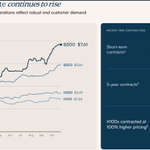
3-year contract pricing up 11% sequentially.
5-year contract pricing up 12%.
New H100 capacity contracted at 2x the pricing of a previous deal.
A short-term contract at $40M in annual revenue per MW.
That is not how customers typically behave when they expect abundant supply and rapidly falling prices.
To be clear, I'm not a buyer of $IREN and this is not an endorsement of the stock. Simply an observation about how disconnected the narratives in the equity market appear to be from actual customer behavior.

The Insolvent Analyst retweeted

Macron Announces Street Lights Will Be Turned Off In Response To Energy Crisis zerohedge.com/geopolitical/m…
The Insolvent Analyst retweeted

“In bear markets, stocks return to their rightful owners.” - J.P. Morgan
P.S - In the bear market, short term investors, traders, speculators and leveraged investors sell/forced to sell the good quality shares. All good quality shares are bought by smart and long term investors.
The Insolvent Analyst retweeted

So many retail investors bought commodity stocks when they were pumped on Twitter at the top of the cycle.
Most of these holdings are now in huge losses.
Commodity stocks should never be bought when there is talk of a "Supercycle".
When advice is free..
You are the procuct!

