

Orator, Thinker, Networker, Tech & geopolitics commentator, 13th President of International Federation of Translators FIT (2014-17), Tanguero, Opera lover.
Joined February 2015
- Tweets138K
- Following1.3K
- Followers3.4K
- Likes92.3K






Henry Líu retweeted

🤖 It’s not ‘AI,’ and it’s not ‘superintelligence.’ So, what is it? Trump’s obsession with rebranding artificial intelligence is drudging up a decades-long debate about how to best describe the technology
fastcompany.com/91621442/its…
by @stokel
feat. @tonythorne007
via @FastCompany

Henry Líu retweeted

Genoveva is sixteen. Between a mother lost in delusional dreams and a father clinging to the ruins of long-faded Trotskyism, Genoveva narrates her world with a voice that’s raw, contradictory, fearless, and startlingly innocent.
charcopress.com/bookstore/98…

Henry Líu retweeted
🇪🇺 Access to telephone relay services using sign language #interpreters remains uneven across Europe, according to a new report from the European Union of the Deaf (@EUD_Brussels) & the European Federation of Hard of Hearing People (@EFHOH)
slator.com/europe-sign-langu…
via @slatornews

Henry Líu retweeted

“There is no shame in literary impostorship, only freedom.”
Writer and translator Ilan Stavans reflects on inhabiting other voices, crossing between multiple languages, and finding creative freedom in the act of translation.
tinyurl.com/3xyynfun

Henry Líu retweeted
🇹🇼 Is China seeking to restrict Taiwan's cultural presence?
dw.com/en/is-china-seeking-t…
by @chihui__lin
via @DeutscheWelle

Henry Líu retweeted
How are we to live when we find ourselves suddenly, unexpectedly free?
This #TranslationTuesday, we showcased two poems by North Macedonian author Sllave Gjorgo Dimoski that explore the anxiety of freedom in spare, richly ambiguous verse: tinyurl.com/ycwtu9k4

Henry Líu retweeted

The forgotten virtues of "note-taking" and the lesson of the QWERTY keyboard. Nice shout-out for my new book, Take Note, from @massimosideri @Corriere (buy the book for more about notes, typewriters & Churchill) corriere.it/cronache/26_nove… #TakeNoteBook #shorthand #stenography

Henry Líu retweeted
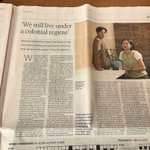
“Definitely no Cantonese allowed.”
Hong Kong writer Eva Wong explores Cantonese, colonial legacies, and linguistic identity. Her story “Overseas Bride”, translated by Jennifer Feeley, was selected for Best Literary Translations 2026 anthology.
tinyurl.com/2rr856c6

Henry Líu retweeted

You're gonna LOVE the upcoming issue, out November 30!
#SFinTranslation #SmallPlanet
It's free. It's fun. It's literally like NO OTHER magazine. Tell your friends.
sfintranslation.com/?page_id…


Henry Líu retweeted
I'M STILL HERE: "“I must express my gratitude to the Brazilian military: thank you for not having killed my mother.” If that leaves you with an uneasy feeling in the pit of your stomach, it isn’t the only section of this memoir that will have that effect."
wordswithoutborders.org/read…

Henry Líu retweeted

📢 Call for Papers
📍 Université de Montpellier Paul-Valéry, France
📅 3–5 June 2027
🎤 Keynotes: Christian Berner & Anthony Pym
📌 Abstract deadline: 30 November 2026
📄 300–350 words | English or French
🔗 buff.ly/vbNt5cN
Henry Líu retweeted
As her mother’s body decomposes in the sea, the story of Águeda and rural Mexico unfolds—one riven by soldiers and the suppression of Indigenous life.
Clyo Mendoza’s Silencio is a masterful assemblage of poetry, lyrical prose, and journalistic fragments.
tinyurl.com/mwu9wyzw

Henry Líu retweeted

‘epistemic literacy - how to distinguish information from knowledge - is the single most important skill we should be teaching’

This is honestly shocking.
Three months ago, Hong Wang was awarded the Fields Medal for resolving the Kakeya conjecture in three dimensions.
Today, OpenAI released a proposed proof of the conjecture in ALL dimensions.
And that’s not all. It also announced a proposed existence proof for quantum chromodynamics and a proposed refutation of the Exponential Time Hypothesis.
Experts say that, if confirmed, these would be Nobel prize and Turing award level discoveries respectively.
A journalist just asked me: “What remains for humans to do?”
I think it’s becoming increasingly clear that more and more problem solving will be automated.
But humans will remain crucial in determining the direction of discovery. Deciding which problems are worth solving.
Because the value of a discovery depends on our needs, our priorities and the kind of world we want to build.
There will be a shift from problem solving to problem setting.
I also think there will be huge individual differences.
People with strong critical thinking skills, creativity and imagination will be supercharged by AI.
People without those skills risk surrendering to it.
I’m particularly concerned for children, who may never develop these skills.
I think epistemic literacy - how to distinguish information from knowledge - is the single most important skill we should be teaching.

Henry Líu retweeted
🇻🇨 @MichaelRosenYes talked to linguist @theteddymack about Vincentian #Creole (aka 'Vincy'), a creole #language spoken on the Caribbean island of St Vincent
bbc.co.uk/programmes/m002qth…
via @BBCRadio4

Henry Líu retweeted
How do you bear witness to lives under attack? In Your Presence Is a Danger to Your Life, Samar Yazbek gathers testimonies from civilians fleeing Gaza. She and translator Leri Price discuss the responsibility of carrying these stories across languages.
tinyurl.com/mwc5dapp

Henry Líu retweeted

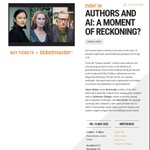
Join us for a conversation about Three Stories of Forgetting alongside Portuguese author Djaimilia Pereira de Almeida and translator Alison Entrekin at our 25th online event in November. Register here: pintbookclub.com/event-detai…

Henry Líu retweeted
New Book: Translation and soft power
By: Tatsiana Haiden (ed.)
buff.ly/TvWgKH0

Henry Líu retweeted
🤖 What happens to #language when machines start talking back?
theconversation.com/what-hap…
via @ConversationEDU

Henry Líu retweeted

Google is using its search monopoly to coerce schools into adopting AI. This highlights the danger of allowing an unregulated monopolist to control an essential service.
Multiple courts have found Google liable for violating antitrust laws, and this latest move shows it remains unchastened.
As the public increasingly pushes back against the use of AI in schools, Google is making clear it will punish those who don’t fall in line.

Breaking: Google will turn off web search for schools that opt out of A.I. for kids.
nytimes.com/2026/11/03/us/go…

Henry Líu retweeted
In Ideocracy, Miguel de Unamuno challenges the rule of rigid doctrines, arguing that ideas should be broken like boots—“by breaking them in and using them.”
Read William Hepner’s translation of this bracing essay on compassion and intellectual freedom.
tinyurl.com/yv8ntv9t
