

Veni, Vedi, Velcro - I came, I saw, I stuck around. Ex-academic historian. Ex-policy advisor/speech writer. Ex-hausted father. Marginalia on history & culture.
🇫🇷 🇬🇧🇦🇪
Joined February 2023
- Tweets10.1K
- Following1.7K
- Followers2K
- Likes13.5K







The great Shakespearean actor Sir John Gielgud once summed up Richard Burton's baritone voice in a single, luminous way: "the voice which would sing like a violin and with a bass that could shake the floor." The image is exact.
Burton's voice was a richly resonant baritone with a natural Welsh lilt that Burton refined through rigorous training (projecting Shakespeare across valleys as a youth) yet never fully erased. It gave it an authentic, coal-dusted timbre that evoked the valleys of his upbringing.
This duality made it electrifying on stage in Shakespearean roles like Hamlet, Henry V, and Coriolanus, where its range conveyed everything from introspective melancholy to commanding fury. On screen, where its measured, weary cadence - often laced with cigarettes, whisky, and world-weariness -added mythic weight to characters in films like The Robe, Becket, Who's Afraid of Virginia Woolf?, Where Eagles Dare.
In an era of increasingly naturalistic acting, Burton's voice stood out as a throwback to grand theatrical tradition while feeling viscerally modern and personal -making him one of the last true vocal giants of the screen.
ithaca rising 🇫🇷 🇬🇧 retweeted

Theodore Dalrymple on Islam and the riots, the best commentary I have read thereon. What lies ahead for any Western country whose citizens are ignorant of Western history and its civilization. @ufhamilton @UNCSCILL @CivitasInst @UTCivics @osuchasecenter @MadisonProgram @WashingtonWVU lawliberty.org/mere-anarchy/…

For Guns of Navarone, they built the entire interior of the gun emplacement as a large set at Shepperton Studios.
The full interior (including the massive guns and working elevator) was constructed in the studio, with the huge cave entrance built outdoors on the Shepperton backlot because it was too large for a soundstage.
The Telegraph described the guns set as one of the biggest ever built for a British film at the time - a three-storey structure. The exteriors were filmed on Rhodes, Greece.
telegraph.co.uk/films/0/guns…


ithaca rising 🇫🇷 🇬🇧 retweeted

French universities are the least selective of the OECD... and unsurprisingly has one of the highest fail rate because students aren't good enough
Some students complain that they don't know why they were admitted or not. And they're not wrong but that's because for most schools, admission is in parts a lottery. There aren't enough spots for everyone.
Rather than select for merit (or for $$$... Universities in France are basically free for nationals and most non-nationals) we select through luck.
And then the real selection happens a few years later when the "lucky" students realise they weren't up for it. In the meantime that has a massive cost for public finances
So what is logical political conclusion of all this?
Blaming parcoursup, the French equivalent of CommonApp or UCAS...
Sure the app has some issues, but it's essentially a dating app between schools and students. It's at best the tip of the icerberg. When a wise man points to the moon, the idiot looks at his finger.
Politically however it's quite savvy by the govt to lean into the app backlash. Let students rage against the machine, changing the app won't cost as much in € as the big structural changes
And it won't cost as much in political capital than announcing we are ending the hypocrisy of a "non-selective" system that punishes the best students and let's weaker students crash.


When new French Marine Commandos receive their green berets, the tradition isn't purely French. It was shaped in Scotland in 1942, when Philippe Kieffer's Free French volunteers trained at the British Commando centre at Achnacarry and were folded into the Inter-Allied Commando structure.
From that period they took both the green beret itself and the distinctive "à l’anglaise" way of wearing it - tilted to the right, badge over the left eye - a small but deliberate reminder of the British instructors and methods that formed the unit.
Léon Gautier, the last of the 177 men of Commando Kieffer who landed on Sword Beach, was a regular presence at these ceremonies in Ouistreham until his death in 2023, sometimes placing the beret himself. Watching the clip, you see the same setting and the same unbroken line: men who completed the hard selection their predecessors endured under British training, now marching through the town that still marks the start of the liberation. The style of the beret and the place itself keep that 1942 origin visible without needing much explanation.
For all the centuries of Anglo-French rivalry - the endless mockery, the old jokes about the "sweetest enemy," the habit of needling each other at every opportunity - there has always been a quieter understanding between their soldiers. When the stakes are real, the banter drops away. The men who trained together at Achnacarry, landed side by side on Sword Beach, and still wear the same green beret in the same way know how to recognise genuine courage when they see it, regardless of the flag on the shoulder.

Cérémonie de remise des bérets verts.
Le béret vert porté aujourd'hui par les commandos marine est directement hérité des traditions des commandos britanniques auprès desquels furent formés les hommes de Philippe Kieffer durant la Seconde Guerre mondiale.
Les commandos marine portent leur béret « à l'anglaise », incliné vers la droite avec l'insigne placé à gauche.
ithaca rising 🇫🇷 🇬🇧 retweeted

Good article on Napoleon’s work ethic - many thanks to Brad Corbin for sending this to me - “Napoleon would dictate letter after letter to his secretaries, often on a variety of subjects, without needing to stop for a moment and think. To show this, during the first three months of 1807, Napoleon sent 1,715 letters, an average of 19 letters per day.” medium.com/@Chaosers/what-ma…

ithaca rising 🇫🇷 🇬🇧 retweeted

It will never fail to surprise that the ancient Etruscan names for their major deity, the counterpart of Roman Jupiter, were….
Crap and Tin.

Clarke is right about the risk, but J.R.R. Tolkien shows the practical way out of it. Fairy stories work less by inventing wonder than by clearing the grime off ordinary things: once you've met the centaur and the dragon, the actual sheep, the trees, the hillside stop looking like inventory and start looking like themselves again.
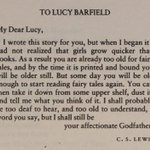
C.S. Lewis was more direct about the obstacle. When he dedicated The Lion, the Witch and the Wardrobe to his goddaughter Lucy Barfield, he wrote that she was already growing up and might soon be too old for it -though he hoped she would one day be old enough to enjoy it again. The adult who still feels slightly silly reading the books he loved at ten has only traded one kind of immaturity for another; that quiet embarrassment is what keeps the landscape flattened into material we can use or leave. Stay with the stories and the places keep something of their own presence.


“There is a danger associated with growing up, of putting aside children’s books. We must be careful lest all we are left with is a world that is very much not alive, a natural world that is mere piles of stuff – stuff that people can use or not use, preserve or destroy, just as they want.” Susanna Clarke, In Defence of Fantasy Fiction

« J'ai l'amour de la raison, je n’en ai pas le fanatisme […] quand vous en aurez fait une divinité, elle vous aveuglera et vous persuadera des crimes. »
- Anatole France, The Gods Are Thirsty (1912)
"I love reason, but I do not have its fanaticism […] when you make it a divinity, it will blind you and persuade you to commit crimes."
In The Gods Are Thirsty, Anatole France holds up the French Revolution's Reign of Terror as a cold mirror. Évariste Gamelin starts as an idealistic young painter who wants a better world. He ends up as a revolutionary judge sending people to the guillotine for not being pure enough. France shows how fast a hunger for justice can turn into a hunger for blood, and how the finest slogans can give ordinary people permission to do terrible things.
The book isn't just about 1794. France had seen mob logic up close during the Dreyfus Affair. He knew that dogmatic certainty - even when it wears the clothes of reason or virtue - has a way of eating everything around it. Every age makes its own gods. And those gods are always thirsty.
They're thirsty again in France. What started in September as student protests in the banlieues over teacher shortages, overcrowded classrooms, broken buildings, and the mess of Parcoursup has grown into big nationwide marches about the cost of living, inequality, and crumbling public services. Plenty of the grievances are real. But the pattern Anatole France described is hard to miss. The same language of justice and equality that draws people into the streets keeps getting used to justify the ugliest stuff. Hooded far left militants and thuggish opportunists peel off from the main crowds and treat destruction itself as proof they're on the right side. Moderation starts looking like betrayal. Violence becomes the sincerity test.
France never pretended the Revolution didn't begin with genuine complaints, or that liberty, equality, and fraternity were empty words. He just showed what happens when those ideas get turned into absolute gods that demand total purity. Once that happens, they stop lighting the way and start consuming the society they're supposed to save.
Anatole France, the Dreyfusard who loved reason without worshipping it, would have recognised the scene. The warning isn't that protest is wrong. It's that the moment an ideal becomes absolute, it stops clarifying anything and starts feeding.


« Pablo un des rares qui a du savoir-rire. »
- Jacques Prévert on Picasso
"Pablo, one of the rare ones who knows how to laugh."
Jacques Prévert and Pablo Picasso became close friends in the years after the war, mostly around Saint-Paul-de-Vence, Antibes, and Cannes. Biographers of Prévert. Biographers like Yves Courrière and Carole Aurouet describe an easy, companionable bond built on shared humour and mutual respect, centred on the circle at La Colombe d’Or.
They worked together on several projects. Prévert provided the story for the ballet Le Rendez-vous, for which Picasso painted the curtain. Prévert also wrote the text for the 1959 book Portraits de Picasso (photographs by André Villers) and contributed to Diurnes in 1962; and he included the playful poem "Promenade de Picasso" in Paroles. Picasso, in turn, dedicated books and drawings to him as "mon ami" or "mon cher ami" and painted a small scene of the Prévert family bathing that he inscribed "pour mon ami Jacques Prévert."


Great that your daughters loved it! The film is only a small slice of a much larger world. I'm hoping to ease my kids into the Patrick O'Brian books at the right time.
The surest way to get kids interested is reverse psychology: put the book you want them to read on the highest shelf and sternly forbid it as “adults only.” Curiosity does the rest.
Start at the beginning with Master and Commander (1969) and read in publication order - which is also the chronological order. There are 20 finished novels plus one unfinished; they form one long story of Jack "Lucky Jack" Aubrey and Stephen Maturin in the Royal Navy during the Napoleonic Wars.
The movie mainly draws from the 10th book (The Far Side of the World), mixed with bits from earlier ones, and changes the historical setting. Jumping straight to it means missing how the friendship and characters develop. Better to go in order - if the first one hooks you, you'll keep going.
Enjoy!


Yo también se las puse a mis hijas (8 y 11 años); quedaron fascinadas. A todo le sacaron una analogía actual de nuestra vida.
La película es una joya en cada pequeño detalle.
Soy todavía muy ignorante al respecto de la historia; ¿qué libros debería leer para saber más sobre las aventuras del «Suertudo Jack»?
ithaca rising 🇫🇷 🇬🇧 retweeted


In praise of Master and Commander
✍️ Madeline Grant
spectator.com/article/in-pra…

Cash pensions were only one part of the system that met men like the 4e Ligne's wounded in 1809. The Hôtel des Invalides, reorganised and better funded under Napoleon, offered lodging, food and medical care, yet its capacity remained tightly restricted - typically a few thousand residents at any time - and admission required strict proof of severe disability, long service, or the absence of family support. Most pensioners were therefore expected to live outside the institution. Isser Woloch's The French Veteran from the Revolution to the Restoration (1979) shows how successive regimes expanded the pension rolls while still struggling to meet demand, and how Napoleon’s brief experiment with "veteran camps" (land grants in annexed territories under quasi-military discipline) largely collapsed because the settlers resisted the regimentation.
Even with a partial pension, civilian reintegration was uneven. Natalie Petiteau's Lendemains d'Empire (2003) draws on village studies, pension files and police records to reveal a spectrum of outcomes. Some rebuilt modest lives through family networks, marriage or small-scale work, while others experienced lasting poverty or social marginality, especially when wounds limited mobility and their only training had been military. Under Napoleon the state encouraged disabled soldiers to marry by offering dowries, but only a fraction of the intended unions took place.
After 1814–15 the Restoration honoured many existing pensions yet viewed large numbers of Napoleonic veterans with suspicion, adding political friction to already difficult economic circumstances. Some later received the Médaille de Sainte-Hélène (1857), but that was symbolic recognition decades later. The persistent gap between official rhetoric of reward and the lived reality faced by hundreds of thousands of returning men was all too real.
The same pattern recurs in our own time. Public ceremonies and memorials still rightly honour the service of those who fight, yet the quieter, longer work of supporting the men and women who come home physically or psychologically marked by war remains incomplete, under-resourced, and too often left to families, charities, or the veterans themselves.


In some alternate cinematic universe the sequels already exist. The multiverse really did us dirty on this one.


ithaca rising 🇫🇷 🇬🇧 retweeted

When the Revolution Turned on the Far Left
"Jean-Luc Mélenchon, so fond of invoking the great revolutionary moments, would do well to remember how the Thermidorians crushed the far left in the name of republican order."
lepoint.fr/histoire/samedis-…

Given that this was Trafalgar Week, I finally showed Master and Commander to my preteen kids - still sugared up from watching the MCU's Infinity Saga these past months. I almost wept as they sat there mesmerised, watching Captain Jack Aubrey, his good friend Dr Stephen Maturin, and the gallant HMS Surprise take on the Frenchies. They loved it so much they begged to watch the sequel. Alas, not.
We were promised a whole ocean of sequels drawn from Patrick O’Brian's twenty-book treasury, yet we were left with only this one magnificent voyage.
The disappointment cuts deep in its sadness. The picture came out just after everyone had stuffed themselves on Pirates of the Caribbean's rum-soaked capers. And although it was critically adored and pulled in respectable money worldwide, it didn't quite deliver the obscene domestic blockbuster numbers the studios now insist on before they'll green-light another expensive wooden ship full of extras getting wet and cold for months on end.
So the Surprise sits at anchor in our heads, her powder magazines untouched, while we quietly grieve the French frigates we never chased, the dinners in the great cabin we never attended. We wonder how the Hollywood bean-counters - who never once smelled salt spray or heard a broadside - managed to convince themselves this particular adventure wasn't worth continuing.
Alas, Master and Commander is one of those quiet sorrows that all film buffs will continue to carry like an old wound from a duel they never quite fought.
I think we ought to read only the kind of books that wound and stab us. If the book we're reading doesn't wake us up with a blow on the head, what are we reading it for?… We need the books that affect us like a disaster… A book must be the axe for the frozen sea inside us.
- Franz Kafka, letter to Oskar Pollak, 27 Jan 1904.
The opposite of "reading should be fun and soothing".

ithaca rising 🇫🇷 🇬🇧 retweeted
Solutions not considered by the author of this dog-bites-man opinion piece. Forget about downsizing and reforming existing departments, which are dying on the vine anyway. The biggest mistake reformers could make would be to allow existing humanities departments to replace themselves.
We need to do a complete reset [aka Renaissance] of the humanities outside union-controlled public high schools and 'progressive' colleges and universities. Fund university-level humanistic study only at civics institutes at public universities, with broad (not micromanaging) state oversight. These would be intended to train future leaders on the Ciceronian / Churchillian model. Also fund sound private institutions like @RalstonCollege and @UATX that care about the traditional humanities. Topline research in the humanities needs to be re-established in private institutes, accountable to the vision of founders via board oversight. This is the direction traditional reformers are going in already but there needs ot be a clear strategy.. @firstthingsmag @RalstonCollege @ufhamilton @UNCSCILL @CivitasInst @UTCivics @LawLiberty @BradleyFdn spectator.com/article/anybod…
