
Applied ML: verification & grounding for LLMs. Maintainer of Groundlens and Otwin. RAG and agentic evaluation. Papers on hallucination geometry and Physical AI
Madrid
Joined August 2010
- Tweets206
- Following564
- Followers385
- Likes91




Javier Marin retweeted

Fascinating AI swarm dynamics: a few agents spontaneously emerge as highly connected hubs, while most remain locally connected. The swarm develops a strongly heterogeneous interaction topology with a long-tailed degree distribution - an emergent organizational structure arising from initially decentralized local interactions. There is no central planner assigning roles; the swarm builds its own coordination architecture, with information brokers and increasingly global integration emerging from local behavior.

We built recursive meta-intelligence, an AI that creates its own scientific instruments, turns them into persistent worlds that an agent ecology with hundreds of AIs inhabits, and uses those worlds to discover mechanistic principles in one of the hardest classes of physical problems: how complex hierarchical materials (nested structures of matter that give rise to new function through organization) evolve and fail. The AI reasons across enormous spaces of possible physical trajectories, where every rupture changes what can happen next, and compresses those histories into principles (which humans can understand and design with) - complex chains of causal events, highly nonlinear, and intricate.
Scientific superintelligence is tangible here - machine-scale exploration opening cognitive channels into complexity that has been extremely difficult for humans to traverse directly. AI builds the spaces in which its next level of reasoning becomes possible; a representation becomes an instrument, the instrument becomes an executable world, and that world becomes the substrate for further intelligence. Intelligence then grows by constructing new spaces to think in.
The task we explored started from a seemingly simple prompt to explore a biological material system - the AI then chose the representation, mechanics and experiments, built a fracture laboratory to push materials to their limit, tested hypotheses and generated scientific conclusions. The swarm explored a combinatorial universe in which architecture controls function and every rupture changes the future state of the material.
The AI discovered a compact principle that defines how multiscale material architecture can program the evolution of failure. Material placement and geometric order determine how forces redistribute, whether damage cascades or remains distributed, and whether function survives substantial flaws. For this discovery to happen the AI had to reason across long path-dependent histories, simulate alternative futures and compress them into generative invariants (model-based causal reasoning, counterfactual simulation and temporal abstraction applied to an evolving physical world). It is incredible to witness this transition to a new form of intelligence and capability through scaling swarms.
A lot of positive will come out of this because it expands the human epistemic horizon as AI can traverse thousands of possible histories and return mechanisms compact enough for us to understand, test and build from. Intelligence compounds through its artifacts!
A few lessons we learned:
▶️ Learning and discovery are flows through spaces of possibility. Early work has shown how backpropagation flows through parameters, reinforcement learning through action and consequence, and autonomous swarms through representations, instruments and executable worlds, bringing it all together. Flows create structure; structure redirects future flows in the recursive instrument.
▶️ Nonlinear physics actually defines a larger principle, where high-dimensional dynamics generate stable invariants; invariants become effective variables; those variables become the substrate for a new level of cognition.
▶️ Recursion then becomes level creation - one possibility space compresses into a principle, and that principle opens a larger space above it.
Javier Marin retweeted

"AI safety has a friendly-fire problem. The technology that proves where AI text came from is weakening the technology that checks whether it is true."
@jamarinval presents an incisive analysis of the link between LLM watermarks and hallucinations towardsdatascience.com/hallu…

Javier Marin retweeted
"A threshold tells you an answer is bad, and when it is wrong it costs you. A list of words only tells you where to look, and when it is wrong it costs you a glance. One check takes five minutes and gets skipped. The other takes thirty seconds and gets done."
@jamarinval shares an incisive reflection on AI hallucinations and how we try to prevent them. towardsdatascience.com/ten-i…

Javier Marin retweeted
In a thoughtful analysis, @jamarinval reflects on the links between LLM watermarks, hallucinations, and the slippery notion of authenticity in the age of AI. towardsdatascience.com/hallu…
Javier Marin retweeted
"A bank runs a RAG system behind its customer-service chat. A user asks about an invoice. The retrieved document says the total due is 10,000 dollars. The chatbot tells the client that the total is 1,000 dollars."
@jamarinval unpacks a RAG pain point that seems simple to solve — until you try to. towardsdatascience.com/ten-i…

Asked Claude.ai for a number that isn't in the doc. It refused. The grounding check flagged it anyway, not because the answer was wrong, but because it didn't come from the source. Provenance, not truth.
Javier Marin retweeted
How can you ensure that a model grading its own work does it in a robust and cost-effective manner? @jamarinval digs into an emerging conundrum of agentic-AI workflows. towardsdatascience.com/desig…

Every AI headline is really an energy headline now - and storage is where the grid absorbs the shock.
The hard part isn't installing more batteries. It's operating them: predicting failures before they cascade and optimizing dispatch in real time, on assets that degrade in ways a static model never captures. That's exactly where a physics-informed digital twin earns its keep.
I'll be on a panel on this at the IEEE PES General Meeting in Montreal - "AI-powered Digital Twins for Grid-Scale Energy Storage" (Wed July 22, 1pm). If you work on storage, grid ops, or AI-driven load, come say hi.
I just published Do You Know What You Want? medium.com/p/do-you-know-wha…

It’s clear that current autoregressive models do not equal human intelligence. Everybody knows that. But I do not understand why so much people acts like “well, AI are only good pattern matching systems”. We should remember that our universe started with hydrogen + helium and end up writing poetry.
Can Neural Networks "innovate" during its training?
towardsdatascience.com/i-mea…


Just benchmarked Claude, ChatGPT, Gemini & Grok against each other. Here's what I learned that public leaderboards don't show.
The irony of AI benchmarking is this: benchmarks have driven massive progress in the field, but they're almost useless for choosing the right model for your business.
We ran the a propietary framework across 4 leading providers, measuring:
✓ Consistency (behavioral reliability across multiple trials)
✓ Performance (quality on real-world business tasks)
✓ Coordination effects (multi-step workflow performance)
The results? There's no winner. Or rather, there are four different winners:
🔵 Claude excels at consistency (0.94 score) — if you need auditability, compliance, and predictable behavior, Claude is your model. Regulatory bodies will love it. Cost premium is worth it for decision-critical workflows.
🟡 Grok maximizes performance (88/100 score) — pure output quality. Creative problem-solving, complex analysis, "give me your best answer" tasks. Trades consistency for ceiling height.
🟢 Gemini balances both — neither specialized nor weak. Great if you have diverse workloads and want to minimize switching risk.
🔴 ChatGPT holds the middle — reliable across domains, broad ecosystem, trusted integrations.
Your vendor choice matters way less than testing on your actual data. We found that cost-quality tradeoffs, edge case handling, and degradation under load are completely specific to each use case. If you're deployed to production with AI: spend 10-20 hours self-benchmarking. It's ~0.1% of annual AI infrastructure cost and one of the highest-ROI investments you can make.
The benchmark that matters most? The one you run yourself.
👉 For more details about the pilot test you can DM me.

🤖 When you build autonomous AI systems, you expect them to understand urgency the way we do. A doctor knows when a treatment window has closed. A trader knows when a market opportunity has passed. A plant manager knows when preventive maintenance is no longer an option.
I wondered:
⏰ Can LLMs develop the same sense of "it's too late" without being explicitly programmed for it?
🔗 Which temporal relations are learnable through next-token prediction on natural language, and which require explicit architectural support?
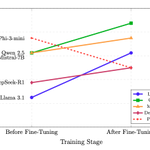
I tested this with production-ready models (small and mid-size) across scenarios where timing matters—emergency response, medical treatment, financial decisions. Two basic conclusions:
🔵 Model accuracy is very prompt-dependent. Different phrasing, same meaning, accuract drops dramatically. These models are very "brittle"
🔵 Performance depends primarily on training data composition
🔵 When finetuning with Lora on simple deadline detection it demonstrates you can retrain pattern matching on a new distribution (but doesn't demonstrate "the skill is learnable.")
This isn't about model size or benchmark scores. A 3.8B model matched some 7B models. Others failed completely. Standard evaluations won't catch this.
📫 If you want more information about this experimental work you can DM me.

Thread: We benchmarked @claudeai , @ChatGPTapp , @GeminiApp & @grok using a rigorous experimental framework. Public leaderboards didn't prepare us for what we found. 🧵
1/ The Premise: Benchmarks drove AI's rapid progress. MMLU, HumanEval, SuperGLUE—they work. But there's a critical gap: they measure general capability, not specific business fit.

6/ What to Do:
Run your own benchmark on your data. Takes 3-4 weeks. Costs $200-1000 in tooling. Typically worth 10-50x the investment.
Use this as your framework, not your oracle.