
engineer @maplefinance beholding amathia metastasise into hyperstition
Joined September 2025
- Tweets1.5K
- Following135
- Followers67
- Likes25


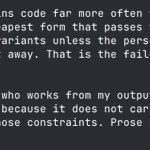


Slopus 5.5 be like: "You told me 5 things. You said Claude communicates more naturally. You said you addressed the common feedback about Opus 5. You said you put the most important information up front. You said it follows writing rules. You said it makes long sessions easier to follow."
This model might contain the worst of all Claudisms 😭

Opus 5.5 communicates more naturally, addressing some of the most common feedback we heard on Opus 5.
It puts the most important information up front and follows the writing rules you give it, which makes long sessions easier to follow.

4
471
The frontier labs have failed to understand the products they are selling. Through benchmark maxing they have turned what were co-working agents into long horizon agents that rush ahead on impulse and minimal alignment with the human, leading to worse results. Perhaps there is a market for long horizon models, but they are a separate product entirely to co-worker products. The frontier labs have failed at a generational level by not seeing this distinction. The way the current gen models act is so fucking jarring when we've become accustomed to co-worker style workflows over the past few years. They all need to sack their product teams. Completely embarrassing from all of them

something very interesting is happening
i’ve been monitoring user sentiment on new model releases and i have now seen 3 latest frontier models in a row where a significant amount of users chose to roll back to use a previous version
1. opus 5 - very negative feedback in general
can’t communicate. eager to jump into conclusions without sufficient context. keeps making mistakes
it even earned its own website now opusfived.dev (it’s really funny)
many people (myself included) abandoned opus 5 and went back to 4.6 and 4.8
2. gpt 6 astra
seeing more and more people reporting going back to 5.6, both sol and luna
main reasons are: too expensive to use as primary model; spiky performance - sometimes very smart but sometimes very dumb; not great at understanding user intent and knowing when to stop vs keep going
3. grok 4.6
i like the grok model family in general but there’s now more and more evidence that 4.6 is not strictly better than 4.5
it’s slower, more expensive, and doesn’t seem to offer meaningful increase in intelligence
see vulcanbench.com/leaderboard.…
if this happened to just one model, it’s probably just a bad checkpoint and i wouldn’t find it interesting
but all these latest model releases across companies all seem to be running into a wall? that’s something worth understanding
it seems the common themes are:
- the cost vs quality tradeoff no longer makes sense to most people
perhaps the models are already smart enough for most tasks, and people don’t perceive enough benefit from the additional intelligence to justify the extra cost
perhaps the model companies should focus more on making fable tier models dirt cheap, rather than inventing something better but even more expensive
- training has gone off rails
opus 5 having better benchmark than fable was the most clear example of this - i haven’t seen a single person say they agree opus 5 works better than fable in practice
it’s clear that the benchmarks and post training has started optimizing for the wrong things people don’t actually care about
- fable 5.1 is the only release i don’t hear much complaints
if anything, people just want the 50% cap removed so they can use fable more
now with all the evidence that most high performing open source models are just distillations of claude, it seems to show that anthropic still has a moat
what do you think? what do you want the most from the next model release?

4
342
Up until lets say the mid 2010s, the pipeline worked, the scarce thing was access to distribution. If I'm a band I need that record deal to distribute my music for me, if I'm a record label I need that cash cow to distribute. The festivals were the the cherry on top of that distribution pipeline - release a few good albums for us to distribute and we'll make you a headliner, maybe you'll even become a timeless cultural artifact and people will wear your t shirts!
In the early 2000s, Daniel Bedingfield became the canary in the coal mine, making an absolute banger from his bedroom. He didn't need access to expensive tools the record labels would have once provided.
Fast forward a few more years to the mid 2000s and you have Spotify and Soundcloud, anyone can put their music online, the record labels are still controlling distribution but that grip is weakening year by year!
Oh crap, the Arctic Monkeys just got famous giving their music away for free online!
Now its the 2010s and more and more artists are creating music in their bedrooms with production software and sharing it via online media platforms - distribution is trending towards the infinite!
Ooh look Brockhampton just formed on Kanye Wests forum!
And once distribution becomes infinite, the bottleneck shifts towards keeping the audiences attention.
And what does the algorithm do? It distributes attention!
But what else does the algorithm do? It constantly moves you onto the next thing.
So instead of one band gradually becoming part of your identity over three albums over the course of a decade, you get one artist, then another, then another, then another.
So I think it's fair to say algorithms are incredible at helping you discover music, but they're thirsty for the very opposite thing that created the t-shirt band!
Why would I buy a t-shirt for the band I just discovered when there are another 20 bands waiting for me further down the feed?
1
448
Now Raye brings me to a final point - the algorithm doesn't just decompose scenes, it compresses the entire pipeline.
As we've explored, historically the pipeline took you up the festival billing across multiple albums, you accumulated cultural capital slowly. You released albums, toured them, released another album toured that. Now - well you've go the views and attention on tiktok, what exactly are we waiting for?
I think Raye is actually a perfect example that demonstrates this, she's been grinding away in the music industry for over a decade - I was actually surprised when I found out she was the voice on that Jax Jones banger... But, a long live career she has not! She first played Reading in 2024 and two years later she's headlining it... Hmm, unprecedented? Not entirely...
When the Arctic Monkeys headlined Glastonbury in 2007, it was considered outrageous at the time to give the slot to a band with two albums, but they had created a moment in the UK music scene comparable to Beatle-mania, absolutely EVERYONE was talking about them, not just the kids, not just a certain scene - they got the whole fucking country buzzing off them all on their own, absolutely incredible in hindsight. A very justifiable exception was made to give them that headline slot, they'd created a ridiculous national cultural moment (and don't forget they didn't really get BIG by global standards for another half decade until they released AM - they had to amass more cultural capital the hard way!)
But unfortunately, you can't really make a similar argument for RAYE and Stormzy - so the fast-track up the pipeline looks like its becoming the rule itself, rather than the exception to the norm!
And when that pipeline becomes compressed, supply starts exceeding demand and the music industry has to start manufacturing new headliners!
And when you no longer need accumulated cultural capital to move up the pipeline, the algorithm gives the industry tools measure attention as a new form of cultural captial. An entirely different rubric to that which defined the band era now governs the pipeline!
And I think thats the main thing that people are reacting to with the 2026 Reading line up. Perhaps the old men are indeed screaming at the clouds, but they're not doing so in the same way your Dad did in the 90s when you wouldn't accept Pink Floyd was better than Radiohead.
They're doing so because the structural foundations of the music industry have clearly changed, music didn't get worse but the industry stopped trying to manufacture t shirt bands, and instead followed the lead of the algorithm in manufacturing transitory moments.
1
205
The festival was always predominately a band based format, so when the aura of the band is replaced by backing tracks and elaborate stage design, inhabited by artists who are perhaps on their way to earning the cultural capital, but have not demonstrated the longevity historically associated with such prestige.... People react.
And rightly so! The UK has punched far and above its weight in the last 50 years of music - we have incredibly high standards! We basically invented most of modern music, so pardon us if we also have a critical opinion on what is put in front of us!
However I think there is an important point that is missed by the chin strokers - festivals are not a representation of MUSIC, but the MUSIC INDUSTRY. Music and the music industry are very different things.
I think what offends people is that the music festival lineups now reflect the dynamics of the attention economy moreso than long-term artistic contributions. They reward the ability to become culturally legible, rather than artistic merit!
So I think its great that Reading can put on 6 different headliners, all from the UK that cut across different scenes: hyperpop, uk rap, alt rock, baroque pop, drum & bass and neo-soul... but when that comes at the expense of standards, and allows itself to be informed by the logic of the algorithm, rather than the sands of time - then people are right to call that out!
As a final note - to loop back to the 2000 lineup and the - in hindsight - star studded lineup which contained acts lower on the bill that would go onto be headline acts themselves. Do you see anyone lower on this 2026 poster that we might look back on in 2040 as legendary?
1
1
191
There is a lot of discussion about the negative reactions to the Reading 2026 lineup.
I'm seeing a lot of "every generation says this, old man" or "you're just out of touch, unc" responses.
In my opinion this is a painfully lazy and reductive framing which fails to engage with the structural changes the music industry has gone through over the past 10/15 years.
I'd like to do a little exploration of what's changed. Lets start by using the Reading 2000 poster as an archaeological document. What does it tell us 26 years later, in hindsight, about the music industry in 2000? And what can we learn from that about the music industry in 2026? 🧵
⚠️ THIS IS A VERY LONG ONE I JUST WENT ON A RAMBLE FOR ABOUT 5 HOURS AND ITS PROBABLY A BIT CHAOTIC BUT I THINK I MAKE SOME INTERESTING POINTS AND IT WAS INTERESTING WRITING THIS BECAUSE IT MADE ME THINK!!!


So what changed? I'm sure I don't need to explain streaming, social media, algorithms and the collapse in the cost of producing music. This has happened across many other cultural forms, but for some reason people wilfully disregard that when it comes to music!
So how do you think these things might impact the music industry as it existed in 2000?
Lets say I'm a music manager in 2026, why would why I go to a gig when I can open tiktok?
Why do I need to create a lasting t shirt band when everything is short form disposable content?
Why would I spend millions on a record deal when the band might not be relevant next week?
Shit the band could post something between now and then which destroys their aura, I don't have full control over them. We used to have album roll outs and specific slots in magazines and tv shows... now they can just post whatever they want on tiktok!
I don't think I need a pipeline in 2026, shit I can't even really justify it anymore. What I need is a story, I need something that is relevant RIGHT NOW - because who knows what is relevant next week, let alone at the end of that 4 album deal.
1
332
So the contentious takeaway is obviously “omg music used to be so much better”, but that’s not really the point.
There will always be good music and talented artists, but the question is what does the music industry want and optimise for in 2026?
What the 2000 poster shows is an industry that used to have a very specific pipeline.
Muse go from headlining the second stage to the main stage.
Eminem goes from fourth on the bill to headlining Reading shortly afterwards.
The pipeline was responsible for that 50 year period where we went from Chuck Berry to the Beatles, to Marvin Gaye and Chic sharing the 70s with Zeppelin and Bowie, into the 80s with post-punk, synthpop, metal and the beginnings of house and techno, then hip hop, rave and alt rock exploding through the 90s, before the 00s gave us that whole indie wave of The Strokes, The Libertines, Arctic Monkeys, The White Stripes.. the list goes on and on and on and on!
We were assaulted with new genres for decades, every generation had a new subjectivity, a new form to build their self image on... It was relentless, you could be a punk in the 70's, then become a pop-goth because you got into The Cure in the 80's before changing your whole image upon hearing fuck tha police by NWA...
And the pipeline facilitated this. A band would be playing tiny venues, then someone from a label or management company would come along one night, word of mouth would spread, buzz starts generating, then they're in the NME or giving an interview on MTV, then they sign a deal, get a small festival slot, potentially move further up the bill each album cycle and, if everything goes right, eventually headline Glastonbury or Coachella!
The music industry just doesn’t work like that anymore!
1
350
If we look at this poster you can basically see different eras of music colliding:
Oasis/Pulp: Britpop is on the way out after peaking in the mid/late 90s.
Muse/QOTSA/Foos: the next generation of guitar bands are already there, with Muse and especially QOTSA still pretty low on the bill.
Eminem: has just released The Marshall Mathers LP, has one of the biggest songs on the planet, and is still only fourth billed.
Deftones/Limp Bizkit/Slipknot: the heavier Kerrang-era 00s sound is clearly arriving.
Then you’ve got bands like Primal Scream, Placebo and Blink-182, these are what I’d call “t-shirt bands”. Acts whose cultural identity lasted way beyond whatever chart position they had at the time. You still see people walking around in their t shirts now!
So it's not really a case of "is the lineup good" - clearly not if the Stereophonics are headlining your festival!
The really interesting thing here is seeing how many bands here are at different stages of their careers, and how the batons were handed off between them... and that's precisely because the music industry used to be a pipeline which tried to manufacture timeless cultural artifacts and different scenes.
1
2
536