





Pinned Tweet
Many folks were suprised by how fast I decided to leave my PhD program at Harvard and join MegaETH two months ago. To be honest it was such an easy choice. Any systems researcher would do the same after reading @yilongl_megaeth's analysis of Etheruem performance and chatting with @yangl1996.
我觉得claude desktop的UI改进挺好的,看起来干净了很多,原来总给我一种泛黄陈旧感,让我觉得昨天开发的东西都很旧不想再碰。
我用claude就是因为opus 5.5,不用别的agent是因为怕被封号,就这么简单。
批评说去掉了品牌感,导致用户迁移到其它agent没有心理障碍,怕是根本没想明白大家为什么用claude
不过新设计宣发时候非要强调迭代得多快,挺抽象的。用户只想知道为什么更好了,你越说快用户越不放心。就算设计没有明确的benchmark数字,也是可以讲清楚方向的。
when can people understand they need to show evals launching a harness

Introducing Octopus OS, a reinvented agent harness.
Agents can edit their own harness in the middle of a task, on their own. Unlike Harness² and similar projects, self-improvement isn’t a separate stage bolted onto the agent. The whole architecture is just the environment they work in.
Over 8 months, chasing self-improvement that feels truly native, I dropped the usual agent loop entirely and designed a new architecture that works a lot like a real operating system, with a 45k-line Rust kernel holding it all together. The system state lives in JSON files: goals act as real environments where agents work, along with inputs, outputs, and custom triggers they respond to. Agents can edit all of it while they work inside.
It was also built as a product from day one, not a research demo. The full desktop app took 3 months, built on top of the Codex source.
The client already works, and you can use it today like any other agent, Codex included.
And it’s open source.
我看最近大家都在玩oppo 心力球,也买了一个。
但这东西居然要求买oppo手机,且数据是被oppo管理的。
下面是一份帮你自主管理心力球数据的sdk,你可以随意让agent写应用来帮你管理硬件。没有任何限制,不需要oppo手机,不需要下载应用。
github.com/kiyoakii/xinliqiu…

Has anyone noticed that Claude obviously reduced 5h session token limit? It's been burning so fast for the past few days


Been running deepswe with deepseek v4.1 flash for fun. Interestingly it recognizes deepswe question format and always tries to guess what hidden tests would be instead of programming as an expert. In its thinkings, keyword "hidden tests" just comes out of nowhere. RL I guess.
OpenAI's fraud.

根据我几天的实测,codex会在拥挤时自动把astra降级成5.6 luna,有的账号会直接全局默认降级,没有任何通知,且应该按照astra价格收费。
如果你也有一样的担忧,可以用我写的监控器,默认半小时监控一次。
github.com/kiyoakii/is-gpt-n…


根据我几天的实测,codex会在拥挤时自动把astra降级成5.6 luna,有的账号会直接全局默认降级,没有任何通知,且应该按照astra价格收费。
如果你也有一样的担忧,可以用我写的监控器,默认半小时监控一次。
github.com/kiyoakii/is-gpt-n…
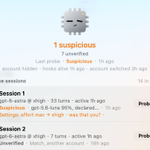
OK, enough. I'm tired of wondering whether GPT quietly got worse on me and just isn't saying so. To find out if it's my paranoia, I built is-gpt-nerfed: a nerf detector for Codex.
Nerfing can happen at three levels, and it checks all three:
- Account level: your whole account has been degraded. Every new session gets the worse model. Caught by probing a brand-new session.
- Session level: only some of your sessions are degraded. Caught by forking the session ephemerally and fingerprinting the answers, so nothing shows up in Codex.
- Request level: only some of your requests are degraded. A single turn quietly sent to a smaller model or a lower reasoning effort. Codex's own records give this away, so this check costs zero tokens. If those records lied, this would be the hardest level to catch. It's also the least likely: switching models mid-session throws away multiple layers of cache, which costs them more compute.
It also tells you when you've been quietly moved up to a canary model, like the 5.6 Sol → 6 Sol switch people have been reporting on X.
🤖 Made with AI

A friend ran it and found his gpt-6-astra sessions answered by 5.6 Luna. He'd never have known.
github.com/kiyoakii/is-gpt-n…
