

Building Baton @baton_market with @dylangans - the best place to buy or sell small businesses | former @Google, @Spotify, @Zillow #NYC
Manhattan, NY
Joined February 2008
- Tweets3.1K
- Following790
- Followers750
- Likes4.4K








Pinned Tweet
Today, I get to announce that Baton has raised a $10M Series A. 🎉
We’ve been heads down building the world’s best marketplace for SMB acquisitions for the last four years, and today is a testament to the progress we’ve made.
holy shit, watching the @Broncos gives me more gray hair than raising three teenagers.
But 4-2 after the running the gauntlet in the first 6 games of the season ain't bad!
A seller tells you 60–70% of revenue is "contracted."
The contracts are annual and don't auto-renew.
That's not contracted revenue. That's a list of customers who could leave in 12 months.
The contract is paper. Five years of the same customers renewing at the same margins is the evidence.
Ask for the renewal history, not the contracts.
I would have Broad Nosh a bit higher and Pop Up Bagel lower - maybe in the banned category... not really sure it's actually a real bagel place lol

Announcing Bagel-Bench: the definitive guide to NYC bagels.
Every Friday for the past 2 years, we’ve ordered bagels for the whole @ExtendHQ team. 1000s of bagels later, we’re publishing our findings:
S-tier: Apollo and Bagel & Schmear are SOTA, pushing the frontier on the taste × reliability Pareto curve. two of NYC’s leading applied bagel labs
A-tier: Brooklyn Bagel, NYC Bagel & Coffee House, and Murray’s are strong production-ready alternatives. The gap to the frontier is real, but we remain bullish.
B-tier: solid baselines, but we’d like to see more bagel R&D
C-tier: these shops have impressive distribution. We’d love to see that same investment in the core model
D-tier: significant work to do before we’d recommend consumption
like all benchmarks, this one is biased. unlike most benchmarks, we’re admitting it upfront.
what bagel should we eval next?

iMessage: 57 unread
Me: panics
Actually: 6 messages and 51 people hearting a photo of someone's dog
@Apple, please stop counting reactions as unread messages.
Really like this as the interface to agents (or heck my phone or computer)… but kind of feel like it doesn’t need the health stuff and can not be a subscription for that part!

Introducing Interface, the primary hardware for the agent era.
Interface lets you control all your agents from your hand.
$99 for early adopters. Ships in January.
This resonates so much. Especially in finance (or law) and other knowledge work, I think this will be way more important. LLMs did well in coding first since the unit test is the trust, but in finance / law you want the implicit trust that a person with experience and knowledge reviewed the work product. Or covers on the ~5-10% of edge cases.
That is what I love about Crosby the law firm, it’s lawyers behind the agent, but I know that every review has been, well, reviewed by a lawyer. Same goes for M&A, or a financial model, that someone reviewed and vetted.
pivotal.substack.com/p/trust…
Yesterday we got a one star and two star review on TrustPilot. They were complaining that the leads were bad, the service had degraded, and a promised pizza party never happened.
1) we don't sell leads, and 2) (unfortunately!) we've never given a pizza party as an incentive. 🍕
But that was actually super helpful to understand they were talking about a different company (Baton Leads).
Guess this is the risk you take in having an amazing domain - baton.com where people confuse us w/others!
At least the team was able to figure it out and get the reviews removed since they clearly weren't us.
Gotta love the internet!

Flying into LGA is literally the most amazing view of a city in the US (bar none), and certainly top 5 in the world.

This is fascinating to me, especially as we're planning our seventh annual Diwali party at our house, and I'm setting up multiple bridge groups with two different set of friends that, as far as I can tell, tick off three of the top reasons here.
Also, picnics are in huge decline according to this research, and we're constantly having picnics here in the middle of New York City!! Central Park and LTCA Playground FTW for folks in the know.
I wonder if, as more people are in the suburbs and working from home, or kind of insulated from being out and about since COVID, a lot of these things just start to have a higher hurdle rate and are harder to create the activation energy for?
This is especially acute for us, as two of our three kids have just left for college - I think we're actively searching for connection and reconnection with more of the adults and friends in our lives as our kids head off and aren't in the house anymore. 😭
But as they always say, "The only way out is through!"

New newsletter: THE DEATH OF THE AMERICAN HOST
The share of Americans who say they host friends or family at their home at least monthly has declined by 70 percent in the last 50 years.
derekthompson.org/p/the-deat…

I had my first "ewwww" moment with an AI assistant when Instinct started to suggest products that I should buy based on what I had in email and upcoming trips.
- suggested a to-go coffee flask b/c we have a Blue Bottle coffee subscription?
- some travel accessories b/c we have a trip to Pittsburgh this weekend
🤷
It's kind of ironic that as much as we give Meta shit, there hasn't been any of this from Muse. I have already shifted over to Muse (for a bunch of other reasons) but this reinforced the decision.
It's impressive that they've built a system, Nexus, that they can share across different portfolio companies, and actually save real time for existing employees, letting them work on more impactful things in the business.
It's maybe more impressive that the core team is around 40 people that built that leverage into the acquisitions!

Today, Long Lake completed our $6.3B acquisition of Amex GBT.
Long Lake acquires and transforms generational businesses with AI across the American services economy.
Amex GBT is the travel partner for 17,500 businesses in 140 countries. Last year, Amex GBT booked 35 million trips for 10 million travelers.
This marks Long Lake’s 40th acquisition, and our family of companies now employs nearly 30,000 people.
We founded Long Lake three years ago with the thesis that AI is going to change every company, but there’s a large overhang between AI capabilities and how most businesses leverage AI tools.
We partner with strong, profitable, and growing businesses to help them deploy AI and improve their customer service.
Our first cohort of companies has doubled their EBITDA in less than two years through topline and productivity growth, all while increasing headcount. (We’re proud to say that we’ve never conducted a layoff.)
We’re excited to share a bit more about what we’ve been up to.


Chat Joglekar retweeted

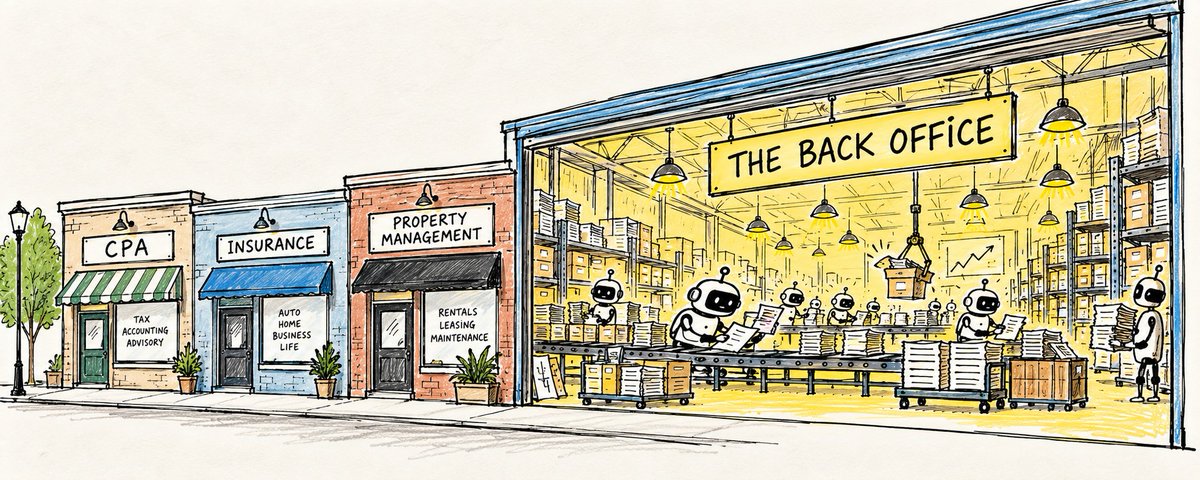
Here’s why Greg is wrong, from someone who bought, grew, and sold one of these:
Nobody running of these is dumb, and the fact that they've survived is testament to the fact that they're smart.
To me, baked into this strategy is a sense of paternalism. Look at these dumb boomers. I can come in with absolutely zero industry experience and a Claude Code subscription and change this industry!!
The most pervasive dynamic within Main Street businesses is resource scarcity.
Not enough time or money to do any of the million things that you plan to.
Awesome, so you want to do some big Claude Code thing?
Cool, you're going to need to find time to do that between figuring out how to repair the trucks, fix your broken Google My Business listing, and not take a salary that month because of the reinvestment you're making with the hope that it will pay off.
Getting a CRM implemented correctly is hard enough!!
You need managers who enforce the process, employees who change their habits, and someone accountable when things break.
Now try rebuilding delivery around AI WHILE KEEPING THE BUSINESS ALIVE AND SERVICING DEBT.
You come in full of piss and vinegar and on day four your operations manager quits because she liked doing things the old way, and suddenly you’re covering her job instead of building agents.
Greg acknowledges key-person risk, but it deserves far more weight in his economics.
The people, process, and change management required to make even basic technology productive can consume years.
Innovation has to improve the performance of the whole business.
Justin Roff-Marsh and I have discussed the sequence: identify the constraint, get more productive use from its existing capacity, then add capacity where necessary to increase throughput.
Said another way ---If an accounting firm’s bottleneck is senior review, generating drafts ten times faster may just create a bigger queue.
You have to show how AI frees the reviewer, change the workflow so that capacity gets used, and then upgrade whatever limits further growth.
Technological innovation must drive global maxima, not local maxima.
Even real savings elsewhere need to be converted into lower expenses (which is only weak replacement) or redeployed against the constraint.
A list of automated tasks tells me very little about how much more profitable work the firm can complete.
Now put a large, expensive acquisition loan underneath that transition.
In the SBA buying range, debt payments compete with the money you need for implementation, training, replacement hires, and additional capacity.
Saving people time doesn’t automatically remove their salaries.
Your plan is to do what? Have Betty train you in the first three weeks to replace her, and then you're gonna fire her. Let me know how that goes for you with a big ass loan due every month.
More than likely you're going to end up keeping Betty and adding a bunch of AI expenses, which are going to reduce all of your fancy pre-acquisition projections.
You can spend months paying for the existing payroll, new software, and human review before realizing any savings.... If at all.
And cutting a support role can make your scarce, expensive specialists less productive if they inherit its work.
Ultimately a playbook like the below is achievable but requires an enormous amount of experience, judgment, skill, etc.
And the idea that a corporate refugee is going to parachute in out of their W2 with a couple agents and transform a business model fundamentally feels like something that someone who's never tried to do it before in a real business would say.
I'm happy to have this debate with anybody who'd like to have it. I've both owned these businesses and built agents in an enormous number of these categories referenced.

Chat Joglekar retweeted

The SBA technical Update is out. (link to document in comments)
Viso recommended a few updates, and 2 very important recommendations made it into the final document!
1. QofE prepared for buyers is OK
2. Working capital true-ups are not rebates, and are explicitly allowed (this one is almost word-for-word from our letter).


Sent 2 letters to SBA today (co-signed with several QofE providers and SMB law firms) asking for some policy clarifications aimed at better diligence processes and better working capital structures for business acquisition loans.
Quality of Earnings: We asked SBA to (1) recognize engagement structures that keep the buyer inside the diligence process , but keep seller QofE excluded and keep the lender in control of the quality of the provider and report. We argued that the buyer, who signs the guaranty and runs the business, shouldn't be handed a finished report they were not allowed to inform and (2) we asked SBA to add a working capital analysis to the required scope of work: the cash conversion cycle and a defined normalized net working capital amount.
Closing Mechanics: Two clarifications are requested: make clear that a post-close working capital true-up is not a performance rebate and is a normal part of a business acquisition deal. We asked that the SBA make clear that in a true-up, if there is a seller's cure, those funds can stay in the operating business instead of being swept to loan principal so the borrower is not short-changed on vital working capital because of a misapplication of SBA rules (this happens too frequently!); AND we asked that the 5-business-day escrow limit applies to a lender's escrow of loan proceeds, not a seller-funded holdback securing post-closing obligations. Seller escrow hold-backs are designed to protect buyers and lenders, they should not be off the table because another part of the SOP limits a different type of escrow to 5 days.
Without clarity on these two points, we will continue to have sellers who are rightly reluctant to include working capital in the price, because they have heard SBA rules don’t allow true-ups to be fairly applied. And we'll continue to have some banks that won’t allow seller escrow hold-backs. Both of which actually increase risk rather than reduce it, and we are sure that is not what SBA wants.
The two working capital asks are designed to work together: When a buyer starts with an LOI that includes "normalized working capital" in the price, the QofE diligence defines the amount for the buyer and the lender, and fair working capital true-up mechanics in closing protects it. Result of which should be that it becomes easier to negotiate "normalized working capital" in the purchase price as the standard.
What do you think? Are these good changes that result in reduced risk for buyers, banks and SBA?

Clearly need more people to not be in Private Equity and out building and growing existing small businesses!
bloomberg.com/news/features/…

LFG!!!

Cal is set to announce a significant naming rights deal with Databricks, a data and AI company, sources tell @FOXSports.
The deal is for up to 10 years + $22.8 million and includes rebranding the Golden Bears' football field "Databricks Field at California Memorial Stadium.”

Chat Joglekar retweeted

Manufacturing is the most contested category on Baton right now.
Over the last six months, the average manufacturing listing received about three times the buyer interest of a typical listing. But that interest is concentrated: manufacturing businesses that received offers saw more than 10 times the engagement of those that did not.
Here's what our 2026 industry data shows:
👉 Interest clusters at $500K–$1M (36% of buyer activity) and again above $5M (32%). There is considerably less activity in between. Owner-operators and strategic buyers are active in the category, but they are often looking for different types of businesses.
👉 About one-third of buyer activity is on listings priced above 5x cash flow, nearly matching the 3–4x range. The median manufacturing listing attracting buyer interest is priced at $1.5M at a 3.4x multiple, with $420K in SDE.
👉 Nearly half of buyer questions are about financial performance, followed by customer quality, growth, and assets and equipment.
Want to see how manufacturing compares with other industries? Read the full 2026 report covering buyer activity across 10 industries: baton.com/small-business-acq…
