

Southern Lit scholar, English / journalism professor & faculty adviser of The Clarion, the student newspaper at Brevard College. Retweets are not endorsements.
- Tweets2.9K
- Following4.7K
- Followers491
- Likes8.4K




ALT Yellowleaf Church and Creek In southeastern Lafayette County, roughly halfway between Oxford and the community of Yocona, is Yellow Leaf Baptist Church. Situated atop a ridgeline, the church is named for nearby Yellow Leaf Creek, which flows south into the Yocona River. The name of church and creek are reminiscent of “Whiteleaf” in Faulkner’s fiction, which similarly denotes both a church and a creek in the southeastern quadrant of Yoknapatawpha County, as well as a hamlet and a store—some iteration of “Whiteleaf” appears in four different novels: As I Lay Dying, The Hamlet, Intruder in the Dust, and The Town. The real life Yellow Leaf Church was organized in the 1850s; these photographs taken in 2004 are of a building constructed in 1946 that had stained glass windows and all-wooden pews. Unfortunately, it was destroyed in 2017 when high winds toppled a tree onto it and caused an electrical fire. A new, larger sanctuary had recently been built and was not damaged, but the original ..

ALT Yellow Leaf Baptist Church, April 2002. Photograph by John B. Padgett

ALT Yellow Leaf Baptist Church, April 2002. Photograph by John B. Padgett

ALT Interior of Yellow Leaf Baptist Church, April 2002. Photograph by John B. Padgett


ALT Screenshot: DY's AS I LAY DYING map


ALT Gray background with the DPLA logo and Banned Book Club logo and the words "Digital Public Library of America presents The Banned Book Club. Let Freedom Read. TheBannedBookClub.info

ALT As I read AS I LAY DYING, I witnessed Faulkner unfold dozens of themes and characters simultaneously. I struggled to ground the narration and overarching themes in the novel’s setting. It appeared at times that the story had no central location to ground its beautiful, though chaotic, story. I turned to the “Location-Character Force-Directed” graph function in DY hoping to piece together a complex nest of characters and places. But the diagram the website produced revealed a web of characters and locations that, while expansive, centered on one main location: the Bundren House. Returning to the novel, my DY experience helped me better grasp the underlying tension of the novel. Just like the diagram, the novel fixates on one family drawn together by the death of their mother. But the novel’s plot unfolds as individual desires and personal conflicts pull the family apart. Masked behind chaos, Faulkner depicts the terrible yet striking fall of the Bundren family - Theo Johnson

ALT Composite screenshot of force-directed graphs in Digital Yoknapatawpha

ALT When using DY, "I found the way it maps a novel in time and space very helpful in making sense of the often confusing and ambiguous time jumps in THE SOUND AND THE FURY. The feature incorporates a special visualization, in representing the frequency of visits to certain locations through a sort of heatmap design. It also includes a temporal element, allowing me to play through the timeline of events both in page order - which aids in visualizing the progression of the narrative - and in chronological order - which aids in understanding more wholly the character’s lives and experiences. I found both the map and the timeline especially helpfulin understanding the importance of past events, especially in a novel such as THE SOUND AND THE FURY where the entire narrative is centered around a haunting past. I would recommend using this feature to anyone who is struggling to ground themselves in Faulkner, especially considering his tendency to jump in time without notice! - Katie Troup

ALT DY screenshot for THE SOUND AND THE FURY

ALT Why have people stopped reading Faulkner? Because he’s so hard to understand. The first time I read THE SOUND AND THE FURY, I couldn’t understand any of it because I’d never read a book where the author apparently had zero concept of time. Why couldn’t Faulkner just speak plainly? But after a while the gems of Faulkner’s writing started to grow on me: the complex characters, fraught relationships and portrayal of Southern culture. The first time I used DY in class, my original thought was, “Why would anyone choose to spend so much time making something like this?” There was no denying that it went into a crazy amount of depth that I as a reader had never even considered. But in Faulkner’s world, where scenes switch between decades without any announcement, the database helped me to understand in the most basic sense what was going on in the book. Specifically, I could go through scene by scene and DY would tell me when each event occurs. It would have been much harder to get ...

ALT DY screenshot of heatmap for THE SOUND AND THE FURY

ALT I don’t know how I would’ve gotten through Faulkner’s THE SOUND AND THE FURY without Digital Yoknapatawpha. Two features that I found especially helpful are the timelines at the bottom of the page. Faulkner’s stream of consciousness writing and sudden changes in time and setting made the novel almost incomprehensible to me. Whenever I felt lost, I went to the timelines. One timeline shows the book page order, and the other timeline shows the chronological order, because the narrative does not go in chronological order. If I needed to orient myself on where I was in time, I would go to the page order timeline and DY would show me when that certain event was occurring. I am also able to see where on the map the event occurred. I used the timeline features mostly in Benjy’s section. It felt like every paragraph occurred at a different time than the last. The timelines are the only thing that kept me aware of time when reading THE SOUND AND THE FURY. - Ethan Vogelman

ALT DY screenshot for THE SOUND AND THE FURY

ALT Students in my Southern American Literature class, a second-semester advanced high school English elective at St. Albans School in Washington DC, spent this spring using Digital Yoknapatawpha to better understand multiple Faulkner works. The entire class read “DRY SEPTEMBER” and THE SOUND AND THE FURY; some read “A ROSE FOR EMILY”; and one student independently read AS I LAY DYING. Inspired by my work with the NEH DY study, I asked the class to use DY not just to understand Faulkner’s chronologies, but also to ask and answer questions about characters like Caddy. Who is she beyond how her brother’s describe her? What is her world? DY’s visual tools helped my students see Faulkner’s stories more deeply, and the mapping displayed on the site also informed a final mapping project for our next text, Jesmyn Ward’s SING UNBURIED SING. My first year teaching with DY taught me that I will always use DY. When high school students can see the literature they are reading, the aha moments come...

ALT Ms Mills Southern Lit Class

ALT Sherman, 8 texts: Growing up in the South Carolina Lowcountry in the 1960s and early 1970s, one of my earliest memories was being shown an encyclopedia photo of Union General William T. Sherman and associating that image with the devil, such was the power he wielded in the South, even 100+ years after the Civil War. Perhaps that is why Sherman appears in 8 Faulkner texts, nearly always for the devastation his troops wrought in the South, especially in the burning of Atlanta and the subsequent “march to the sea” in 1864. He crossed the Savannah River in 1865 and proceeded north into South Carolina, continuing his path of destruction in the state where the war had begun; some of those ruins continue to dot the landscape today. Faulkner’s treatment of war and history has long been one of my abiding interests in his work, and in an audio clip at UVA in the 1950s, he addressed how such history (and memory of it ) continued to resonate for decades. Or as in my childhood memory, for more ...

ALT William Tecumseh Sherman. Source: Wikimedia Commons

ALT W.C. Handy, THE TOWN: William Christopher Handy has often been called the "Father of the Blues." Faulkner mentions him by name when he travels “from Beale Street in Memphis” to Jefferson's Opera House to play the music for the Cotillion Ball, an aristocratic event that is disrupted by the suggestive dancing of Manfred de Spain and Eula Varner Snopes, and the two fights that break out. At home after the ball, one of the fighters beats his wife. Sex and violence are also evoked in the short story “That Evening Sun,” a title that Faulkner borrows from the first line of Handy’s famous “St Louis Blues” (use the link to hear the 1925 recording by Bessie Smith and Louis Armstrong). In the story, Nancy, the Negro laundress and substitute cook for the Compsons, feels (to borrow a different phrase from Handy’s song) like she’s “on [her] last 'go round" after her husband, ironically named Jesus, threatens her and the white man responsible for her pregnancy. At twilight she takes the ...

ALT W.C. Handy. Source: The New York Times

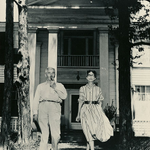
ALT William and Estelle at Rowan Oak. Source: Wikimedia Commons

ALT June 19. 1954: Faulkner rejects TIME magazine cover story about the publication of A FABLE, telling Donald Klopfer at Random House that both TIME and its sister publication LIFE have already done that for THE WILD PALMS (1939; see image), and since they want to send a reporter to him, he is sure it means prying into his private life. He does not want his family subjected to this attention: “journalists as individuals are all right, they are just the victims of the system too, and can be fired by their bosses if they acquiesced to my feelings . . . One of the most fearful things in modern American life: the Freedom of the Press . . . when vast monied organizations such as the press or religion or political groups begin to federate under moral catchwords like democracy and freedom, in the structure of which the individual members or practitioners are absolved of all individual moral restraint, God help us all.” – From Carl Rollyson’s WILLIAM FAULKNER DAY BY DAY

ALT 23 January 1939 TIME magazine cover

ALT First page of "A Rose for Emily" in FORUM magazine, April 1930