

Building infrastructure to help companies become AI-native.
Canada
Joined November 2023
- Tweets482
- Following191
- Followers537
- Likes4.4K

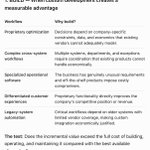



About a month ago, I caught up with the CFO of a company operating a portfolio of elder care facilities, with roughly 2,000 employees. They'd spent the last year building an internal AI team, were already paying an external implementation partner multiple six figures annually, and were considering bringing on another firm to accelerate their pipeline of projects.
Even companies investing heavily in their own AI capabilities may have more work to implement than their internal teams and existing partners can handle. I see this market developing with large firms serving major enterprises, others focused on the mid-market, and plenty serving SMBs. Within each segment, there will likely be firms specializing in particular industries, functions, and types of implementations.
I don't expect there to be nearly as many AI implementation firms as accounting or law firms, but I do expect a fairly fragmented market with room for many meaningful businesses. And the existence of an internal AI team won't necessarily make external implementation partners any less relevant.
2
5
362
Anthropic just released Working with AI, a report based on 66 interviews across 58 enterprise customers. 22 of the most interesting findings:
1. Two-thirds of companies reported reducing hiring because of AI. Only two reported eliminating a position and laying someone off directly because of automation.
2. Five companies reported letting employees go because they refused to adopt AI.
3. Ten companies reported hiring more because of AI, primarily for implementation and IT support.
4. Nine companies reduced their reliance on external contractors. One financial services company cut over 100 offshore data and development contractors.
5. Six AI-native startups estimated they'd need 4× as many employees, on average, to operate without AI.
6. One AI-native startup spent 90% of its operations budget on AI tokens and just 10% on headcount.
7. A startup's marketing operation went from 80% human work and 20% AI to the reverse.
8. Most AI applications increased business output rather than directly reducing costs.
9. Higher-value AI deployments tended to involve more substantial changes to how companies organized their work.
10. Of 100 AI-built software applications examined, 80% automated previously manual work. The other 20% replaced existing software.
11. An accountant built an application for a retirement-plan audit process that previously required 80 hours of manual reconciliation.
12. A real estate investment manager built a deal tracker that replaced software costing $10,000 annually.
13. Another employee recreated a legacy Windows XP application that would otherwise have cost an estimated $250,000 to replace.
14. The accountant's audit application still required an external implementation vendor and wasn't in production months later.
15. One company used AI to reduce its planned hiring of document reviewers by more than 90%. But getting existing reviewers to increase their throughput proved difficult.
16. A law firm built an AI conflict-checking workflow in under a week, but abandoned it after employees resisted taking on the more complicated cases it surfaced.
17. Companies reported that some of their earlier AI applications were already becoming obsolete as underlying models improved.
18. One manufacturer used AI to translate its product interface into ten languages, then abandoned the feature because it couldn't support customers in those languages.
19. Some companies are combining sales prospecting, account management, and customer success into a single role responsible for the entire customer relationship.
20. Others are combining product management, design, engineering, QA, and infrastructure responsibilities into broader roles.
21. A trucking company made its data warehouse accessible to AI agents, allowing managers to run analyses themselves instead of waiting for BI requests that could previously sit in a queue for months or even years.
22. As employees increasingly build their own software, companies are having to invest in shared infrastructure, security, and maintenance to manage the growing number of internal applications.
My biggest takeaway: the technology is already capable of changing how entire companies operate, but the economic benefits are far from automatic. A company can automate a task in a week and spend the next six months figuring out how to deploy it, get employees to use it, and change the surrounding workflow.
12
21
2,013
Answering the impossible question of: how should companies *actually calculate the ROI of AI? Some notes and thoughts ...

The director of finance at a 250-person company was telling me how his 17-person finance team is using AI to work more efficiently.
They've purchased Claude Max subscriptions for the team and are building their own custom skills and artifacts. It got me thinking about two approaches to AI adoption in the enterprise:
1. Equip your employees with AI tools. Give everyone access to the best models and let them figure out how to do their jobs faster.
2. Automate the work itself. Identify the repetitive processes employees are spending hours on and build task-specific agents to handle them, freeing people up for work that actually requires their judgment.
Both approaches are incredibly forward-thinking, but curious if we’ll be seeing a standard over the next ~6 months.
I'm increasingly optimistic about private equity firms building their own AI infrastructure to deploy across portfolio companies.
A shared harness and runtime for AI agents could automate significant amounts of manual work across finance and operations, with each acquisition benefiting from infrastructure that's already been built. The potential to create enterprise value from day one is enormous.
The inverse is equally interesting. At our stealth co, we're already seeing opportunities where taking equity in the companies we automate, potentially alongside PE firms or LBO financiers, could be more attractive than simply charging for implementation.
Lots of interesting ways to capture the value created by AI beyond selling the software or services.

There seems to be three paths to AI deployment co’s over the next few years:
1. Expand beyond “managed AI”. Including: managed IT and backend tech support as a whole.
2. Get acquired/partner with PE firms to help build their platform (harness, runtime - infra to help companies go “AI-native”).
3. Go in-house within a larger company, to help build out their internal AI team.
Interestingly, about a month in, we’ve been approached regarding the latter two. While the first is the most intriguing (to us, at least).
7
39
3,077
There seems to be three paths to AI deployment co’s over the next few years:
1. Expand beyond “managed AI”. Including: managed IT and backend tech support as a whole.
2. Get acquired/partner with PE firms to help build their platform (harness, runtime - infra to help companies go “AI-native”).
3. Go in-house within a larger company, to help build out their internal AI team.
Interestingly, about a month in, we’ve been approached regarding the latter two. While the first is the most intriguing (to us, at least).
Canada has some of the best engineering talent in the world, and we've been fortunate to connect with some exceptional engineers here in Montreal.
If you're building an AI team, hiring forward-deployed engineers, and open to remote talent, reach out!
1
8
646
IMO, there will be a bending spoons equivalent who will acquire Ai-native service businesses, in let’s say 18-24 months time, who raised too much $ at peak times. Think AI deployment CO’s, law firms, accounting firms … the economics just don’t support it (in most cases).
We shall see.
In conversations with owners of manufacturing and distribution businesses doing $30M–$100M in annual revenue over the past few weeks, one of the more interesting benefits of implementing AI that came up was the potential to increase enterprise value.
Beyond the obvious EBITDA improvements, you're building operational alpha that can be applied well beyond your own business.
> As an acquirer, you can buy smaller incumbents, deploy your existing AI infrastructure across their operations, and improve their margins without proportionally increasing headcount.
> As an acquisition target, you're more attractive to a larger strategic buyer who can use that same alpha across their existing operations and future tuck-ins.
The value of implementing AI shouldn't be measured solely by the savings it generates internally. The ability to replicate that alpha across acquired businesses could be worth considerably more. Just a thought.
4
25
2,598


Nice launch this weekend ;) Congrats! @ivanhzhao @akothari

4
1,133
AI can do any work you wish for it to do, but a human will always be held accountable for its outcome.
5
358
An interesting one: last week, our team spoke to the Head of AI at a large logistics company who's actively looking to hire in-house AI engineers, but specifically wants people who think more like entrepreneurs than traditional developers.
They have a global team of ~1,600 team members, and an existing software development team of ~100. They have a robust talent pipeline of engineers who can ship code, but their main challenge was around finding engineers who can walk into a department, understand how the business operates, identify what's worth automating, and actually own the implementation.
My point here: it’s fascinating how much the definition of a good enterprise engineer is changing with AI.
[Should companies hire their own AI engineers or work with an external implementation firm?]
*** The case for hiring internally:
You own the talent, the knowledge stays within the company, and your engineers develop an increasingly deep understanding of your systems, processes, and people. They can continuously improve what's been built without relying on an outside party.
We recently spoke with the head of AI at a large logistics company that's actively looking to hire engineers who think more like entrepreneurs than traditional developers. Makes complete sense. If you're planning to deploy AI across dozens of workflows over the next several years, building that capability internally can be a very worthwhile investment.
But there are a few things worth considering.
> First, hiring an AI engineer doesn't necessarily mean you've hired someone who knows how to implement AI in a business. There's a pretty meaningful difference between building an agent and figuring out which workflows to automate, understanding how those workflows operate, integrating with legacy systems, managing exceptions, and getting employees to actually rely on what you've built.
> Second, the economics depend heavily on how much work you have. Hiring two or three capable engineers can easily become a several-hundred-thousand-dollar annual commitment once you account for salaries, benefits, recruiting, and management. That's perfectly reasonable if you have a sustained pipeline of valuable projects. Less so if you have three workflows you want automated and no clear idea what comes next.
> Third, your first AI hire is arguably the hardest one to get right. You need someone capable of making architectural decisions, evaluating models and tools, handling integrations, and understanding business processes, often without much technical guidance internally.
*** The case for working with an external firm:
You're effectively buying experience, execution capacity, and access to people who've already encountered some of the problems you're likely to face.
One manufacturer we've been speaking with runs a lot of its operations through an older on-premise ERP, spreadsheets, macros, and engineering documents. Implementing AI there involves much more than writing code. You need to understand the corners where information and context is stored, how different systems interact, which processes depend on undocumented logic, and what can safely be automated. An external team that's dealt with similar environments may be able to get to production considerably faster than a company hiring its first engineer and figuring everything out from scratch.
There's also flexibility. You can bring in specialized expertise for a few months without committing to a permanent team, and expand or reduce that involvement as your needs change. Of course, outsourcing has its own drawbacks. External teams can be expensive, may never develop the same institutional knowledge as employees, and can create serious dependencies if the customer doesn't own the code, documentation, infrastructure, and ability to maintain what's been deployed.
If you're a large organization with a clear, ongoing pipeline of AI projects, strong technical leadership, and the resources to recruit and retain good engineers, building internally makes a lot of sense. We recently spoke to a CFO of an eldercare facility company who has their own internal AI team, as well as is engaging with third party firms to speed up deployment of their AI backlog.
If you're earlier in your transformation, don't yet know which workflows are worth automating, or need specialized expertise across several systems, working with an experienced implementation partner may be the more economical starting point.
Would love to hear how more thoughts on this -
10
16
1,122
It seems pretty obvious to me that one of the biggest bottlenecks to mass AI adoption is simply getting the technology deployed across businesses at scale.
Of course there are constraints around compute, GPUs, energy, data centers, research, etc., but there's an enormous amount of work to be done just getting AI integrated into how businesses operate. And much of that work will require specialized engineers and consultants for years to come. The way I see it, the biggest economical category of all time.
Who should own AI transformation inside a company? The CEO, COO, CFO, CIO, or individual department heads? The more interesting question is which parts of the transformation should be centralized, and which should be owned by the business.
I'd separate responsibilities into three layers:
1. Central AI/IT team: Own the technical foundation.
Security, governance, infrastructure, integrations, technical standards, and reusable components.
You don't want five departments independently building their own infrastructure, managing sensitive data, or establishing conflicting security policies.
_
2. Business departments: Own the problems and outcomes.
Finance, operations, sales, and other functions should identify opportunities, prioritize workflows, define requirements, and be accountable for the economic results.
The people closest to the work generally have the best understanding of its nuances, exceptions, and constraints.
_
3. Cross-functional deployment teams: Own execution.
Bring together the process owner, AI engineers, and IT/security to build, test, deploy, and continuously improve each implementation.
The business defines what success looks like. Engineering determines how to achieve it reliably. IT ensures it operates within the company's technical and security requirements.
This is effectively a federated model, and the appropriate structure will vary with company size and complexity. The underlying principle is fairly simple:
> Centralize what benefits from consistency and shared infrastructure.
> Decentralize what requires domain expertise and accountability for results.
The mistake is assuming that because AI is a technology, the entire transformation should belong to the technology department.
Spoke to the COO of a $75M materials distributor who's still running on a painfully slow, outdated ERP, but has no intention of migrating to a modern one. He'd rather layer AI agents on top of his existing systems.
Two reasons, according to him:
1. ERPs will be obsolete in five years.
2. He can't be bothered retraining his staff on a new system. Too much business disruption.
Josh retweeted

By the way, it’s still prohibitively expensive to do the change management necessary to get the productivity gains from AI in many, if not most, enterprise settings
I actually don’t think the vast majority of retrofits are fundamentally tractable. even as the models get better
Systems level changes have to happen on human time, which in some sense is good news for us all, but presents particular challenges for introducing this technology to existing organizations
Deriving the general shape of the AI native company, we should expect to take decades, not unlike electricity especially since some of the binding constraints that need to be lifted also move on human time, but at the level of electoral politics