

Helping 3,500+ investors build wealth in Digital Assets with the ABN System | Ex-Investment Banker → Co-Founder @ Decentralized Masters 👇
Joined January 2013
- Tweets10.9K
- Following1.7K
- Followers2.5K
- Likes1.9K







Pinned Tweet
Two weeks ago we held Market Intelligence Live in Miami. Three days at the Fontainebleau with hundreds of our members.
3 days packed with real strategy sessions on positioning capital for 2026 to 2030.
The conversations that happened in that room, at dinner, in smaller breakout sessions, were the most valuable of my career.
Building a community online is one thing.
Meeting them in person changes everything.


5 things that destroy otherwise intelligent investors:
1. Fees
2. Emotional exits
3. Oversized positions
4. Unwritten investment theses
5. Confusing confidence with competence
The market doesn't care how impressive your resume is.
(I learned the expensive way)
If I were building a portfolio from scratch today:
I wouldn't put it in cash.
I wouldn't go all in on Bitcoin.
I wouldn't chase the hottest stock.
I'd build 3 specific layers…
Here's the exact setup:
In 2017, I had this upside down.
Almost everything sat in the riskiest layer, and the core just didn’t exist.
But when you build in this order…
You can be in a high-variance market without taking high-variance risk.
If you got something from this..
Follow me @juniortgr for more content on macro, markets, and building a portfolio that survives the future of finance.
In 2017, I turned a 5-figure portfolio into 7 figures.
Then I watched it disappear.
I had the financial education, the experience, and the conviction.
But what I didn't have was an exit plan.
It taught me that being right about an investment means very little if you can't keep the gains.
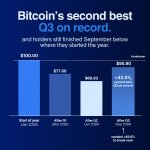
The signal everyone spent 2026 waiting for finally printed on 8 September.
Bitcoin was at $78,449.
It had already run from about $62,000 to $82,000 before the signal showed up.
So the indicator confirmed a move that had largely already happened. And then price went back to $77,000.
Here's the detail I keep coming back to. On the day it printed, the 2 moving averages finished $93 apart on an asset trading near $78,000. That's a gap of 0.13%. Depending on whose data feed you used, the signal either existed or it didn't.
A rounding error decided whether a thing everyone was waiting for was real.
None of this is a flaw in the indicator. It's a flaw in what people believe it is.
A golden cross is the 50 day average crossing above the 200 day average. Both are arithmetic about the past. It cannot tell you anything about tomorrow. It can only tell you the shape of the last few months has changed.
It's a rear-view mirror with a very impressive name.
In April we told our community we wouldn't act on a projected cross, only a printed one, because a projection is somebody's opinion wearing a chart's clothing. I still think that was right.
But the honest other half, which almost nobody says out loud: by the time it printed, most of the move was behind it.
Both things are true. Waiting for confirmation costs you the first part of the move. Acting on projection costs you everything when the projection is wrong. There's no version where you get the whole move and keep the discipline.
So what is a confirmation signal actually for?
Not entry. It's far too slow for entry. It's for changing posture, which is a much slower decision than a trade. Moving from defensive to offensive. Sizing differently. Deciding what you're willing to hold through.
The mistake is treating a lagging indicator as a starting gun.
I'd rather be 20% late to something real than on time to something that never arrives. But I'm not going to pretend late is free. It isn't.
How we separate signals that time a decision from signals that only describe the past is covered in the free Sovereign Collective, link in bio.
Have you ever waited for confirmation and then realised the confirmation was the move?
Education only. Not financial advice, not a recommendation, and not personalised to your situation. Digital assets are volatile and you can lose money. Market data as of the date posted. Past results never promise future results.
Brent is at $109.64. WTI is at $98.58.
That gap is the story, not the price.
Both are crude oil. Brent is seaborne. WTI is landlocked American crude sitting in Oklahoma. Same commodity, different postcode.
The gap between them is normally 3 to 5 dollars, which is roughly what it costs to move a barrel from one place to the other. Right now it's about 11 dollars, and October has averaged near that all month.
So the market is not paying up for oil. It's paying up for oil that doesn't have to cross a particular stretch of water.
That premium is on the route, not the barrel.
Look at what sits underneath it. At least 18 vessel attacks in 2 weeks. A supertanker caught fire after striking a sea mine. And the workaround that kept volumes moving, transferring cargo ship to ship further south, is now exposed as well.
The detour stopped being a detour.
There's a second bottleneck in the same report that almost nobody will mention. US officials are working with refiners around the world to raise output because of a diesel shortage.
You can have plenty of crude and still be short diesel. Crude in the ground, crude on a ship, and crude turned into usable fuel are 3 separate problems.
And diesel is the one that matters most to ordinary life, because diesel moves freight, and freight prices sit inside almost everything you buy. That channel runs slow. It shows up months later as the price of things that have nothing to do with oil.
So when I read an oil headline I'm not asking whether oil is up. I'm asking which part is actually scarce. The barrel, the route, or the refinery.
3 different problems. 3 different durations. 3 completely different things to do about it.
The headline number tells you none of that.
Reading what a price is actually pricing, instead of what it appears to say, is the core of how we teach analysis in the free Sovereign Collective, link in bio.
When you saw oil was up, did you assume there was less of it?
Serena Williams' coach once told her she was winning 80% of her points at the net.
He made the number up. He's admitted it publicly, laughing.
She believed him, started moving forward, and won Wimbledon that year.
Everyone calls this "believe in yourself." It isn't.
He never told her she was a great player. She knew that already and it would have changed nothing. He gave her one specific number about one specific action. The belief attached to a behaviour, not an identity.
A behaviour you can go and do on the next point. An identity just sits there.
I passed CFA Level 1 at 21, top 10% globally, and took all three levels back to back. People assume that takes believing you're exceptional.
It doesn't. I needed something much smaller: that I was a person who sat down at the same hour every day whether or not I felt like it.
That was my volley. One action, repeatable tomorrow morning.
The people who fell away weren't short of intelligence. Most were sharper than me. They were waiting to feel ready.
Same thing runs a company. Your job isn't to inflate people. "You're brilliant" can't be acted on. Your job is to find the true specific thing someone hasn't noticed about themselves and name it precisely enough that they can do it again on purpose.
One caution. Mouratoglou lied about the data. He did not lie about the capability. He'd watched her closely enough to know she could actually do it.
Invent a capability that isn't there and you haven't motivated anyone. You've arranged a public failure with your name on it.
Finding the behaviour that actually moves the needle, instead of the one that feels productive, is how we work in the free Sovereign Collective, link in bio.
What's the one specific thing someone said about you that changed how you worked?
Amazon started in a garage in 1994. Everyone knows that part.
Here's the part nobody repeats. It went public in May 1997, roughly 3 years old, at $18 a share and a few hundred million dollars of value.
3 years. A teacher with a brokerage account could own it before almost any of the growth happened.
That door is closed now.
The median company going public in 2025 was 12 years old. For tech it peaked around 15. In the 1990s the average was 8.
And the bigger number, the one that actually ends the argument: the share of startups that ever reach an IPO at all has fallen from over 25% to 2%.
Private capital under management went from under $1 trillion in 2000 to $16 trillion in 2024. The money that used to be raised from the public is now raised before the public is invited.
So when a founder in a garage today builds something enormous, the compounding happens over 12 years inside a cap table you cannot access. By the time it lists, the early investors are selling into your bid.
Nothing about this is a conspiracy. It's just where the capital went.
But it means one habit is quietly broken. Hunting for the next Amazon in public markets is hunting in the pond after the fish were moved.
I stopped looking for the 100x in listed equities years ago. I own public markets for a different job now: compounding, income and liquidity. Not lottery tickets.
The garage story was never about grit. It was about a market structure that let ordinary people own the first 3 years. That structure is the thing that changed, not the founders.
Understanding where returns are actually generated before you allocate is the first thing we cover in the free Sovereign Collective, link in bio.
Are you still investing for the structure that existed in 1997?
A shooting conflict involving the Strait of Hormuz started in late February. Oil is near a 5-month high and above $100.
Gold is down about a fifth since that conflict began.
If you believe gold is what you own when the world gets dangerous, that sentence should be impossible. The world got measurably more dangerous and the hedge lost a fifth of its value.
Here's the mechanism, and it's the useful part.
Gold does not price geopolitics. It prices real interest rates, and it pays you nothing to hold it.
So follow what the conflict actually did. It pushed oil up. Higher energy fed into inflation. Higher inflation made rate rises more likely rather than less. Traders still see a 90% chance of another increase before year end. Higher rates mean better returns on assets that pay interest, which is a direct headwind for an asset that doesn't.
The crisis created the exact conditions that damaged the thing people buy for crises.
That's not a flaw in gold. It's a flaw in the reason most people own it.
An asset does not hedge bad things in general. It hedges one specific variable. Gold is a hedge against currency debasement and falling real rates. It is not a hedge against war, or recession, or uncertainty, or anything else that makes you uneasy. Those are feelings. Real yields are a number.
Which is why gold has spent October consolidating above $4,100 after a 6% fall the previous month, in the face of a stronger dollar and high bond yields, while the Fed chair signals he'd rather hold rates than move them.
The question worth asking about anything you own as protection is not what are you worried about. It's which variable does this actually respond to, and is that the same variable that would hurt you.
Most people have never checked, and they find out during the event they bought it for.
Matching the hedge to the actual exposure is one of the first things we work on in the free Sovereign Collective, link in bio.
What do you own as protection, and do you know what it's protecting you from?
Here's a number that should change how you think about your own risk.
Household net worth in the US is now more than 8 times disposable income. An all-time high.
Households' equity holdings alone are worth nearly 3 times their annual after-tax income. Which means, as BCA Research put it in a note yesterday, that the S&P rising 10% in a year lifts a household's capacity to spend by the equivalent of a 28% pay rise.
Not a 10% effect. A 28% one.
That's the mechanism behind the resilient American consumer everyone has been puzzling over for 4 years. People spent through a pandemic, through the aftermath, through sustained high inflation, and the explanation was mostly sitting in their brokerage account rather than their paycheque.
Their strategist's line was that the stock market isn't the economy, but it's influencing it like never before.
Now the part that matters, which the headline version misses.
For decades, the stock market isn't the economy was a comfort. It was what you told yourself during a drawdown. Markets fall, the real economy keeps going, your job is fine, wait it out.
That gap is closing. If consumption is increasingly downstream of portfolio values, then a falling market reduces spending, which reduces earnings, which reduces the market. It runs in reverse exactly as efficiently as it ran forwards.
And that has a personal consequence almost nobody has priced.
Your portfolio and your income used to be reasonably independent. A bad market didn't necessarily threaten your job. The more consumption depends on asset prices, the less true that is. The next serious drawdown is more likely to arrive alongside pressure on your employer, your bonus and your industry, rather than separately from it.
Which means the two things most people quietly rely on to offset each other have become correlated.
Diversification is not only about what sits inside the portfolio. It's about whether your income, your savings and your holdings all depend on the same conditions. For a lot of people they now do, and nothing on a statement will tell them.
Working out what you actually own, and what it's secretly correlated with, is where we start in the free Sovereign Collective, link in bio.
If your portfolio fell 30%, would your income still be safe?
We had a sales slump and 2 people left in the same stretch.
I assumed we had a talent problem. Wrong diagnosis.
What we actually had was a team that had stopped telling me things.
People were watching a founder they couldn't read and deciding, rationally, that raising a problem was more expensive than staying quiet. Nothing in the hiring process fixes that. You can bring in excellent people and they will go quiet within a month for the same reason.
So I did something that felt ridiculous at the time. I told the whole company about my childhood. The difficult parts. Not as a speech about vulnerability, just facts about where I came from and why I am the way I am.
It changed how people spoke to me almost immediately, and our performance followed.
Here's why I think it worked, and it isn't about being open.
People don't withhold information from someone they understand. They withhold it from someone unpredictable. Once the team could model me, the cost of telling me something uncomfortable dropped, and problems started arriving while they were still small.
That's the actual asset. Not morale. Early information.
Most founders treat this as a spending problem. Better salary, better job ad, better recruiter. Then they blame the talent pool.
The talent pool is fine. A-players are evaluating whether your thing is worth their next 3 years, and money stops moving people past a certain number. What moves them is ownership, a real seat, and something they'd want to have built.
I allocate capital for a living and the rule is identical on both sides. You don't get returns from the thing you bought. You get them from the structure you put around it.
We work on exactly that kind of structural thinking in the free Sovereign Collective, link in bio.
What is your team not telling you right now?
Today is the anniversary of the worst day in stock market history.
19 October 1987. Black Monday. The Dow fell 508 points in a single session, 22.6%, and nothing has beaten it since.
The famous answer to who came out ahead is Paul Tudor Jones.
He made 200% on that day alone and finished 1987 up 125.9%. He personally walked away with around $100 million.
He'd earned it. He and his analyst Peter Borish had spent months studying the price action of 1929 and found the parallels. More importantly he'd identified the mechanism: portfolio insurance, a strategy newly in fashion, which automatically sold index futures as prices fell. Falling prices triggered selling, which caused falling prices. A machine built to protect portfolios was wired to amplify the decline.
That's a real edge and it's completely unrepeatable. It required a specific structural insight about a specific new product, plus the capital and the instruments to express it before anyone else noticed.
Nobody should plan around being Paul Tudor Jones.
Which brings us to the other group who came out ahead, and almost nobody mentions them.
Everyone who did nothing.
The Dow opened 1987 at 1,897 on 2 January. It closed the year at 1,939 on 31 December.
The worst day in stock market history happened and the year still finished green.
Nearly 60% of the losses were recovered within 2 trading sessions.
Sit with that. The window in which an ordinary investor could do themselves permanent damage was roughly 48 hours wide.
The people ruined that week were not ruined by being wrong about the market. They were ruined by selling. The ones who were equally wrong and did nothing were fine by Christmas.
One of those outcomes required genius, months of research and a hedge fund. The other required not looking at a screen for two days.
Only one of them is available to you.
Building the structure that makes doing nothing possible is most of what we work on in the free Sovereign Collective, link in bio.
What would you have done on the Tuesday?
I've spent this weekend watching the news from Dubai with more than a passing interest.
I was born in France. Grew up there. My family is still there.
Here's what actually happened.
Around 550,000 people protested across the country, 110,000 of them in Paris, over the rising cost of living and the state of public services. It became the worst unrest France has seen in years.
More than 2,400 arrests. Close to a thousand police and gendarmes injured. There were casualties on both sides. In Paris shops were looted and fires started. In Lyon the tourist office was burned. In Limoges the spire of a 143 year old town hall collapsed in flames.
Then the government began coming apart.
The interior minister attempted to resign. The president refused to accept it and instead ordered a review of what failed in intelligence and police preparation. The prime minister called a crisis meeting for this morning. An election to succeed Macron is 6 months away.
Underneath all of it is a budget.
A minority government is trying to pass €54 billion in savings, aiming to bring the deficit from 5.4% of GDP down to 5%. That's the fight. Everything above is what happens when a country can't agree on how to close a gap.
Now the part most people won't see reported.
The spread between French and German 10 year debt hit roughly 147 basis points this month. Widest since 2012. The French 10 year yield has been near 5%, which it last touched in 2002. Scope has cut France to A+. Moody's has it on negative outlook. On Monday French yields rose again, the euro weakened and the CAC fell.
That's the quiet version of the same story, and it's been running for months.
One observation, and it isn't about French politics.
Most people file sovereign risk under emerging markets. Something that happens to countries with weaker institutions, somewhere else. This is a G7 economy, inside the euro, borrowing at levels it hasn't seen in 24 years, because its parliament cannot agree on a number.
I don't know how it resolves. Nor does anyone telling you they do.
Reading what a spread is telling you is one of the first things we teach in the free Sovereign Collective, link in bio.
Does your portfolio quietly assume political stability somewhere?
For 41 years it was illegal for an American to own gold.
April 1933. Executive Order 6102 required citizens to hand in any gold coin, bullion or certificates worth more than $100, which was about 5 ounces. Deadline, 1 May. The government paid $20.67 an ounce.
January 1934. The government revalued gold to $35 an ounce.
Nine months. 69% higher.
Everyone who complied had sold at a fixed price to the only buyer in the market, and that buyer then set a new price. The gain went to the entity that wrote the rule.
Private ownership stayed illegal until 31 December 1974.
Here's what that episode actually teaches, and it isn't about gold.
Those people owned the right asset. They were correct. They'd protected themselves from exactly the thing that was coming, and it made no difference at all, because the rule changed around the asset rather than the asset failing.
What you own is one question. Where it sits, who holds it, and under whose rules, is a completely different one.
Almost everyone spends their time on the first and none on the second.
We spend time on the second in the free Sovereign Collective, link in bio.
Do you know whose rules govern the things you own?
Goldman Sachs expects Brent at $71. The EIA expects $105.
It's trading around $104 right now.
One of the best-resourced commodities desks in the world thinks oil is roughly 30% too expensive. A US federal agency with its own modelling thinks it's about right. Same asset, same quarter, same information available to both.
Sit with that before you read another forecast.
These are not amateurs disagreeing about something obscure. This is the most analysed commodity on earth, with the most capital behind the research, and the professional range covers a 30% move in either direction.
Which tells you something useful, and it isn't that one of them is stupid.
The Strait of Hormuz situation genuinely has two readings, and both are defensible.
Flows through the strait are running about 43% below pre-conflict levels, which sounds like a supply crisis. But some Gulf producers are exporting more than they did before the war, and the Brent to WTI spread has gone from a normal $3 to $5 out to $10.35.
That spread says the stress is in shipping, insurance and getting cargo out, not in missing barrels. Shipping problems resolve. Missing barrels don't.
So is this a structural shortage or an expensive logistics problem? Reasonable people with better data than you or I are split, and the price reflects that split rather than an answer.
Here's the part most people get wrong.
When the expert range is that wide, the instinct is to find the smartest forecaster and follow them. That's the wrong move, because the width of the range is itself the information. It's telling you this is genuinely unresolved, and no amount of further reading resolves it for you.
The correct response to an unresolvable question isn't a better answer. It's a position small enough that both answers are survivable.
You will never be more informed on this than Goldman. You can absolutely be better positioned than someone who picked a side.
This is commentary, not investment advice. Always consult a qualified advisor about your own situation.
Sizing for questions you can't answer is most of what we do in the free Sovereign Collective, link in bio.
What are you holding at a size that only works if you're right?