

Science Tokyo ICT M2 / Slavakis Lab / Intern @SakanaAILabs @ZOZOIncPR/ ex-intern @astar_research @fujitsulabs
Tokyo / Japan
Joined July 2023
- Tweets104
- Following308
- Followers379
- Likes368






Pinned Tweet
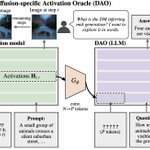
Can an LLM learn to interpret diffusion model activations?
We trained an LLM, Diffusion-specific Activation Oracle (DAO), that reads activations from the intermediate denoising step to answer open-ended questions about the generated image, and it does so with high accuracy.
🧵

Diffusion Modelの生成過程のactivationを新たなモーダルとして質問に答えられるLLMを作りました!
最終画像に関してかなり正確に答えられるだけでなく、自然言語のインターフェースから生成画像のスタイルを変えたり重要な重みを特定できることも示しました。
B4の@yamanokonokonoとのワークです!

[5/6]
Result 3
Using attribution patching through DAO, we identify components that contribute to visual attributes specified in natural language.
Intervening on the top-ranked components successfully changes the target attribute in the generated images.

1
1
156
[6/6]
We find that DAO’s capabilities are limited for more advanced interpretability QA, such as model diffing, and further exploration is needed.
Check out our paper for more details!
arxiv.org/abs/2611.28621

2
151

Kotaro Yoshida retweeted

Finished my oral presentation of Cross-Centaur at #EMNLP2026 Main!


👥 Can LLMs understand and simulate human behavior?
Excited to present two papers on this at #EMNLP2026 Main in Budapest🇭🇺 From psychology to daily activity.
🎤 Oral: Cross-Centaur
Tue Oct 27, 09:00–10:30, Room P1
🪧 Poster: MobQA
Mon Oct 26, 16:45–18:15, Hall H

Kotaro Yoshida retweeted

先日、東大CS専攻の修士課程を終えました🌸
魂を削って書いた97ページの修論の一部が今回のNeurIPSです!ほかにもICLRなど、計4本の主著を国際会議に通せました🚀
素晴らしい同僚、メンター・指導教員のおかげです!ありがとうございました!


Kotaro Yoshida retweeted

Happy to join Sakana AI as Chief Scientific Advisor :-)

Sakana AI welcomes Jürgen Schmidhuber as Chief Scientific Advisor.
sakana.ai/schmidhuber/
Sakana AI is incredibly proud to announce that Jürgen Schmidhuber, universally recognized as the father of modern AI, is officially joining Sakana AI as Chief Scientific Advisor.
For nearly four decades, Jürgen has explored how machines can learn to learn. His foundational work in the 1990s drove core advancements in deep learning and established early frameworks for world models. Crucially, his pioneering innovations in meta-learning opened the very path toward recursive self-improvement.
These ideas have already shaped our own research, from the Darwin Gödel Machine to The AI Scientist. Now Jürgen will help guide our newly formed RSI Lab, whose objective is to trigger a compounding cycle of scientific discovery aimed at improving machine intelligence. We are assembling a critical mass of world-class experts in Tokyo to make this a reality.
Welcome, @SchmidhuberAI !

Kotaro Yoshida retweeted

Introducing Fugu Max and Fugu Ultra v2: the next evolution of Sakana Fugu’s multi-agent orchestration system.
Try: sakana.ai/fugu
Blog: sakana.ai/fugu-max-release/
The frontier that actually matters is the Pareto frontier: capability on one axis, cost on the other. But the industry still treats it as a static menu of isolated models. Today we are resolving that with a dynamic architecture:
Fugu Max expands the Pareto efficiency frontier. By orchestrating our largest pool of open-weights and specialized models to date, including NVIDIA Nemotron family, it dynamically routes tasks to the leanest capable model. Fugu Max delivers performance within striking distance of elite models at two to six times lower cost.
Fugu Ultra v2 pushes the peak capability of orchestration higher than ever before. On Chartography, it outperforms Opus 5 and Fable 5. On DeepSWE, it outperforms models that cost three to five times more per token. Crucially, it does all of this without Fable 5, Fable 5.1, or GPT-6-Astra in its agent pool.
The Fugu orchestration system evolved with model resiliency in mind. It does not rely on individual frontier models to deliver frontier output. By orchestrating a swappable pool of open and specialized models, it outperforms closed ecosystems while protecting users from vendor lock-in, API revocations, and sudden service cutoffs.
Fugu Max expands the Pareto frontier outward. Fugu Ultra v2 pushes it upward. Orchestration does not force a choice between cost and capability. It advances both simultaneously.
Kotaro Yoshida retweeted

サカナAIを10万社に、住友商事・SCSKが業務提携
nikkei.com/article/DGXZQOUC0…
生成AIを利用して業務変革に取り組む日本企業は54%。アメリカ(76%)や中国(73%)と差が開いています。3社協業によって国産AIが企業活動の現場へ一気に浸透する可能性があります。

Kotaro Yoshida retweeted

I joined NVIDIA in Redmond this week. I'll be working on the efficient large-scale pretraining of language models — at the intersection of optimization and systems.
Grateful to my PhD advisor @bouzoukipunks , my committee, and the collaborators and mentors at Mila, Microsoft Research, Google DeepMind, and Meta who got me here.
Kotaro Yoshida retweeted

I’ll be presenting two WS papers in Hall A! #ICML2026
7/10, 1:00–2:00 PM @ Hall A 2106–2117 / 2200–2215 “How Small Can KAME Be?”
ML for Audio
7/11, 3:45–5:00 PM @ Hall A 4007 “Feedback-to-Rubrics” Full paper: arxiv.org/abs/2605.29857
Human-AI Co-Creativity
文書・コードに対する専門家によるインラインコメントが含む暗黙知を再利用可能な形式知として学習するフレームワーク、Feedback-to-Rubricsを提案しました。
私の@SakanaAILabs での初めての成果になります。
#ICML2026 に来られる方はぜひお立ち寄りください!
"Feedback-to-Rubrics: Can We Extract Expert Criteria from Inline Comments?" will be presented at the Workshop on Human-AI Co-Creativity: Advances, Opportunities, and Challenges on July 11 at #ICML2026
Paper: arxiv.org/abs/2605.29857 (Extended full-paper version)
LLMs are increasingly used for writing and review support, but their usefulness depends on context-dependent criteria, such as expert preferences or organization-specific conventions, that are often tacit, undocumented, and difficult to elicit directly. We propose a problem setting for learning reusable natural-language rubrics from accumulated inline comments on artifacts such as human-written or LLM-generated drafts.

I will be at #ICML2026 and presenting Feedback-to-Rubrics at the Workshop on Human-AI Co-Creativity!! This is my first work at @SakanaAILabs!
I’m really looking forward to chatting and getting your feedback😆
Come see us in Room 401 on July 11th!
"Feedback-to-Rubrics: Can We Extract Expert Criteria from Inline Comments?" will be presented at the Workshop on Human-AI Co-Creativity: Advances, Opportunities, and Challenges on July 11 at #ICML2026
Paper: arxiv.org/abs/2605.29857 (Extended full-paper version)
LLMs are increasingly used for writing and review support, but their usefulness depends on context-dependent criteria, such as expert preferences or organization-specific conventions, that are often tacit, undocumented, and difficult to elicit directly. We propose a problem setting for learning reusable natural-language rubrics from accumulated inline comments on artifacts such as human-written or LLM-generated drafts.
Extended full-paper: arxiv.org/abs/2605.29857

213
Kotaro Yoshida retweeted
"Feedback-to-Rubrics: Can We Extract Expert Criteria from Inline Comments?" will be presented at the Workshop on Human-AI Co-Creativity: Advances, Opportunities, and Challenges on July 11 at #ICML2026
Paper: arxiv.org/abs/2605.29857 (Extended full-paper version)
LLMs are increasingly used for writing and review support, but their usefulness depends on context-dependent criteria, such as expert preferences or organization-specific conventions, that are often tacit, undocumented, and difficult to elicit directly. We propose a problem setting for learning reusable natural-language rubrics from accumulated inline comments on artifacts such as human-written or LLM-generated drafts.