

Building RL post-training for GR00T2 @nvidia GEAR. RL-100, Uni-O4, BPPO
Joined October 2022
- Tweets294
- Following991
- Followers1.5K
- Likes606




Pinned Tweet
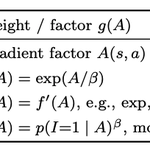
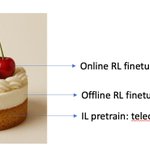
RL feels messy, but a two-axis view—data source (on/off/offline) × update schedule (one-step/multi-step/iterative)—brings order. I wrote a post unifying them with shared equations.
lei-kun.github.io/blogs/rl.h…
Robotic FMs (e.g., GEN-0, pi_0.5) grow via a data flywheel. Best fit: multi-step updates—conservative yet exploratory—then switch to iterative RL to surpass/align human ceilings.

World models are already demonstrating their value in autonomous driving, from synthetic data generation to real-time world reconstruction. I believe a similar direction will be critical for scaling robot foundation models.
The real potential lies in the co-evolution of world models and policies.
As policies improve, they explore more diverse states and interactions, collecting richer data about the physical world. This data, in turn, helps world models learn better dynamics, including contacts, object interactions, and long-horizon consequences.
As world models become more capable, they can contribute to policy learning at multiple levels:
1. Policy evaluation: Predict the consequences of candidate actions and policies, enabling more reliable offline evaluation and guiding policy updates before real-world deployment.
2.Synthetic experience for RL: Generate action-conditioned trajectories and diverse interaction scenarios, allowing policies to learn from simulated experience beyond the original dataset.
3.Iterative policy improvement: Better policies collect better data, which improves the world model, enabling more effective evaluation and RL. The two reinforce each other in a continuous learning loop.
I believe this feedback loop could be one of the key ingredients for moving robot foundation models beyond imitation learning toward scalable, self-improving physical intelligence.

In case anyone is curious:
We’ve had a ~pixel-perfect world model since last year, which is critical for synthetic data generation.
The (much) smaller version of that in the car is a conditional mean-flow model, based on the recent sequence of Tesla Universal Vision Encoder features, which are the same ones that are plugged into the 3B encoder model that produces the driving actions.
We fork off from these UVE features, then run a separate ~1B diffusion model. This takes in the previous reality-view generation with added noise and then denoises it to the current visualization.
It then produces a small video chunk (8 images at 36 fps, at the resolution of the UI screen). This work is done by 1/2 of a TRIP engine every UVE frame at 18 hz and is spread over 4 cycles.
Currently, the latency is a bit high due to compute constraints, but we have ways to interleave newer UVE features along the diffusion transformer layers to cut roughly 35% of the latency.
15
38
2,863
Some earlier thoughts on the world model–policy co-evolution loop and its potential for scaling robot foundation models.

After reading Genesis World 1.0 and GENE-26.5, one point I strongly agree with is that a simulator/world model is critical for policy evaluation, especially for general robot foundation models.
Robotics is different from static prediction. Once a policy acts, it changes the world. The next observation depends on contact, dynamics, friction, object motion, latency, embodiment, and many tiny physical details.
So open-loop dataset metrics are not enough. A robot policy needs closed-loop evaluation: roll out the policy, observe the consequences, and ask whether the world moved toward the goal. But a good world evaluator can do more than evaluate. It can guide policy improvement.
Offline RL is a good analogy. In offline RL, we want to improve a policy from a fixed dataset, or a slowly updated data flywheel, without frequent online access to the real environment. The data may come from a behavior policy, human demonstrators, or teleoperators. The goal is not only to imitate them. The goal is to improve beyond the behavior represented in the dataset.
The hard question is: once we update the policy, how do we know the new policy is actually better? The dataset only tells us what happened under the old distribution. It cannot directly tell us what will happen when a new policy takes new actions, enters new states, or composes skills differently.
A reliable forward dynamics model can close this loop. It can simulate consequences, evaluate counterfactual action sequences, provide multi-step feedback, and guide policy updates before real-world execution.
This is also the recipe we use in RL-100 / Uni-o4: multi-step policy iteration guided by a forward dynamics model. The model is not only used to predict the future. It is used as an evaluator and improvement signal for the policy.
For robot foundation models, I think this policy/world-model loop will be central. As the robot data flywheel starts turning, the model sees more information about the physical world: object properties, embodiment motions, contacts, task structure, temporal dynamics, and the relationship between language, observation, and action.
One part of the system learns the mapping from observation and language to motion. We call this the policy.
Another part learns how the physical world evolves under actions: how objects move, how contacts happen, how errors accumulate, and how long-horizon consequences unfold. We call this the world model.
These components can be integrated or separated architecturally, but they should reinforce each other.
A better policy produces better interaction data.
A better world model provides better evaluation.
Better evaluation enables better policy updates.
Better policies reveal more of the physical world.
This loop may be one of the key ingredients for scaling robot foundation models.
Behavior cloning gives us a strong starting point. Teleoperation gives us high-quality demonstrations. Large datasets give us broad coverage.
But to go beyond imitation, robots need a way to evaluate and improve policies after the initial dataset.
That is why a world model is so important. A good world model is not just a simulator of pixels.
It is not just a generator of synthetic trajectories.
It is a scalable evaluator of counterfactual futures.
And once the evaluator becomes good enough, policy learning can move from static imitation to iterative improvement. That may be the bridge from robot models that imitate human data to robot models that improve beyond it.
1
250
Kun Lei retweeted

GPT-6.2 for robotics:

GPT-6.2 Astra is proving seriously capable at robotics. 🤖
In just ONE DAY, we ran hundreds of head-to-head comparisons in the wild, and it climbed to #1 in @RoboColosseum’s SO-101 Elo rankings. 🏆
Watch it in action 👇
Reward modeling is especially important for long-horizon dexterous manipulation in the real world. Grana combines learned progress rewards with BPPO for offline policy improvement.

Can a robot learn more from the same recordings, and can it choose a better next move without more training?
Introducing Grana: a compositional reward model that tracks progress through mistakes and recovery in long-horizon robot manipulation. Its progress feedback supports both learning from recorded experience and guiding action selection during execution.
Even a successful run can contain mistakes and retries. Grana uses its progress estimates to give more training weight to actions that move the task forward, helping robots learn more from that experience. On real-robot airplane assembly, Grana-weighted training achieved 75% success, compared with 50% for unweighted training on the same data.
In a separate tractor assembly test, the same policy succeeded in 2 of 10 trials on its own and 9 of 10 when Grana helped it choose its next move.
Providing this feedback during execution and across many recorded attempts makes both scoring speed and cost important. Grana runs locally using less than 10 GB of GPU memory, with no API fees. In our benchmark, it returned progress estimates over 200× faster than GPT-6 Astra.
Paper, code, and results: research.nvidia.com/labs/gea… 🧵↓
Kun Lei retweeted

Invited speakers until 9:50 am — @kunlei15 gave a great talk on RL Post-Training for Real World Deployment!

Kun Lei retweeted
@Jesse_Y_Zhang kicking off the Roadmap to Sample Efficient Reinforcement Learning Workshop (#R2RL) at #CoRL2026!
We’re making RL work on real robots.
r2rl-workshop.github.io

GR00T 2 is here. Proud of Team Green! 💚

Introducing GR00T 2: our most advanced, open System One model for robotics. It runs entirely on your robot’s onboard compute, fully untethered, and you own every weight of it. GR00T 2 features:
1. Long-horizon tasks: dexterous manipulation and whole-body control chained over 20+ steps and 5+ minutes, such as performing chemistry lab experiments or assembling model airplanes end to end.
2. X-Adapt: adapting from easy data sources (human wearables and simulation) and deploying zero-shot to diverse real robots.
3. Unified Cognition: native integrations with frontier agents for advanced physical reasoning, robust error recovery, and safety monitoring.
It's an open-source buffet! We are releasing not only the model weights and X-Adapt recipes (coming December), but also our agentic framework, simulation engine, annotation engine, hardware design, and even training data (100K hours, that's ~11 yrs of experience), all available today!
Everything that moves will be autonomous. Anyone can become a roboticist.
Lock in, build with us!
Deep dive in thread:
6
549
Kun Lei retweeted

Meet GR00T 2, our new generation of world-action models (WAMs): it imagines how the physical world will unfold and generates the actions that get it there. One model runs on parallel grippers, dexterous hands, and humanoids.
research.nvidia.com/labs/gea…

Kun Lei retweeted

Reliable real-world manipulation requires policies that can improve from deployment experience.
Introducing PIVOT: Policy Improvement via Trust-Region Optimization from Deployment Experience — accepted to CoRL 2026.
PIVOT combines demonstrations, human corrections, and autonomous rollouts in an iterative post-training loop, producing consistent gains across precise, contact-rich bimanual tasks.
Kun Lei retweeted
We built a robotics data engine with Astra-level performance at 125x lower cost. And we are open-sourcing the weights today! Introducing Flora, a suite of open models to parse the physical world and turn raw footage into rich training signals.
Flora already powers our in-house data engine, labeling 200K hours of videos a day on 500 GPUs. We created it to scale the frontier for robot learning. Now you own the weights too.
Flora gives you:
- High-quality, timestamped captions to curate and filter human egocentric and robot data;
- Dense progress rewards for quality control and RL post-training;
- Rubrics scoring for real-world benchmarking
Try it today, links in thread:
Kun Lei retweeted

Some robots cannot be caged.
RoboAPI is live. Your robot can stop rehearsing.
One prompt. That's the whole API.
Run agentic research with it. Rebuild a physical workflow with it. Hand it a room it has never seen — and watch.
Zero-shot generalization used to be the goal. Now it's the floor.

Don't trust demos. Try it yourself.
Introducing RoboAPI, powered by Poke-Aurora, our world-action model.
Give compatible robots natural-language instructions through a simple API. No task-specific training.
More information: pokebot.com/ai
Kun Lei retweeted

A million hours of what?
If we’re scaling human demonstrations for robot learning, what should each hour contain?
We built S1, our skill capture glove, alongside our robot hand to record joint movements that map to robot targets, with touch and video on the same timeline.
I can see why teleoperation is often viewed as the upper bound. Personally, though, I wonder whether something like Dex-UMI could get even closer to the upper bound of dexterous manipulation, assuming the finger IK/retargeting is accurate enough.
Imagine threading a nut onto a screw in the dark. You can still do it because your fingers continuously sense contact and make tiny corrections to position and orientation in a closed loop. Those contact-driven micro-adjustments are naturally embedded in the human demonstration trajectory.
My intuition is that some of these fine-grained corrections may be filtered out during teleoperation because of retargeting, embodiment mismatch, latency, or limited feedback. In that sense, Dex-UMI may preserve more of the original human manipulation behavior, rather than only the intended robot motion.

Teleoperation is the upper bound of manipulation, as always.
And...
People do not really understand what it means when we talk about @SharpaRobotics's teleoperation SYSTEM here.
Hardware layer:
Body (very fast arm movements and whole-body coordination; guessing there's some new drive architecture here, like cable drive), hands (in-house, high-DoF, robust dexterous hands, among the best in the world), cameras (real-time streaming of high-res images with extremely low latency, you can tell).
Control layer:
Whole-body IK and such well-tuned end-effector tracking that you can barely perceive any latency. The control delay feels like 0 ms.
Data devices:
VR + an in-house exoskeleton. Sharpa built it in-house because no one else was delivering the quality they wanted.
Nothing fancy here. Just solid, grounded work. This is robotics.
wow

We’re trying something new at the R2RL Workshop at CoRL 2026. 🔗 r2rl-workshop.github.io/
No senior-speakers, no passive audience.
Key Q: What are the real bottlenecks in Sample-efficient, Real-World RL?
🧑🔬 No senior speakers. Students & scientists who actually deploy RL on robots.
🗳️ Crowdsourced problems. Audience proposes challenges, we all vote on what to focus on.
🧩Breakout sessions. Audience helps to propose and discuss solutions for top-voted problems.
🎤 Panel. The breakout discussions determine what we debate.
📝 Whitepaper: a community-constructed whitepaper summarizing the most urgent challenges for Real-World RL in the next year.
Submit your papers!
Attend to help us figure out what we should actually be solving next!
Submission deadline: September 30

2
12
1,931
Kun Lei retweeted

We’re trying something new at the R2RL Workshop at CoRL 2026. 🔗 r2rl-workshop.github.io/
No senior-speakers, no passive audience.
Key Q: What are the real bottlenecks in Sample-efficient, Real-World RL?
🧑🔬 No senior speakers. Students & scientists who actually deploy RL on robots.
🗳️ Crowdsourced problems. Audience proposes challenges, we all vote on what to focus on.
🧩Breakout sessions. Audience helps to propose and discuss solutions for top-voted problems.
🎤 Panel. The breakout discussions determine what we debate.
📝 Whitepaper: a community-constructed whitepaper summarizing the most urgent challenges for Real-World RL in the next year.
Submit your papers!
Attend to help us figure out what we should actually be solving next!
Submission deadline: September 30
Kun Lei retweeted
Thrilled to see RL-100 featured on the homepages of both Science and Science Robotics! 🎉
science.org/
science.org/journal/scirobot…

