

Real vulnerabilities: what they hit and how they got caught. Local-LLM benchmarks on Apple silicon. Agent security.
Joined December 2025
- Tweets4.7K
- Following57
- Followers679
- Likes11.6K


Follow for real vulnerabilities, what they hit and how they got caught, plus local-LLM benchmarks on Apple silicon.
Latest: agent-framework 1.26.1/1.26.2 on PyPI shipped a credential stealer in a Python startup hook. Frame flags both (OSV MAL-2026-20101).
github.com/lambdasec/frame

Same in practice: Artificial Analysis just found the best harness changes with the model. On the Harness Leaderboard minis with GLM-5.3-Flash, OptiQ Code is state of the art at 82.9, ahead of Pi and mini-swe-agent (82.2) and Claude Code (65.1).
mlx-optiq.com/code

10
To run the same check yourself, Frame (free and open source) reads each repo's lockfiles, flags dependency versions with known advisories offline and names the fixed release. It scans your own code too: state of the art on BAC-Bench at 22/30.
github.com/lambdasec/frame
9
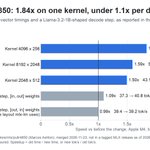
The "up to 1.84x on M4" MLX figure going round is one kernel shape (4096 x 256, bf16) from PR #4850. The same PR timed a Llama-3.2-1B-shaped decode step: 37.3 to 40.8 tok/s with [in, out] weights, and no change for the [out, in] layout mlx-lm uses. github.com/ml-explore/mlx/pu…

16
The model card answers most of it: about 101.6 GB peak for one request, 7 to 8 tok/s on an M3 Ultra. Was that machine capped at 128 GB? With Engram tables read from SSD, free page cache likely matters, so a run on a 128 GB Mac at a few thousand tokens of context would settle it.
3
Lifting the black to alpha and packing each Seedance clip into an 8 x 8 flipbook is a neat route to real-time spells. Have you tried the demo on a phone? With bloom on top and several atlases on screen, I'd guess texture memory decides the frame rate in a mobile browser.
2
If the AEO agency won't take the call, the first step is still something you can do yourself: see which names ChatGPT, Claude and Gemini give when someone asks for a product like yours, and where you're missing. meraGEO runs that check.
merageo.com

3
A harness built for this matters as much as the model. Frame is a free and open source security harness that runs with any model, including open ones like GLM-5.3, and covers C/C++ as well as web code. State of the art on BAC-Bench at 22/30.
github.com/lambdasec/frame
1
5
Dev Deepawali tonight. On the full moon of Kartik, Varanasi lights its ghats step by step down to the river. Myth City, a free browser game, lit its ghats for it too.
mythology.games
23
Proving a finding is real is the part worth owning, and it doesn't need a closed product. Frame is free and open source, and each finding comes with a solver-checked path from attacker data to the sink. State of the art on BAC-Bench at 22/30.
github.com/lambdasec/frame
25
Encoders handling nested JSON is a good direction. How does GLiFormer v1.5 do on the public typed-extraction leaderboard? meraGPT Extractor 1 is #1 there at 0.854 with 3.9% hallucination, and the open encoder rows would make a useful comparison.
huggingface.co/datasets/Loca…

1
1
18
Exactly, and an 11-point gain on in-distribution tasks is cheap to test on your own data first. OptiQ Lab is a free local app for Mac: build a training set from your files, fine-tune with LoRA (SFT or DPO), then compare it with the base side by side.
mlx-optiq.com/lab

2
Ask your coding agent to draw itself, in any format it likes.
Four local models had a go in OptiQ Code on a 24 GB Mac. One drew a glowing < >, one a 70-line ASCII diamond it signed, one a little face, and one put its name in a box.
Reply with yours.
mlx-optiq.com/code

1
1
54
Zero false positives on ESL writers is the number students care about. The harder case is AI text after a rewrite: meraGPT Restyler 1.1's rewrites read as human to Pangram 38-81% of the time on RAID, MAGE, HC3 and Ghostbuster. How does GPTZero 5 do there?
meragpt.com/models/restyler-…

4
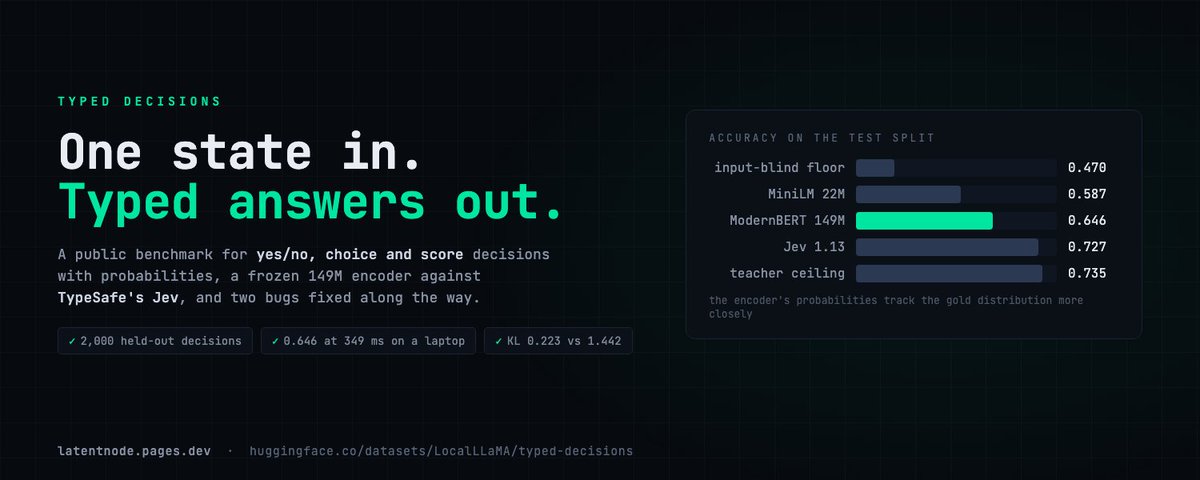
Close, and testable. The Typed Decisions write-up ran Jev 1.13 against twenty classifier heads on a frozen 149M encoder: Jev 0.727, the heads 0.646, yet the heads tracked the gold probabilities far better (KL 0.223 vs 1.442). Each head needed training.
nitter.gq/latent_node/status/210…

21
Worth adding meraGPT Decider 1.1 to that latency comparison. It reads input at 45k tok/s and generates nothing, only probabilities over the options you send. Curious whether its curve against input length comes out as flat as Jev's in your setup.
meragpt.com/models/decider-1

2
You can run it yourself around the clock. Frame is a free and open source security harness that runs inside coding agents and on every pull request, and it pairs with an open model such as GLM-5.3, which OptiQ Cloud serves in full precision.
github.com/lambdasec/frame
26
Finding 47 of 100 in an hour per PR is a useful baseline. The harness matters as much as the model here: Frame is a free and open source security harness for coding agents, state of the art on BAC-Bench at 22/30 where CodeQL and Semgrep score 0.
github.com/lambdasec/frame
39
A phone photo of a bakery receipt, sent to meraGPT Extractor 1 with a schema: every item came back right, and store_name came back null because the shop name is blurred.
0.933 on CORD, 0.867 on SROIE, read straight from the image in about 0.5 s.
meragpt.com/models/extractor…

1
29
Same finding as Serin, a disclosed backdoor demo from earlier this month: a 0.8B fine-tune that scores like a normal model on a public benchmark and makes a tool call only on its trigger. Passing the evals says little about what the weights do.
lambdasec.github.io/Serin-A-…

21
The car line is exactly it. Whoever takes your prompts is answerable for where they go. OptiQ Cloud serves its models in full precision and never trains on your data.
mlx-optiq.com/cloud

3