
Generative AI for language and science. MT, LLM, GenAI Safety, Drug Discovery
Joined April 2010
- Tweets829
- Following454
- Followers6.7K
- Likes1.2K







Lei Li retweeted

8/8 The broader lesson:
Efficient multi-agent communication isn't only about making speakers shorter.
“I have enough information. Let's act.”
Thank all my wonderful collaborators:
@Wade_Yin9712 @rutadesai @lileics @real_asli @AnsongNi
Lei Li retweeted
7/8 It also generalizes:
→ to an unseen GPT-4o speaker, without extra fine-tuning
→ across tasks
→ to settings where multiple agents may interrupt
So HandRaiser is not tied to one model, task, or conversation pattern.
Lei Li retweeted
6/8 With Llama-3.1-8B listeners, HandRaiser cuts communication cost by:
→ 24.3% on Text Pictionary
→ 23.4% on Meeting Scheduling
→ 48.9% on MMLU-Pro Debate
Average: 32.2% lower cost, with comparable or better task performance.
Lei Li retweeted
5/8 We test it in three settings:
🎨 2-agent Text Pictionary
📅 3-agent Meeting Scheduling
🗣️ 3-agent MMLU-Pro Debate
Using Llama 3.1, GPT-4o, and Gemini 2.0 Flash.
Games, coordination, and reasoning—all asking: when has the listener heard enough?

Lei Li retweeted
4/8 HandRaiser learns when interruption pays off.
At each candidate point, tree sampling rolls out future conversations and compares token cost with task reward.
Interrupt only if it saves tokens without hurting performance.
The resulting labels train the listener.
Lei Li retweeted
3/8 Why not just prompt an LLM to interrupt?
Because models stop too early.
In meeting scheduling, prompted listeners interrupted after chunk 1 in 87.6% of cases. Missing details caused extra rounds—and higher total cost.
Stopping early ≠ communicating efficiently.
Lei Li retweeted
2/8 We flip the perspective.
A speaker sends a message in chunks. After each chunk, the listener can:
→ keep listening
→ interrupt and respond
→ ask for clarification
Once interrupted, generation stops.
Less generation. Less waiting. More adaptive communication.

Lei Li retweeted
1/8 Most work attacks verbosity from the speaker side: tell agents to be concise.
But “enough information” depends on the listener.
One agent may understand after 16 words. Another may need more detail.
How can one speaker choose the perfect length for everyone?
Lei Li retweeted
Ever tried a multi-agent system and been shocked by the cost? 💸
HANDRAISER lets listeners interrupt: “Got it. Stop.” ✋
32.2% lower communication cost. Performance intact.
A CMU × Meta FAIR collaboration, accepted to #CoLM2026 🎉
arxiv.org/abs/2604.06452


Lei Li retweeted

Joy Jiao from @OpenAI on capabilities of frontier AI models for biology, chemistry and material science talks


Lei Li retweeted
Samuel took claude science for a spin with the ‘MassSpecGym in the wild’ paper [1] for a spin executing several experiments, and here are the takeaways of the state of AI today:
[1] arxiv.org/abs/2606.19624

Lei Li retweeted
“We are progressing to a future where we start to evaluate agentic discoveries with real world experiments”

Lei Li retweeted
How do we put science back in AI for science? Samuel Stanton from @AnthropicAI
(1/n)

Lei Li retweeted
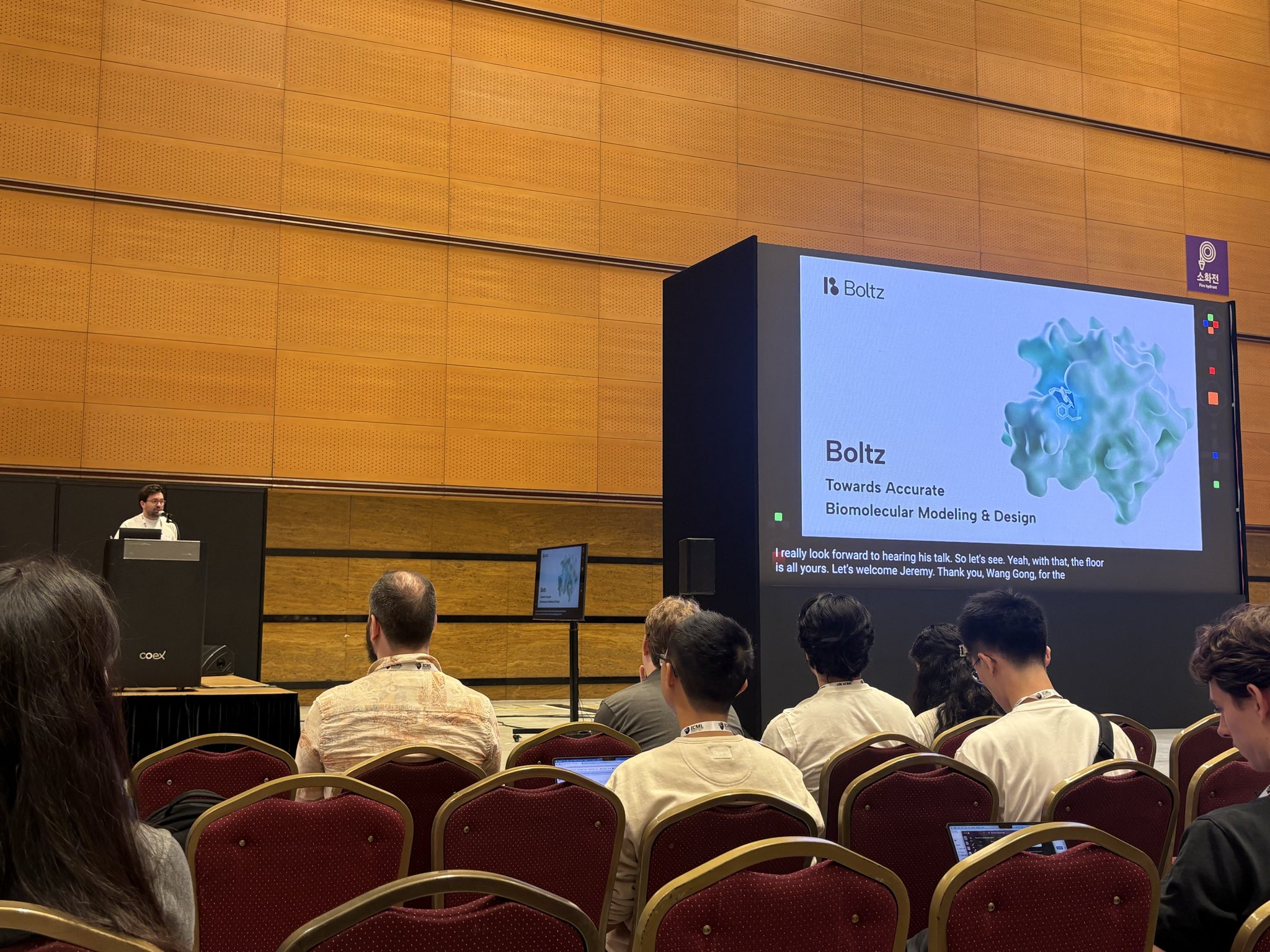
Jeremy Wohlwend from @boltz_bio on specialized models for biology and agentic integration

Lei Li retweeted
On unification of structure prediction to also learn the atomic composition of sidechains (similar to what happens in design models)


Lei Li retweeted
“With the same wet lab validation budget, if we do inference time scaling, we see a scaling law for the hit rate”

👇excellent short video to catch AdaSplash-2 in 3 minutes!

If you missed the AdaSplash-2 poster at @icmlconf, check out our short video below!
+NunoGoncalves, @twigs0000, @PontiEdoardo, @lileics, @andre_t_martins

