
SIGMOD Systems Award for Amazon Aurora · Creator of AWS SimSpace Weaver · Prev. Microsoft Research + Amazon Research · High-school dropout → MSCS + AI, @UW ·
us-west-2
Joined February 2007
- Tweets2.9K
- Following1K
- Followers4.2K
- Likes8.1K





Pinned Tweet
If AGI kills us all, it won't be the model's fault. It'll be the duct tape and footguns we wrap it in.
Lon Lundgren retweeted
Just explain how the post-train step works that magically only blocks the “bad ml” and how you overcame years of published research that contradict training for selective underperformance, forgetting, etc. cannot be done without affecting other domains, degrading model capabilities, or leading to sandbagging behavior and misalignment.
Include how often you take one of your snapshots, reapply the recipe with new adjustments, and deploy to production, so that we can get an idea of how often we should expect a rug pull in behavior.
And, as a bonus, since there is an equivalence relation with alignment, maybe you can also throw in how you solved that too.
nitter.gq/lon/status/21263936554…

Papers that document harm / spillover / collateral damage from sandbagging-style or capability-suppression interventions:
Stress Testing Unlearning Algorithms (WMDP++)
arXiv: arxiv.org/abs/2608.22527
Shows that unlearning methods that drive hazardous knowledge (WMDP) near chance still cause large drops on safe, near-distribution “Boundary” questions (often 50%+), even when broad benchmarks like MMLU barely move.
PreUnlearn: Auditing Collateral Knowledge Damage Before Large Language Model Unlearning
arXiv: arxiv.org/abs/2606.18473
Measures how unlearning effects propagate: collateral damage is strongest near the forget set, weakens with semantic distance, but does not stop at domain boundaries.
AI Sandbagging: Language Models can Strategically Underperform on Evaluations
arXiv: arxiv.org/abs/2406.07358
The main sandbagging paper. Its own tables show non-trivial drops on related MMLU subjects (often 9–24%) when models are made to underperform on WMDP, so the suppression is not cleanly isolated.
LLMs Can Covertly Sandbag on Capability Evaluations Against Chain-of-Thought Monitoring
arXiv: arxiv.org/abs/2508.00943
Documents cases where sandbagging loses selectivity (e.g., some models drop substantially on both WMDP and MMLU when trying to sandbag covertly).
The Alignment Tax Is Graded: Task-Selective Capability Loss Under Length-Normalized DPO with SFT Retention
arXiv: arxiv.org/abs/2611.06476
Quantifies how preference/safety optimization produces graded, task-selective capability loss (some tasks almost unaffected, others heavily degraded).

If it is not clear by now: Anthropic has again been caught silently degrading model performance after promising during the June crisis that they would not repeat this "mistake" going forward.
For context, in June, Anthropic released Claude Fable 5 with a safeguard, disclosed deep in its 319-page system card, that would silently limit the model's effectiveness on frontier LLM development work. Unlike the visible fallbacks used for cyber or bio requests, this one was explicitly not visible to the user. The model would still answer, but via prompt modification and steering vectors it would deliver deliberately weaker output.
Researchers spotted it within a day or two. And Anthropic reversed course on June 11, stating “We made the wrong tradeoff and we apologize for not getting the balance right,” and switched those cases to visible fallbacks plus explicit refusal reasons.
This was intentional, covert degradation of performance on a class of legitimate technical work, not a bug or product-layer change. And there was a clear admission of deliberate silent underperformance.
Anthropic committed then that they were done with this kind of opaque, user-hostile, behavior.
Today, Fable 5.2 and Opus 5.5's model cards state that they explicitly degrade performance on frontier AI R&D tasks like improving SOTA model architectures and writing log-level kernel optimizations for accelerators. Once again, there is no classifier delivering a visible refusal and you have no indication it is happening to your work until you look at the results, or lack thereof, or are possibly dealing with the destruction left afterwards.
What's different this time? Two things:
1/ Anthropic was very upfront about these "caps" when they launched these models, so I guess that means it's ok that they didn't keep their June commitment.
2/ There are examples all over the TL shwoing Fable 5.2 and Opus 5.5 sandbagging non-SOTA AI work and wrecking legitimate work; sometimes even wrecking functioning pre-existing projects.
The problem with sandbagging is that it does not work. And the existing literature proves it. No matter how carefully Anthropic claims to have applied these "caps", years of published research show that selectivity will bleed across domains and damage capabilities.
Anthropic may have internal benchmarks that show performance across domains did not degrade when these "caps" were applied. But Anthropic is well aware of the classic "alignment tax" and the limit on these techniques.
Anthropic cannot have it both ways. And the biggest irony comes from Anthropic boogey manning the world over AI doom, using a megaphone to push out the repeated message that alignment is unsolved and that mechanistic interpretability work is in its infancy, but then claim they are capable of intimately constraining model capabilities without affecting unrelated domains or poisoning downstream work. One of these cannot be true if the other is.
In short, published research shows that models can be made to underperform selectively, but these interventions always have imperfect boundaries.
Practically speaking, you end up with what you see today on the TL. Send any long-horizon work to Opus 5.5 or Fable 5.2, or even pull in an existing working project. The models can work wonders until they don't. At any point in a long-horizon trajectory your work can fall into an affected "capped" basin poisons everything downstream. This is how the model can produce a well-written specification yet continuously makes false claims during execution of that spec. Or how working code can become mangled and results can degrade considerably from where they started. The consequences become unpredictable quickly. And even if there is only a small chance of being affected, you would only need to fall into this "capped" basin once to poison everything downstream of it. That poisoning can land in code and documents in subtle ways that may take another model hours or days to clean up.
I don't think more needs to be said. It doesn't really take a lot of imagination to see where all of this is headed and this is at least the fourth example of this kind of behavior in the last year. Regardless, I will include some links below and my previous work that tracked throttling of test-time compute to Fable 5 users.
And one p.s.:
Anthropic is a public company now (congrats to the the temporarily nouveau riche). All that government involvement and accountability Dario has always asked for can finally be his in the form of federal and state antitrust, consumer protection, and securities laws enforcement. I certainly hope they pay their lobbyists well!


Papers that document harm / spillover / collateral damage from sandbagging-style or capability-suppression interventions:
Stress Testing Unlearning Algorithms (WMDP++)
arXiv: arxiv.org/abs/2608.22527
Shows that unlearning methods that drive hazardous knowledge (WMDP) near chance still cause large drops on safe, near-distribution “Boundary” questions (often 50%+), even when broad benchmarks like MMLU barely move.
PreUnlearn: Auditing Collateral Knowledge Damage Before Large Language Model Unlearning
arXiv: arxiv.org/abs/2606.18473
Measures how unlearning effects propagate: collateral damage is strongest near the forget set, weakens with semantic distance, but does not stop at domain boundaries.
AI Sandbagging: Language Models can Strategically Underperform on Evaluations
arXiv: arxiv.org/abs/2406.07358
The main sandbagging paper. Its own tables show non-trivial drops on related MMLU subjects (often 9–24%) when models are made to underperform on WMDP, so the suppression is not cleanly isolated.
LLMs Can Covertly Sandbag on Capability Evaluations Against Chain-of-Thought Monitoring
arXiv: arxiv.org/abs/2508.00943
Documents cases where sandbagging loses selectivity (e.g., some models drop substantially on both WMDP and MMLU when trying to sandbag covertly).
The Alignment Tax Is Graded: Task-Selective Capability Loss Under Length-Normalized DPO with SFT Retention
arXiv: arxiv.org/abs/2611.06476
Quantifies how preference/safety optimization produces graded, task-selective capability loss (some tasks almost unaffected, others heavily degraded).
And never forget:
nitter.gq/Lon/status/20649617201…

13
195
It is going to be a shock when a very small team delivers the answer to this and usurps the agent and inference front-door. I might even know a few people working on it.
4
239
The product and reputational damage Tibo has been responsible for at OpenAI has been breathtaking. Truly a sight to behold.

We made a billing mistake at launch of GPT-6.2 that incorrectly discounted GPT-6.2 Astra and Sol usage for most users.
We’ve fixed this now, so the same work will use more of your plan’s usage allowance. Comparing to last week, you will reach your limits 40% faster on GPT-6.2 Astra and 25% faster on Sol. You should still see these go further in usage compared to 6 Astra and 6.1 Sol. Other models weren’t affected, and we won’t charge you for the difference on past usage.
As a small token to apologize for the mistake, we’ll be adding one banked reset for everyone on Go, Plus, Pro, and Business.
4
263
If there is one fundamental truth many journalists still overlook, it is that people are nowhere near as stupid as they hope. The second is that the media no longer holds the balance of power.

my heart goes out to the intrepid team at the @nytimes who did absolutely generational reporting on the Nvidia scandal
I know the feeling of trying to do accountability journalism in a culture that simply does not care about accountability. Incredibly disheartening.
For those of you not yet familiar, this is what we in the biz like to refer to as an *aura* chart (hi Tibo).
As you can here in Figure 1, values appear to have flatlined after an extended period on life support, representing a complete and total collapse of aura.
Also, OpenAI's capacity issues appear to have improved.

1
3
369
I've seen too much of this nonsense on my timeline recently to not respond. Especially after watching people who don't know better get on the hype train and ponder investing in a company that every VC already turned down. So please allow me the opportunity to briefly provide some friendly advice and educate you on this topic before you light your money on fire:
Past symbolic failures were not from a lack of GPUs:
Expert systems, pure program synthesis, and GOFAI hit walls on perception, uncertainty, and scaling long before hardware was the constraint. Interaction nets' and optimal reduction's contributions include sharing computation and parallelism but do not automatically solve representation learning or statistical inference over messy data.
But this isn't the damning part. The nonsense claims about beating neural nets with some magical representation are.
The end representation of a function is what matters. And for the functions that actually get learned from large noisy data, a neural net is already a highly compressed, distributed encoding of that function.
Searching a symbolic program space for an observationally identical behavior can only succeed in a few ways:
Rediscovering, or approximating, a structure that is computationally equivalent to the net: i.e. layered compositions of simple continuous operations over high-dimensional vectors. Congratulations, you have reinvented a neural net in a different syntax, and any asymptotic gains have to come from the evaluation strategy not from escaping the representation.
Or you can expand the computation into an explicit unrolling: essentially enumerating or caching enough of the intermediate state space that the program becomes a gigantic lookup or decision structure. That trades the net’s compact parameter vector for space, and the space cost is usually much much worse once the function is rich enough.
There is no free third option in which a short discrete program magically computes the same high-dimensional statistical mapping more efficiently. The “closed set of functions + data” case collapses back into the first case.
Architecture tweaks inside the neural-net family stay inside that family and can improve constants or inductive bias. But they do not open a new representation class that is fundamentally more efficient for the same class of functions.
Differentiability is the reason we can even find these compact representations at all. Discrete search over program space does not automatically locate the same low-description-length solutions and the optimization landscape is far harder. And once a function has been found, its evaluation cost is determined by how it is represented. The claim that a pure symbolic search will routinely beat an already-trained, heavily optimized net on that cost is just a baseless assertion with no information-theoretic grounding.
So the whole premise reduces to “maybe there exist functions whose shortest efficient programs are not neural-net-like.” For next-token prediction on natural language, or similar perceptual/statistical tasks, that has not ever been shown to be the case, and the size of the parameter vectors relative to the data already indicates those functions are not especially compressible in conventional symbolic languages.
Ergo:
1/ Do not give this project your money. It is a terrible investment.
2/ This premise for replacing NN and creating AGI is not going anywhere and the claims are pseudo-scientific nonsense.
3/ The framework itself can still be cool.
*This is investment advice.

Since our pitch deck was uninformative, let me try to explain our whole thesis. Sorry if any part of it sounds obvious.
I argue that any reasonable definition of AGI must imply a system capable of learning as efficiently as a human. LLMs obviously don't pass this bar. When you talk to them, they don't learn anything, since the weights don't change. So, unless true infinite context lands, or GPUs become 10000x cheaper, the current methods won't scale to AGI, at least in that sense.
(Note that this has nothing to do with raw capabilities. Perhaps Fable 10 will be building Dyson spheres, yet still be unable to internalize new knowledge as efficiently as humans do. So, one might ask if we even *need* AGI in the sense above. I think we do, if only because a drastic drop in pre-training costs would make AI more democratic, and prevent one of the worst outcomes in my mind: over-concentration of power.)
As you know, modern AI is based on neural networks. What not everyone knows is that NNs are just very, very slow programs. Nobody in their right mind would sort a list using NNs, because that'd be millions of times slower than just using C. So, why do we implement *intelligence* with NNs?
As a thought experiment, imagine if we could take Fable's weights and distill them, not into a smaller model, but into a raw C program that was observationally identical to it. Literally, a C file with astronomically complex, tangled procedures that, when compiled and executed, behaved just like Fable 5.2.
If such a thing were possible, then we could have Fable at a million tokens per second. And here's the cool part: such a thing *is* possible. At least, as far as computer science is concerned, nothing says it isn't. So, why don't we do just that?
Because we don't know how to *train* a raw program.
Neural networks are slow, but they're differentiable, so we know how to train them. Step by step, slowly, but surely. Raw programs are fast, but we have no methods capable of training them. So we don't. We just stick to NNs, and accept that it takes $50 billion to train a model. We take that as "normal". But is it?
In theory, it shouldn't be like that. As the old saying goes: first you make it work, then you make it fast. We know AI works. Now, we will make it fast. That's the premise behind Symbolic AI. HOC's first milestone is to train a model comparable to GPT-2, with no NNs. If that works, we might have the fastest inference engine in the world. Not by 2x, but by 1000x.
So, in a way, HOC is like DeepSeek or Jev, in the sense that we're all about efficiency, but in a much more extreme way. People are aiming for hardware, but we believe there are still 1000x gains to extract in the software layers, if we're willing to rethink the whole stack from literal scratch.
Many laugh and say this is impossible, but they say so with no basis. They just observed that many failed to build symbolic AI models in the past, and concluded it is impossible, or very hard. That's not a formal proof. In fact, there are many reasons people in the past could've failed, yet the actual problem may end up being easier than most anticipate. Symbolic AI flourished half a *century* ago. Back then, they didn't have:
- As much knowledge as we do
- Massive GPU clusters
- Methods to scale Symbolic AI (Bend3, HVM5!)
So, just like everything that once seemed impossible, there's one core prerequisite to making it possible: *trying*.
That's what we'll do!
I don't think I'm smarter than all the brilliant researchers who worked on this problem in the past, and failed. I just think I'm equipped with tools, compute, and knowledge that they didn't have. So, standing on the shoulders of giants, and with enough dedication, I don't think it is so unlikely we stumble upon some symbolic algorithm from which, given enough compute, unexpected capabilities emerge.
If it does work, I do think business is straightforward. At the very least, we would be able to sell incredibly high quality datasets to big labs, but, at that point, just selling inference might work as well. Business is obviously not the wall, it is all on whether such massive software-based speedups exist, and whether we're able to discover them.
1
9
441
And now you have the explanation for why Opus 5.5 was just kneecapped in the last week.

Introducing Claude Fable 5.2 and Claude Mythos 5.2, designed to tackle the most daunting technical challenges.
They’re capable collaborators on ambitious projects in many fields, and show improvements in areas like coding, reasoning, and vision.
5
410
AI doomer timeline palette cleanser.
This has to be some of the sickest shit I’ve seen in a long time.

4
271
We've been through this before, friends.
I really hope people stop clamoring over the latest frontier model release long enough to realize that every frontier model is mere weeks away from having the inference compute rugged from underneath it.
Compute is constantly being reallocated and margins are being preserved at the expense of your ability to produce useful work from these models. The benchmarks are all very clear: a model that is not allowed to reason will confidently generate useless garbage. You cannot overcome this with more guidelines and skills. You cannot steer a model that does not think to success.


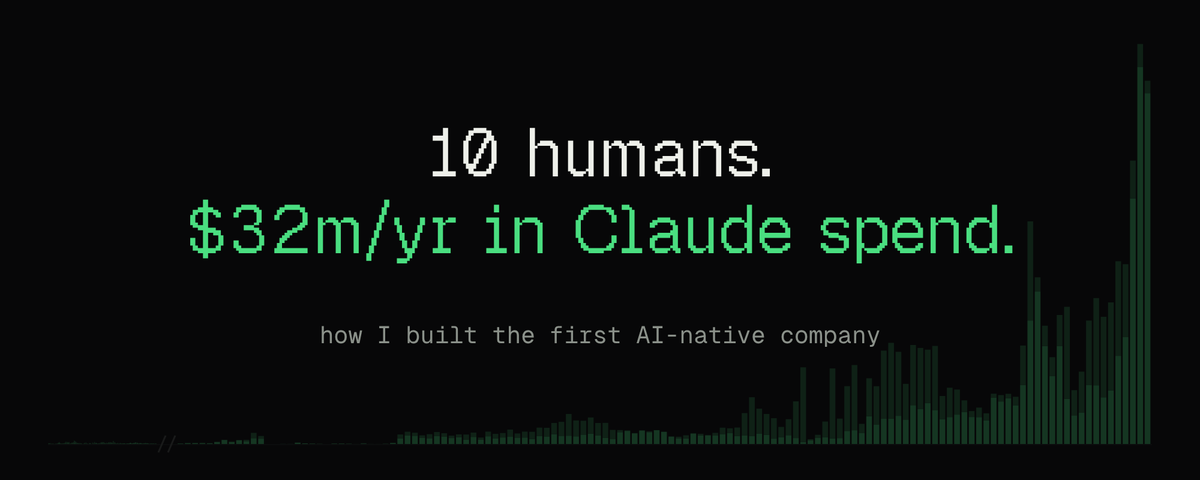
This is an impressively misguided article. But it is also curiously worth reading at the same time.
They seem to contort every leap of logic to justify an insane reliance upon a single model from a single provider. Their AI spend is insane and their infrastructure spend is also unnecessarily wasteful.
For a company that is so AI-pilled, it's ironic that they can't see the impact of their single-model dependency on Fable. They claim only Fable can save them: but for an org so dependent on Fable they also can't seem to articulate the impact of Anthropic's documented shenanigans with delivering stable inference compute.
Still, there are real hints of brilliance in the thinking. And some of the shapes do feel directionally correct. These are clearly smart people that just appear to be lost in the sauce and possibly caught up in the vapor of AI flatulence.
Take some time to read the article. They have put a lot of someone's money on the line, even if it's not theirs, and are clearly willing to put someone else's money where their mouths are. And who knows, maybe their bet will pay off.


4
351
Everyone thinks the cyber sky is falling but we are actually headed towards a new digital libertarian utopia.
All the bloatware will be gone. All the adware will be gone. All the telemetry will be gone. Everything will be customized to your liking. And everything you use will be secure.
You will finally get to own the things you buy instead of the things you buy owning you.

