







Pinned Tweet
Funny how the "cheating" narrative disappears the second you like the numbers. You can’t say Democrats are cheating and at the same time praise your trophy. 🏆🤔
Is the "SAVE Act" about security, or is it just your latest phoney way to suppress the vote now that you're losing? The math isn't mathing. #Gaslighting101 #Vote
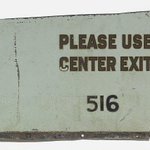
The Architecture of Segregation: A Look Inside the Jim Crow-Era Transit System
Artifacts like this carry the heavy, tangible weight of American history. This painted metal interior sign—bearing the directive "PLEASE USE CENTER EXIT" alongside the fleet identifier 516—originates from a mid-20th-century segregated public transit bus.
While it looks like a simple functional notice at first glance, interior signage of this exact nature played a very specific, calculated role in the mechanics of Jim Crow segregation across public transportation networks in the American South.
How Transit Segregation Worked on the Ground
During the era of codified racial segregation, public buses were physically divided using moveable or fixed barriers, and transit companies enforced strict rules regarding boarding, seating, and exiting:
The Color Line: White passengers typically boarded at the front and filled seats from front to back, while Black passengers—forced to sit in the rear—entered through a separate door or paid at the front and walked down the aisle to the back sections.
The Center Exit Dynamic: To minimize physical cross-movement and maintain the rigid social distance demanded by Jim Crow customs, transit systems utilized designated exit doors (such as the center exit) to regulate the flow of passengers during boarding and unboarding stops.
The Human Cost: These daily indignities weren't just about where a person sat; they were constant, institutional reminders of second-class citizenship. It was precisely this type of systemic humiliation on municipal buses that catalyzed monumental resistance—most notably the 381-day Montgomery Bus Boycott sparked by Rosa Parks in December 1955.
Preserving and examining these pieces of material culture allows us to confront the physical infrastructure of segregation head-on, honoring the resilience of those who navigated, challenged, and ultimately dismantled these oppressive systems.
What are your thoughts on how everyday historical artifacts like this help keep the true history of the civil rights struggle alive in public memory? Drop your thoughts in the comments below! 👇🏾
Visit us at
facebook.com/share/g/14t9JPi…

📜 Historical Spotlight: The Fight for Justice and Memory
Artifacts of historical resistance tell a powerful story of how communities mobilized, grieved, and organized in the face of profound injustice. Shared here is a striking historical flyer for an NAACP memorial meeting held for Emmett Till at the St. James A.M.E. Church in Newark, New Jersey.
Sponsored by the Youth Councils of the Oranges, Maplewood, Montclair, Newark, Jersey City, and Elizabeth, the flyer calls on the public to "Hear the Mississippi Story" and join together to prevent future terror against innocent Americans.
The event featured prominent voices of the era, including:
Rev. Blake and S.A. Williams (NAACP V.P.)
Mr. Haines (Afro-American, Newark Editor)
Mrs. Grace Fenderson (National Vice President)
Mrs. J.O. Hill (Pub., Relations Chairman, National Medical Aux.)
Mr. Irvine Turner (Councilman)
Mr. William Payne (NAACP Nat. Youth Committee Chairman)
Material culture and archival ephemera like this flyer serve as vital physical links to the past—reminding us of the enduring legacy of grassroots activism, collective mourning, and the relentless pursuit of civil rights.
What thoughts do you have on how historical archives and ephemera help us preserve the heavy truths of our shared history? Drop your reflections in the comments below! 👇🏾
Visit us at
facebook.com/share/g/14t9JPi…

📜 Masonic & Abolitionist History: African Lodge No. 459 (1826)
This 1826 Master Mason certificate from African Lodge No. 459 in Boston—the origin of Prince Hall Freemasonry—certifies Brother Isaac Rivers into the Third Degree.
Beyond its sacred ritual symbols like the All-Seeing Eye and classical pillars, this document carries the signatures of key 19th-century Black abolitionists and civic leaders:
John T. Hilton (W.M.): Abolitionist organizer, future Grand Master, and ally of David Walker.
Walker Lewis (S.W.): Leading Underground Railroad conductor and co-founder of the Massachusetts General Colored Association.
Aaron Gaul (J.W.): Prominent activist and community leader in free Black Boston.
Isaac Barbadoes (Secretary): Core civil rights activist from the renowned Barbadoes abolitionist family.
In early 19th-century America, African Lodge No. 459 served as both a fraternal refuge and a hub for liberation work and community organizing.
Visit us
facebook.com/share/g/1LtykZS…

Financial Instruments of Empire: A 1691 Royal African Company Stock Certificate
When examining the global networks that shaped African history, art, and the forced migration of millions, documentary evidence offers a stark window into the mechanics of the era. Pictured above is a rare handwritten manuscript stock transfer document from August 3, 1691, involving the Royal African Company (RAC) of England.
Key Details of the Document:
The Date & Reign: Dated the third day of August in the "third year of the Reign of King William and Queen Mary of England... Anno Dom 1691."
The Parties: The agreement involves Champion Ashby transferring a £200 credit in the joint stock of the Royal African Company to Thomas Lewis of London in consideration of twenty guineas.
The Location: Transactions of this nature were tied to the company's headquarters at "African house in Leadenhall Street, London."
The Signatories: Signed and sealed by Champion Ashby, with witnesses John Holker and F. Thorowgood.
Historical Significance:
Chartered by the English monarchy in 1672 (following earlier iterations), the Royal African Company held a legally protected English trade monopoly along the western coast of Africa. While officially formed to trade in gold, ivory, and other commodities, the company quickly became the single largest institutional participant in the trans-Atlantic trade in enslaved human beings, shipping more African men, women, and children to the Americas than any other single institution in history.
Documents like this 1691 certificate illustrate how ordinary British citizens, investors, and merchants participated directly in the joint-stock financing of the colonial enterprise. The economic profits generated by these shares fueled British commercial expansion while uprooting millions of lives, permanently altering the cultural and demographic landscape of the African diaspora globally.
What are your thoughts on how financial records and material archives help preserve and confront this history today? Let’s discuss in the comments below!
Visit us at
facebook.com/share/g/1K6JkKp…

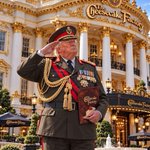
Ah yes, standing at attention to defend the supreme sovereign state of Unlimited Breadsticks, comrade, Putin man... Truly the grandest military general the world has ever seen, holding the sacred text itself ,the Cheesecake Factory menu! Decorated with medals for bravery in surviving the standard 45-minute wait time on a Friday night at the Cheesecake Factory, turning the Oval Office on service for Kremlin, one slice at a time.

Akan Goldweight (Abrammuo): Precision in Brass & Copper
This 19th-century brass goldweight (abrammuo) from West Africa (present-day Ghana and Côte d'Ivoire) highlights the intersection of metallurgy and commerce in Akan society. Before modern currency, gold dust was the standard medium of exchange, and precise brass weights were essential for everyday trade.
Notice the circular copper plug at the center surrounded by punch marks. If a cast weight was slightly under standard weight, brass founders meticulously drilled into the piece and hammered in a copper insert to bring it to exact specification. Each weight was hand-crafted using the lost-wax method (cire perdue), making every piece unique.
Visit us at African & African American art, the global connection
facebook.com/share/g/19oaHo9…

Matthew Guy retweeted
We’re one week away from Election Day.
Ohio, @SherrodBrown and @AmyActonOH are ready to bring about the change we need right now.
So don’t wait – vote early or make a plan to vote on November 3rd. IWillVote.com/OH
The Obama's presidential library..
.
Why "four hands"? The Obama Presidential Center’s sloped tower was designed around hands joining together to mirror Obama’s roots as a Chicago community organizersymbolizing how individual citizens reach out to form collective power.
The 4 facets represent citizen, community, nation & world uniting ("me to we"). While architects view it as a sculptural hands-joined beacon, critics with zero art background just see a Darth Vader helmet or trash can .

Honoring the Trailblazers: African American Pioneers of Reconstruction Congresses 🏛️✨
Honoring the Trailblazers: African American Pioneers of Reconstruction Congresses 🏛️✨
Check out this remarkable 19th-century engraving by Wellstood & Co.! It captures five extraordinary Black leaders who helped reshape American democracy during the Reconstruction era, breaking barriers to serve in the United States Congress.
Here is who is featured in this portrait:
Top Left: Hiram R. Revels (Mississippi) – In 1870, Revels made history as the very first African American to serve in the U.S. Congress when he was elected to the U.S. Senate.
Top Right: James T. Rapier (Alabama) – A dynamic advocate for civil rights and public education, Rapier served in the U.S. House of Representatives representing Alabama.
Center: Blanche K. Bruce (Mississippi) – Bruce achieved a monumental milestone as the first African American to serve a full term in the U.S. Senate (a feat that wasn't repeated for another 90 years!).
Bottom Left: Joseph H. Rainey (South Carolina) – Born into slavery, Rainey became the first African American elected to the U.S. House of Representatives and the first to preside over a House session.
Bottom Right: John R. Lynch (Mississippi) – Entering Congress at just 25 years old, Lynch was one of the youngest members of the U.S. House and went on to become an influential historian and author on Reconstruction.
These leaders paved the path for future generations under immense political pressure and historical challenges. Their legacies remain a crucial, inspiring chapter in political history.
Feel free to customize or add your own thoughts to spark discussion with your group members!
Visit us at facebook.com/share/g/1QLy1Tj…

Piece of History: "Kennedy - The Spirit of '68" Campaign Button 🇺🇸✨
Check out this vintage pinback button from Robert F. Kennedy’s 1968 presidential primary campaign.
The Design: Simple and iconic—bold red text spelling out "KENNEDY" with "the spirit of '68" set against a blue outline map of the United States.
The History: RFK ran on a platform of racial equality, poverty relief, and ending the Vietnam War. Buttons like this captured a powerful message of hope and unity during one of the most turbulent years in American history, right up until his tragic assassination in June 1968.
Today, campaign pins like this remain popular pieces of political history.
Do you collect vintage political memorabilia? Share your favorite pieces in the comments!
Visit us at
facebook.com/share/g/1Ni3GRQ…

Things You Might Not Know About Louis Armstrong 🎺
He learned his craft in juvenile detention:
At age 11, Louis was sent to the Colored Waif's Home for Boys after firing a pistol on New Year's Eve, where he received his first formal cornet training.
He wore a Star of David all his life:
As a boy in New Orleans, he was taken in and employed by the Karnofskys, a Jewish immigrant family who helped him buy his very first horn. He wore the pendant to honor their kindness.
His signature voice came from a strain:
His famous gravelly tone was the result of vocal cord strain, scarring, and surgeries from decades of non-stop touring.
He was obsessed with health remedies:
Louis was a fanatical advocate for an herbal laxative called Swiss Kriss, losing 100 pounds with it and frequently gifting packets to friends, fans, and fellow musicians.
He chose Queens over New Orleans for his final resting place:
Despite being the global face of New Orleans jazz, he chose to be buried in Flushing, Queens, reflecting his complex feelings toward his hometown's history of segregation.
facebook.com/share/g/19ev84S…

The U.S. is literally the #1 producer in the world at 5.2M barrels/day, nearly 20% of global supply. We’re a net exporter of refined fuel and don’t need a single drop of Russian diesel. Trump is finding excuses to help his sweet heart Putin.
So why blame Ukraine? Because it’s an easy cover for corporate price gouging while attacking Kyiv for destroying Kremlin war funding. Ukraine striking Russian refineries is self-defense, not the reason your fuel is expensive.

Matthew Guy retweeted
The U.S. is literally the #1 producer in the world at 5.2M barrels/day, nearly 20% of global supply. We’re a net exporter of refined fuel and don’t need a single drop of Russian diesel. Trump is finding excuses to help his sweet heart Putin.
So why blame Ukraine? Because it’s an easy cover for corporate price gouging while attacking Kyiv for destroying Kremlin war funding. Ukraine striking Russian refineries is self-defense, not the reason your fuel is expensive. Think again.

Spotlight on Innovation: Anna M. Mangin & the Pastry Fork (1892) 💡✨
On March 1, 1892, African American inventor Anna M. Mangin was granted U.S. Patent No. 470,005 for the Pastry Fork!
Before her invention, blending pie crusts and biscuit dough was done mostly by hand. The heat from hands often melted the butter or shortening, ruining the dough's texture.
Anna’s design featured flattened, perforated tines that allowed bakers to effortlessly cut butter into flour without overworking the dough. It was also multi-functional,perfect for mashing potatoes, beating eggs, and squeezing lemon juice.
Her invention was featured at the 1893 World's Columbian Exposition in Chicago, showcasing Black innovation and forever transforming kitchen history.

Matthew Guy retweeted
MAKE NO MISTAKE:
By interrupting Ukraine's Starlink access, trump and Elon Musk are ACTIVELY helping Russia, the country that is helping Iran target and KILL American soldiers.
I don't care what party you belong to.
This is inexcusable.
Matthew Guy retweeted
Calling Russia "not our enemy" while posting Russian talking points is peak bad faith.
It seems there are more accounts from the Russian bot factory popping up after Ukraine blasted one of their data centers. Russia isn’t our partner ,Trump’s bromance with Putin is well noted, and it is definitely not in US interests.
While Ukraine was actively fighting terrorists in Afghanistan alongside American troops, Russia was quietly funding and arming the Taliban to fight and kill US soldiers. Today, Moscow is leading the push to de-dollarize the global economy and destroy American financial dominance.
If a country funds your enemies, targets your soldiers, and works around the clock to wreck your currency, calling them "not an enemy" isn't just delusion ,it's weaponized propaganda. If they're not an enemy, they're something far worse.
The 366th Infantry Regiment
African American Officers & Enlisted Personnel, formed at Camp Dodge, Iowa, in November 1917, was unique because it included both Black enlisted soldiers and a significant number of Black junior and field-grade officers.
Combat Overseas: Arriving in France in mid-1918, the 366th saw extensive combat on the Western Front, participating in heavy fighting in the St. Dié Sector, the Marbach Sector, and the Meuse-Argonne Offensive—the largest American campaign of the war.
The division adopted the black buffalo as its shoulder insignia in tribute to the 19th-century Black 9th and 10th Cavalry regiments ("Buffalo Soldiers").
Soldiers of the 3rd Battalion, 366th Infantry Regiment, are participating in a timed gas mask drill. In the foreground, smoke or tear gas is deployed to simulate an actual gas attack, forcing soldiers to rapidly don their Corrected English Type (Box Respirator) gas masks within seconds.
Encampment: In the background, rows of pyramidal canvas bell tents show the regiment's temporary staging area in the Vosges sector shortly before they entered front-line combat.
Visit us at
facebook.com/share/g/1MMjUaA…

The Birth of the Traffic Light: How Garrett Morgan Contributed to Modern Road Safety
At the turn of the 20th century, city streets were a chaotic mix of horse-drawn carriages, streetcars, early automobiles, and pedestrians. Intersections were inherently dangerous, leading to frequent collisions.
While early pioneers laid the groundwork, London's John Peake Knight tried a gas-lit semaphore in 1868, Salt Lake City's Lester Wire created a two-color electric light in 1912, and Detroit's William Potts introduced the yellow light in 1920 ,early signals switched abruptly between "Stop" and "Go." Drivers were often caught in the middle of the intersection when traffic started moving from the cross street.
After witnessing a severe crash between an automobile and a carriage, African American inventor Garrett Morgan designed a solution. On November 20, 1923, he was granted a patent for his three-position mechanical traffic signal.
The "All-Hold" Safety Phase: Morgan’s T-shaped signal could stop traffic in all directions simultaneously. This gave vehicles time to clear the intersection and gave pedestrians a safe window to cross.
At night or during low-traffic hours, it could be set to "half-mast" to warn drivers to proceed with caution.
Morgan sold his patent rights to General Electric for $40,000. His concept of a dedicated clearance interval remains the foundation of modern traffic safety systems today.
Visit us
At facebook.com/share/g/1977hBN…
