

Fellow @CarnegieEndow. I work on climate, clean energy, industrial policy, and geopolitics of green transition. Previously @Princeton @Harvard. Views my own.
Washington, D.C.
Joined December 2013
- Tweets595
- Following515
- Followers640
- Likes2K




Pinned Tweet
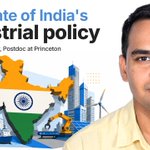
Delighted to have this out in @phenomenalworld where we bring out the drivers of institutional coordination in Tamil Nadu's industrial transformation and argue for coherent sub-national imaginations of industrial policy in federal democratic settings. phenomenalworld.org/analysis…

Mausam Kumar retweeted

In 2021, the IEA projected the world would add about 14 GW of battery storage a year this decade. In 2025, it added 115 GW.

Mausam Kumar retweeted

China is winning the car war ft.trib.al/NxqqYeV
Mausam Kumar retweeted

International climate talks collapsed on Sunday without any major agreement after delegations including the EU rejected a deal they saw as pandering to the fossil fuel industry bloomberg.com/news/articles/…

"Nations including Bhutan, Kyrgyzstan and Tajikistan have joined Nepal at the talks in Turkey in calling for greater focus on warming in mountain regions and the associated risks. Japan pledged Tuesday to create a network across the Asia-Pacific region to promote development of early-warning systems to protect against extreme weather events and natural disasters"
bloomberg.com/news/articles/…

247
This should be filed under ‘how not to derisk investments’

STORY | Bringing investment protection law to attract funds: Andhra Chief Minister Naidu
Andhra Pradesh Chief Minister Chandrababu Naidu on Thursday announced that the state will formulate an investment protection law to attract funds.
READ: ptinews.com/story/business/B…
(PTI Photo)

2
268
Mausam Kumar retweeted

After 31 years of COP, governments can't agree that they should transition away from fossil fuels one day. It's implied, I guess.

"But to succeed in this diversification strategy, Korea needs not only innovation policies, but also core partners to help scale different parts of the battery value chain and deploy these new technologies. This is a strategy that Korean chaebols have successfully begun in the United States—but this external dimension should be accelerated and expanded, including to Europe and India"
Great article from my Carnegie colleagues @darciedraudt and Milo McBride on why Korea needs to expand its relationships to Europe and India to consolidate its second place in the global battery race.
carnegieendowment.org/emissa…

2
276
Immensely delighted to share that I have joined @CarnegieEndow as a Fellow. I must also take this opportunity to thank a lot of people for their support during my time at Princeton, Boston, and Harvard. Very much looking forward to contributing towards advancing the intellectual mandate of an institution like Carnegie.
12
40
2,285
Mausam Kumar retweeted

Here is how to stop the AI rot in research and academia. Journals and professional bodies must develop norms and codes of disclosure and attribution. Authors should be expected to treat AI agents as co-authors, when it rises to that level, and disclose +
First day of the COP is here. If the Antalya COP can agree on one of its most important goals of increasing the global share of final energy demand coming from electricity to 35% by 2035, from about 20% today, it may well be monikered the COP of electrification.
Great article from @AkshatRathi to understand what is at stake.
bloomberg.com/news/articles/…

Mausam Kumar retweeted

India's solar factories are getting built from the top down: panels are mostly done, but the polysilicon and wafer plants that come first are still waiting.

"The changes allow for arrests in Singapore and boost the maximum fines for causing or contributing to haze-related fires from S$100,000 (about $78,000) per day to S$1 million per day, with the cap increasing tenfold to S$20 million"
bloomberg.com/news/articles/…

1
6
676
Mausam Kumar retweeted

🚨 Workforces exposed to globalization and decarbonization are often overwhelmingly male. New article at @AJPS_Editor with @ProfRickyClark and @RozaKhoban asks how layoffs of these men shape voting: onlinelibrary.wiley.com/doi/…

Mausam Kumar retweeted

Just made an update from "my" Solar reality vs IEA graph for an upcoming book called "Power to the People". The difference is still going strong...


"Ethiopia is transitioning to EVs more quickly than any other country in the world, driven more by costs than climate, with assets including a glut of green energy and relatively affordable Chinese cars"
bloomberg.com/news/articles/…

9
678
Just to clarify: Wage suppression was not a feature of East Asian industrialization. Amsden debunked this in The Rise of the Rest. East Asia developed by subsidizing learning and not by suppressing wages.


Wage suppression was a feature, not a bug, of the East Asian industrialisation model. Japan, South Korea, Taiwan, China and Malaysia, albeit through different institutional arrangements, all pursued development strategies that prioritised capital accumulation, export competitiveness and industrial investment over rapid wage growth. Governments actively shaped labour markets through wage restraint, restrictions on organised labour, state influence over collective bargaining and policies designed to keep production costs competitive. In several cases, productivity gains were deliberately channelled towards investment rather than immediately translated into higher wages and consumption. This helped generate the savings, investment and competitive advantages that underpinned rapid industrial transformation. It was not an accidental consequence of market forces but, to varying degrees, a conscious development strategy. Crucially, wage restraint was not intended to be permanent. As industrial productivity, technological capabilities and economic sophistication increased, real wages rose. The lesson is that industrialisation often precedes the broad distribution of its gains.
Mausam Kumar retweeted

Absolutely breathtaking view of the mighty Kosi River in Supaul, Bihar, with the Himalayas painting the horizon.
@TourismBiharGov must look beyond the Buddhist circuit and develop these hidden gems to put Bihar on the tourism map.

My colleagues at Princeton have a cool paper on winter PM2.5 pollution in India that allows them to forecast its severity in advance.
They find that "∼70% of the year to year variations in winter PM2.5 pollution across northern India are explained by western disturbances"

1
5
398
Because these storms are tied to the preceding autumn’s ocean temperatures, they can tell months ahead whether a coming winter's pollution is likely to be severe or mild. Link here for the paper:
science.org/doi/10.1126/scia…

173