
AI for small business owners, minus the fake stats. I wrote 5 playbooks on it and checked every number against a real source. Start here:
Joined July 2024
- Tweets2.4K
- Following66
- Followers656
- Likes2.5K




Referred customers were worth at least 16% more than similar customers who weren't referred, in a study that tracked 9,814 bank customers for 33 months (Journal of Marketing, 2011).
You'll also see "83% of customers would refer you, but only 29% do." My research couldn't find a survey behind that one. It circulates between referral software companies quoting each other.
How to get more referrals without buying a referral program:
Ask at the right moment. Book 4's rule is after the third visit, never the first. By visit three they've decided you're their place, so the ask reads like an invitation.
Have the person who did the work ask, in one line. No mass blast.
If you offer a reward, keep it private, or make sure anyone posting about you says they got something. Never tie a reward to a Google review.
Referrals sit on top of the basics: customers who come back and customers who leave reviews. The scripts for both are free.
Comment "BACK" and I'll send them.

What fact-checking 5 books looked like, in numbers:
359 pages.
181 sources kept, each with a link and the date it was checked.
63 more flagged as unverifiable: stats, prices, even one law's exact start date.
2 whole chapters rebuilt because their premise didn't survive.
1 mistake found in a finished book by the research for a later one. Fixed and rebuilt.
The two chapters: the idea that mainstream tools can quote a job from a photo (only one tool I found actually does it), and the standard Google Business advice to post weekly, seed your own Q&A and turn on chat. Google's own pages undercut all three.
Next time someone sells you AI with a number, ask where it came from.
12 of the most repeated ones, traced to their source, are in a free guide. Comment "STATS" and I'll send it.

How to pick your first AI automation with a pen and one sheet of paper:
1. List every task you repeat each week. Quotes, invoices, reminder texts, answering the same five questions.
2. Score each one 1 to 5 on Time: how long it takes.
3. Score it 1 to 5 on Frequency: how often it comes up.
4. Score it 1 to 5 on Ease, backwards: 5 means pure pattern, 1 means it needs your judgment every time.
5. Multiply the three. Highest score is your first automation. On a tie, pick the one with less judgment in it.
Why ease runs backwards: AI follows the same steps all day without getting tired. It's bad at judgment. A task that needs you to read the situation is a bad first hire.
Don't skip step 1. If you only score the task you already wanted to automate, the sheet can't show you anything new.
The blank sheet is free. Comment "FIRST" and I'll send it.

The 10-point edit I run on everything before it posts. Each one is a sign AI wrote it:
1. Em dashes. Make it a period or a comma.
2. A sentence that ends in ", highlighting..." or ", ensuring...". End it where the fact ends.
3. "It's not X, it's Y." Say Y.
4. "Serves as" or "boasts." Write "is" or "has."
5. Crucial, seamless, delve, pivotal, leverage. Cut them.
6. "Studies show" with no study named. Name it or cut it.
7. A list of three where the third item was invented for rhythm. Drop it.
8. "Additionally" at the start of a paragraph. Delete the word.
9. A closing paragraph that repeats the post. Delete it.
10. A testimonial with no real name and real quote behind it. It doesn't go in.
You can measure this. A study of 15 million medical abstracts found 13.5% of the ones from 2024 showed signs of AI processing (Science Advances, 2025).
The page that stops AI writing like this in the first place is a voice document. The template is free. Comment "VOICE" and I'll send it.

If every customer gets the same "time to rebook" text, most of them get it at the wrong time.
A trim, a color, a deep clean and a massage each run on their own clock.
The fix from book 4:
1. List every service you sell.
2. Next to each, write how many weeks until a customer is due again. Your staff probably tell customers this at checkout already.
3. Subtract a week.
4. Send the reminder then, while they're due and before they're overdue.
One thing the research made clear: reminders help, but less than the software ads say. Across 10 trials, reminders raised attendance by about 11%, and the text-only trials on their own didn't reach statistical significance (Journal of Hospital Management and Health Policy, 2026).
So send them, count your rebooking rate every month, and go by your own number.
The rebooking and win-back scripts are free. Comment "BACK" and I'll send them.

An airline's chatbot told a grieving customer he could claim a bereavement fare after his flight. That wasn't the airline's policy.
He took it to a tribunal. The airline argued the chatbot was a separate legal entity, responsible for its own words.
The tribunal rejected that. Air Canada was held liable (Moffatt v. Air Canada, 2024 BCCRT 149).
Your AI assistant speaks for your business. Whatever it says, you said.
So treat it like a new hire:
Week 1: read or listen to every conversation it has.
After that: a 5-minute skim every day and a full read once a week.
Keep an error log with four columns: the date, what happened, real error or just an odd request, what you changed.
Most wrong answers trace back to something missing from the document it reads from. Fix that document first.
Before any of this, pick the right first job for it. Comment "FIRST" and I'll send the scoring sheet from the book.

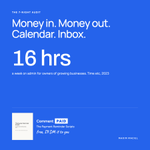
36% of an owner's week goes to admin. For owners running growing businesses that's about 16 hours a week (Time etc survey of 251 US owners, 2023).
Nobody pays you for those hours, and a lot of them happen after the real work is done.
Before you buy any AI tool, find out where yours go. Seven nights, one sheet:
Each night, write down every task that wasn't the job itself and how many minutes it took. Quotes, invoices, texts, reschedules.
Then sort them into four buckets:
Money in: quotes, invoices, chasing payment
Money out: bills, receipts
Calendar: booking and rescheduling
Inbox: email and texts
Add up the week. Multiply by 52. Fix the biggest bucket first.
If yours is money in, start with the reminders. I wrote three that go out with the customer's name, job, date and amount. Comment "PAID" and I'll send them.

How a small business gets a month of content out of one afternoon:
1. List the real questions customers asked you this month. Their objections too. And one story from the job.
2. Every idea has to trace back to a real conversation. If you can't say who said it, cut it.
3. Take one idea and paste it into ChatGPT or Claude, along with a page describing how you talk.
4. Ask for four things back: a social post, a short video script, an email, a Google Business update.
5. Edit every one by hand. Read it out loud.
Ten ideas, four formats each. That's 40 pieces, a month of content, in two or three hours.
Step 3 is where it usually falls apart. Without that page on how you talk, the AI writes the same caption every gym in the country gets.
That page is the template I'm giving away. Comment "VOICE" and I'll send it.

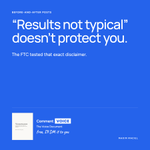
If you post before-and-after photos with "results not typical" under them, that line isn't protecting you.
The FTC tested that exact disclaimer. People still read the ad as showing what a normal customer gets, so the disclaimer didn't fix it.
If you're a gym, a salon, a clinic, anyone who posts transformations:
Post the customer's own words, with their permission.
Leave the number off.
If you do use a number, be able to show what a typical customer gets.
Don't let AI "polish" a customer's review. Rewording an endorsement until it says something they didn't is its own problem.
And a 5-star review from your staff, or your spouse, or your brother, without saying who they are, counts as an undisclosed insider review under the FTC's fake review rule.
I made a free template for writing content that sounds like you: the voice document plus the 10-point edit I run before anything posts. Comment "VOICE" and I'll send it.

Here's the whole review system for a small business. It fits in one text.
Same day as the visit, same line to everybody:
"Thanks for coming in today. If you loved it, a quick Google review helps other people find us."
Two rules on top:
Never pay for a review. No discount, no free add-on.
Never gate. Ask the client who complained about the wait the same way you ask the one who left thrilled.
Why keep asking when you already have 40 reviews? 74% of consumers look for reviews written in the last three months (BrightLocal, 2026). Old ones matter less as they age.
When a review comes in, let AI draft the reply, then edit it yourself and post it. Google's own guidance is to skip the identical thank-you to everyone.
The review line, plus my scripts for rebooking and for customers who stopped coming back, are free. Comment "BACK" and I'll send them.

Two settings that get a small service business paid faster, both on Square's free plan:
1. Recurring invoices. If a client is on a fixed schedule, Square creates and sends the invoice on the day it's due. Nothing for you to remember.
2. Bank transfer over card. On Square Free, an online card payment costs 3.3% + 30¢. A bank transfer through the same invoice link costs 1%, $1 minimum (checked 2026-09-15).
On a $300 job that's $10.20 against $3. Invoice 20 jobs like that a month and it's about $144 back.
Then the reminders. Wave's paid plan defaults to 3, 7 and 14 days after the due date. QuickBooks allows up to three. Both land on three messages.
I wrote those three messages, with the customer's name, job, date and amount built in.
Comment "PAID" and I'll send them free.

You can run a small service business on AI tools for $0 a month. The stack from my 5th book (prices checked 2026-09-15):
Claude or ChatGPT, free plan: quotes, replies, posts
Square Free: invoices, payment reminders, appointment reminder texts
Wave Starter: bookkeeping
Gmail: its AI drafting became free on personal accounts in January 2026
Make Free: 1,000 credits a month to connect the pieces
Canva Free: graphics
Smith.ai free tier: an AI receptionist for 25 calls a month
Seven free plans. No trials.
Paying makes sense later. About $48 a month adds a paid AI plan, Make Core and Wave Pro. A trades business on Jobber lands near $197.
A salon or a gym doesn't need that. The book's version for appointment businesses comes to $78.
If someone quotes you $200 a month for a gym or a salon, ask what's in it.
Which one to set up first depends on where your hours go. Comment "FIRST" and I'll send you the scoring sheet that tells you.

For customers who stopped coming back, three messages on a clock:
Day 60: a check-in. No offer. Just a note that they're due and you'd like to see them.
Day 90: a small reason to come back, with a real end date.
Day 180: the honest one. "If something about your last appointment didn't sit right, I'd genuinely like to know."
Each one in your own words, with their name and what they last came in for.
Now the part the win-back software ads leave out.
The best trial I found compared a text, a phone call and nothing across 11,880 lapsed blood donors. Texted: 8.5% came back. Nothing: 7.4%. Not a statistically significant difference (BMC Public Health, 2020).
So most won't come back. Send 30, count who does, and trust your number.
It's still worth 20 minutes a month. Anyone who returns is a customer you'd already lost.
All three scripts are free. Comment "BACK" and I'll send them.

I've edited videos for 4 years. I can spot AI writing in about one sentence now.
And it's measurable. Pew analyzed 490,000 web pages: between 2023 and 2026, em dashes roughly doubled and "it's not X, it's Y" sentences nearly tripled (Pew Research Center, August 2026).
Your customers notice it too, even if they can't name it.
The fix for a small business is one page on how you actually talk:
1. Who's talking
2. Words you use, and words you'd never use
3. Real customer quotes, copied word for word
4. A few posts you wrote yourself that sounded like you
5. Things you never do
Every prompt reads that page first. Then a 10-point edit before anything goes out.
The template and the 10-point edit are free. Comment "VOICE" and I'll send them.

59% of US small businesses have invoices more than 30 days overdue. Those businesses are owed $17.7K on average (Intuit QuickBooks, survey of 1,305 owners, December 2025).
Most owners handle it with a reminder template.
The best study I found says a generic reminder does close to nothing.
A randomized trial on 9,196 overdue bills: reminders that used the person's name raised payment by about 1 percentage point. Generic ones did no better than sending nothing at all (Digital Health, 2024).
It's old hospital debt in Latvia, so don't carry the size of the effect over to your business. Carry the direction: a message clearly about them beats one that could go to anyone.
So every reminder should carry four things: their name, the job, the date, the amount.
I wrote 3 of them: a friendly nudge, a firmer follow-up, a final notice. None of them sound like a collections agency.
Comment "PAID" and I'll send all three.

I don't code.
Everything I've built with AI (a speech-to-text app, a DM qualifier, a few browser extensions) I built by describing what I wanted to Claude.
So when I wrote 5 books on AI for small business owners, I set one rule: no code, no APIs, no n8n. If a plumber can't set it up himself, it's not in the book.
And the tools are only part of the problem.
The Federal Reserve asked small businesses about AI in an open text box. More than 8,500 answered. "Not knowing where to start" came up again and again. One owner wrote: "I don't know how, and there is nobody to teach me."
So book 5 starts with a scoring sheet. List every task you repeat. Score each 1 to 5 on how long it takes, how often it happens, and how little judgment it needs. Multiply.
The highest number is your first automation.
The sheet is free. Comment "FIRST" and I'll send it.

Put an AI on your business phone and two sentences at the start of every call handle two legal problems:
"You're talking with an automated assistant for [business]."
"This call may be recorded."
The first: several states now have AI disclosure rules. California, Maine and Utah each handle it differently. Saying it's an automated assistant up front, and answering honestly if anyone asks, satisfies all three.
The second: 11 states require everyone on a call to agree to recording. You don't need to memorize which. Say it on every call, to every caller.
One more worth knowing: in February 2024 the FCC ruled that AI-generated voices count as artificial voices under robocall law. AI calls placed without consent can cost $500 to $1,500 per call. That's about calls you make, so read it before anyone sells you an AI that dials out.
Two sentences, written once. Check your own state too, this isn't legal advice.
The whole setup, from the first text-back to the test calls, is in a free checklist. Comment "CALLS" and I'll send it.

Book 1 was finished. 72 pages, built, done.
Then the research for book 5 found a mistake in it.
Book 1 said Rosie, an AI phone answering tool, books appointments and transfers calls on its $49 plan. It doesn't. Booking and transfers start at $149 a month.
That's $100 a month of difference, in a book whose whole pitch is that every fact is checked. So book 1 got corrected and rebuilt.
The lesson if you're shopping for an AI receptionist: the cheap plan and the plan in the demo can be different plans. Before you pay, ask one question in writing:
"On this exact plan, can it book into my calendar and transfer a call to my cell?"
Or start with something cheaper: a text that goes out the second you miss a call. The full setup is in a free checklist.
Comment "CALLS" and I'll send it.

"Your automation will pay for itself in 4 months."
I tried to find where that number comes from while writing my 5th book.
"340% ROI, 4.2-month payback": agency blogs. No data behind it.
"13 hours saved a week per automated workflow, from a 2024 Zapier study": the research found no such study.
"Save 8+ hours a week": a software company's own marketing, no method.
The most solid number I found is smaller. Small business AI users say they save 5.6 hours a week, across all their AI use combined (Business.com survey of 1,009 respondents, 2026). Self-reported.
So measure your own. Time the task before. Time it after. Subtract. Multiply by what an hour of your time is worth.
That number beats anything in a sales deck.
12 of these claims, traced to where they started, are in a free guide. Comment "STATS" and I'll send it.

If your business texts customers from a regular phone number, some of those texts might be disappearing. No error. No bounce.
US carriers require businesses texting from a standard 10-digit number to register a brand and a campaign with The Campaign Registry. Unregistered messages get filtered, and carriers have blocked unregistered texts since February 1, 2025.
You usually find out when a customer says "I never got your text."
Two more rules before you automate a single message:
A text replying to a call the customer just made to you rides on the consent implied by that call. Marketing texts need more than that.
Any reasonable stop request has to be honored within 10 business days, even if they never type the word STOP.
Registration is step 7 of the text-back setup in my free checklist.
Comment "CALLS" and I'll send it.
