

Helping equity-compensated executives and founders plan for early retirement. Posts are not advice. Book an intro call ↓
Los Angeles, CA
Joined May 2009
- Tweets16.9K
- Following359
- Followers5.4K
- Likes23.9K




Pinned Tweet
Only 33% of Americans have a written financial plan.
And many still struggle to understand the concepts behind it.
Here are 10 visuals to help you understand the areas better:
Couple of "hot takes" I've seen the last week:
- Direct indexing isn't great
- Donating via DAF is overblown
- Rejecting the 401(k) match can be worth it
Someone speaking to everyone does not mean they are speaking to YOU specifically.
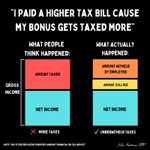
$132,000 withheld on $600,000 of commissions.
Sounds like a lot.
For a high-earning salesperson, it might not be enough.
Let's say you're in sales and earn:
- $400,000 in salary
- $600,000 in commissions
That's $1 million of total compensation.
Your salary has taxes withheld throughout the year based on your payroll information.
But commissions can be treated as supplemental wages.
When paid separately, one method employers can use is a flat 22% federal withholding rate on supplemental wages up to $1 million.
On $600,000 of commissions, that's $132,000 withheld for federal income taxes.
Now look at your total income:
$1,000,000.
As a single filer, a significant portion of your income falls into the 37% federal tax bracket.
So while your commissions may have had 22% withheld, that doesn't mean they're taxed at 22%.
Your actual federal tax liability is determined by your total taxable income.
That's where high earners can get caught off guard.
They see $132,000 come out of their commission checks and assume they're covered.
Then tax season arrives and they owe significantly more than expected.
The commissions weren't taxed at 22%.
22% was simply what was withheld.

If your ESPP has a "look back", you're stting on a wealth hack.
Here's the opportunity sitting in front of you.
ESPPs are relatively simple.
- You set aside your paycheck on a monthly basis for a period of time
- You buy your company stock at the end of the period
- Company let's you buy at a discount (usually 15%)
- The discount puts you at an immediate gain
There some things to look out for like taxation, liquidity, and blackout periods to see how the ESPP works for you.
But some have a provision called a "look back" period.
The discount is applied either at the lower of the enrollment date or purchase date.
For example:
If the enrollment price was $100 and $50 at the purchase price, the 15% is applied at the purchase price.
If the enrollment price was $50 and $100 at the purchase price, the 15% is applied at the enrollment price.
If the latter occurs you are looking at not only at 15% discount, but appreciation already of $50 between the $50 and $100!
It's one of those great perks that can increase your wealth via your employer benefits.
Don't discount the value of your company discount!

Vesting schedule.
Check this with your employer every time in their employee benefit packet.
This applies to your matches and other stock compensation.
Your contributions, however, are always vested and you are entitled to them and their earnings no matter when you are let go.
I don't have a crystal ball.
I don't know if your concentrated equity will do well over the next 1 year or 10 years.
But I can give you an answer that lines up to your priorities now:
- Are you concerned about the tax hit?
- What about the opportunity cost of missing out?
- Or really just the certainty of hitting your near-term goals?
It's my job to ensure the answers you provide are reflected in our reccomendations.
Maybe you do miss out.
Maybe it might be the most optimal outcome.
But we at least had the right reason rather than guessing it.
"I can't access my retirement money until I'm 59.5"
Not unless you've utilized:
- Brokerage Funds
- Roth IRA contributions
- Roth conversions (5 year window)
- HSA reimbursements for qualified expenses
- Rule of 55
- 72(t)
The most common mistake is thinking one vehicle will solve retirement.
It's never really the vehicle that's holding you back.
It's your plan of attack for it.
One of my favorite questions I love to ask clients:
"Imagine money was not a concern anymore. You've done it, and you've hit your version of financial independence. Describe to me what a typical week would look like for you."
No better way to make a tailored reccomendation than to understand what a tailored lifestyle looks like.
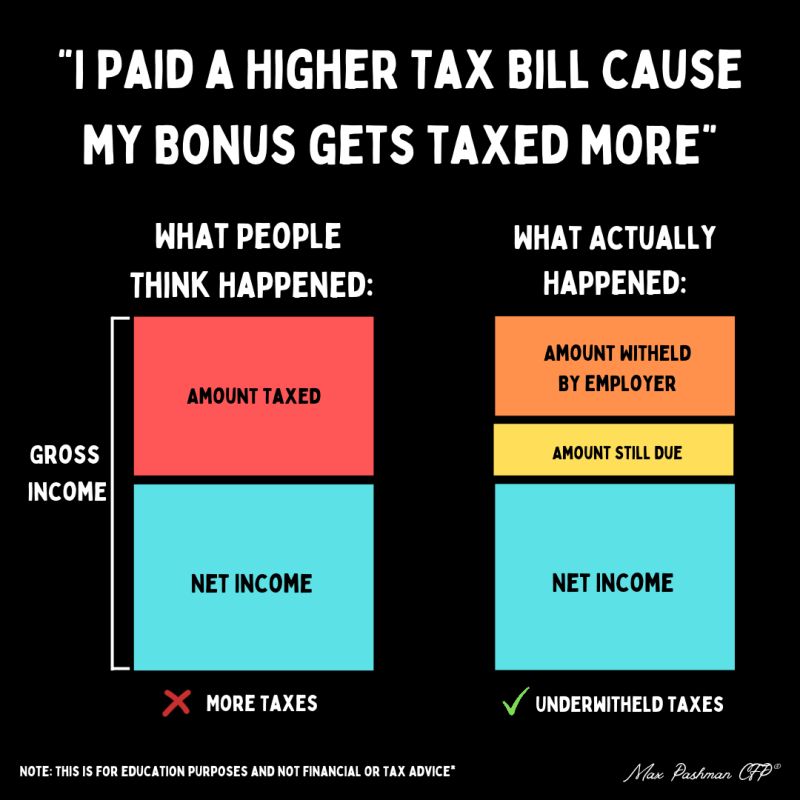
$132,000 withheld on $600,000 of commissions.
Sounds like a lot.
For a high-earning salesperson, it might not be enough.
Let's say you're in sales and earn:
- $400,000 in salary
- $600,000 in commissions
That's $1 million of total compensation.
Your salary has taxes withheld throughout the year based on your payroll information.
But commissions can be treated as supplemental wages.
When paid separately, one method employers can use is a flat 22% federal withholding rate on supplemental wages up to $1 million.
On $600,000 of commissions, that's $132,000 withheld for federal income taxes.
Now look at your total income:
$1,000,000.
As a single filer, a significant portion of your income falls into the 37% federal tax bracket.
So while your commissions may have had 22% withheld, that doesn't mean they're taxed at 22%.
Your actual federal tax liability is determined by your total taxable income.
That's where high earners can get caught off guard.
They see $132,000 come out of their commission checks and assume they're covered.
Then tax season arrives and they owe significantly more than expected.
The commissions weren't taxed at 22%.
22% was simply what was withheld.
Them: My company offers ESPPs, but I don't buy them.
Me: You know you might be leaving a 17.64% gain on the table?
Them: What do you mean?
Me: Well, the appeal of ESPPs is that you can buy your company stock at a discount.
Them: Right, but I don't need to invest in them.
Me: Which is fine. But your company offers you a 15% discount.
Them: So?
Me: Well, let's say the stock was $100 and you bought it for a 15% discount, which is $85. That means that you have already accrued a 17.64% gain:
The Math:
-> $100 - 15% = $85 (Purchase Price)
-> Profit / Investment = Gain %
-> $15 / $85 = 17.64%
So if you were able to sell immediately at the same price you bought at, you created a 17.64% profit!
Them: Wow, that's pretty cool. But isn't it taxed?
Me: Of course. But if you think about it, you're treating it as your own bonus. Plus, it forces you to stay disciplined by putting a percentage of your check on the side.
Them: Now that's pretty cool. Anything else I should know?
Me: Well, does your ESPP have a lookback period?
Them: It does. What is that?
Me: It allows you to purchase at the lower of the offering date price or the purchase date price.
For example, if:
-> Purchase Date Price = $100
-> Offering Date Price = $50
Since your company applies the 15% discount to the lower offering date price, your actual purchase price is even lower at $42.50 instead of $85. That means you get both the 15% discount ($7.50 gain) and the $50 gain from the lookback period.
The Math:
-> $50 - 15% = $42.50 (Purchase Price)
-> Profit / Investment = Gain %
-> ($100 - $42.50) / $42.50 = 135.29%
In other words, your gain is now 135.29%!
Them: Holy cow! I wish I knew this sooner.
Me: Yeah, it's ESPPecially great as a bonus!
Note: This is purely educational and not financial or tax advice.

The HSA is the only vehicle that is:
1) Tax deductible for contributions
2) Tax deferred for growth over time
3) Tax-free for medical expenses
It's triple tax benefit is highly underrated.
The 4% rule was originally a general guideline for someone who is 60-65, has a 60/40 portfolio, and retires for 25-30 years.
So if you're 40-50, have a more aggressive portfolio, and are planning for a 40-50 year retirement, this ain't for you.
October is an excellent time for tax planning:
Areas like:
- Tax loss harvesting
- Charitable contributions
- Reviewing income projections
- Roth conversion opportunities
- Advancing business deductions
Should all be reviewed this time.
If your intention is to use your money soon, you don't want volatility within it.
If your intention is to use your money for many years out, you don't want to leave it on the sidelines.
Time Horizon 101
"I'd rather invest in real estate than get the 401(k) match."
Wild how often this gets confused.
What you invest in is one thing.
What you receive is another.
A 401(k) match isn’t just an investment.
It’s part of your comp.
Turning it down is like turning down a bonus.
To assume tax rates will be higher in the future is nothing more than just a guess.
Tax diversification is your best hedge for this.
60% of current homeowners are sitting on a sub 4% loan.
I wouldn't blame them for not selling, given today's rates and prices.
As a parent, would you be OK handing 4-6 figures of wealth over to your child when they turn 18-21 years old?
This is essentially what you must legally do with a UTMA or UGMA.
Your desired outcome in the future should derive from your planned decisions today.

