
Researcher in the DINO team at Meta FAIR. Before: PhD at Max Planck Institute for Intelligent Systems, Tübingen. Representation learning, agents, structure.
Joined January 2021
- Tweets88
- Following47
- Followers915
- Likes43




Pinned Tweet
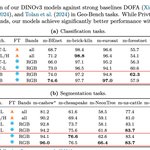
Introducing DINOv3 🦕🦕🦕
A SotA-enabling vision foundation model, trained with pure self-supervised learning (SSL) at scale.
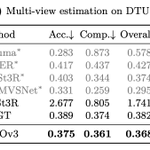
High quality dense features, combining unprecedented semantic and geometric scene understanding.
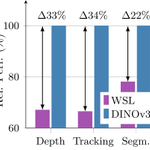
Three reasons why this matters…

The DINO team at FAIR Paris is hiring a PhD student to push the frontier of visual representation learning. We offer hard research topics, a research and engineering team supporting you, and a stimulating PhD community. Help us shape the next generation of DINO models! Details👇
We are looking for someone curious and passionate about research, with good theoretical knowledge and an appetite for empirical work. Position in Paris, flexible start date, the sooner the better. Apply here: metacareers.com/profile/job_…
Max Seitzer retweeted

1/ We’re so glad to share this new study 💫
Does the brain learn like a Deep Net? 🧠⚙️
- 📄Misalignment Between Backpropagation and the Hierarchy of Brain Responses to Images
- 🔗arxiv.org/abs/2605.28693
Thread below 🧵
Max Seitzer retweeted

Today we are announcing our new startup: Exponential Security Labs.
AI agents are being deployed everywhere, making high-stakes decisions and increasingly automating research itself. Yet their reliability and security remain unsolved technical problems, on a frontier that keeps shifting. Our mission is to secure agentic systems through self-improving red-teaming and guardrail agents, leveraging autonomous AI research.
We sit at the intersection of safety and self-improvement, building on a decade of research in adversarial robustness and AI safety. We're looking for exceptional people to join us!
We're looking for exceptional people to join us on this mission, and we're also eager to talk to companies deploying AI agents who want to improve their security. Please get in touch!
More details: expsec.ai/
Founding team: @Nmndsingh, @AnselmPaulus, @maksym_andr, Matthias Hein

Max Seitzer retweeted

🚀 Internship Opportunity!
DINO team is recruiting 2026 interns at both M2 (Master’s) and PhD levels in Paris office.
🔗 If you are interested, check out the job descriptions and apply here:
metacareers.com/jobs/1497501…
metacareers.com/jobs/2011253…
I'm giving a talk about DINOv3 👇

📢 Save the date! Join us for the next @ELLISforEurope x @unireps Speaker Series!
📅8th October – 16:00 CEST
📍 ethz.zoom.us/j/66426188160
🎙️Speakers: Keynote Talk by @maxseitzer & Flash Talk by @JRaugel

Max Seitzer retweeted
1/ You might have seen it—DINOv3 is out! 🦖🦕In this thread, we share key insights on our Gram anchoring ⚓︎ and how it helps to get smooth feature maps.
👇

Max Seitzer retweeted

Can AI help understand how the brain learns to see the world?
Our latest study, led by @JRaugel from FAIR at @AIatMeta and @ENS_ULM, is now out!
📄 arxiv.org/pdf/2508.18226
🧵 A thread:
Nice investigation! We did study those outlier dimensions a bit for the 7B model, which is summarized in section A.2 of the paper.
Some comments:

DINO-v3 has a single high-magnitude channel on its residual pathway, channel 416. Turning off this single channel affects DINO's entire output by 50-80%. For context, turning off a random channel has an effect of less than one percent.
The model builds up channel 416 in its last two layer-scale operations, using a single high-magnitude weight in each op to drastically ramp up channel 416's magnitude. This channel doesn't depend on the input, every image fires with a constant overlay.
After bringing channel 416 up to a value of about ten thousand, DINO-v3 then scales it down in the final layer-norm to almost nothing, removing it without a trace.
4) These outliers are *different* from high norm tokens studied by the registers paper or by An et al in LLMs (arxiv.org/abs/2502.06415), and are not removed by registers & attention bias. My guess is that they are specific to the DINO setup of different heads & losses.

The DINOv3 paper is now available on arXiv: arxiv.org/abs/2508.10104
Have you looked at the paper yet?
Here are three observations that might not be immediately obvious from a first read 👇


3) Web ≥ satellite model
This is a surprising one! Our main web model outperforms the satellite model on some geospatial tasks 🤯Goes to show the power of massive datasets for generalization. Would be interesting to see if this holds for other domains as well, e.g. microscopy!

There are still many more interesting aspects to the paper (it's massive!), so please have a read
arxiv.org/abs/2508.10104