

Fixing hiring’s first filter | Fair for candidates, defensible for recruiters | Founder, RoundOne AI
London, England
Joined March 2009
- Tweets2.1K
- Following1.1K
- Followers518
- Likes1.6K






Everything is on sale today.
Laptops, trainers, a jumper you didn't know you wanted until it said 40% off.
Economists have a name for that feeling.
Richard Thaler called it transaction utility.
You get some pleasure from the thing you bought,
and a separate pleasure from feeling you got a bargain.
The second one can show up even when you never needed the first.
That's how a jumper you would never have bought at full price ends up in the
wardrobe with the tag still on.
Sustainability advocates say something similar about buying fewer, better things.
The cheapest item on the day is rarely the cheapest one over the years.
And I think hiring has its own version of the sale.
The candidate who is free now, says yes to the first offer, and sits comfortably under budget gives you that same little hit. It feels like a deal.
The role has been open for weeks, the pressure is real, and a quick yes feels like relief.
But the price on the day was never the cost. The cost is the onboarding, the team covering while they find their feet, and sometimes the whole search again later.
Plenty of fast hires turn out great, so speed on its own tells you nothing. The feeling of getting a deal is the part to be wary of, in a shop and in an interview room.
Cheap on the day, expensive later.
Before the next offer goes out,
ask the question you'd ask about the jumper: would I still want this at full price?
How do you tell a bargain from a bad buy when you're hiring?
#blackfridaysale #blackfriday #Bargain #hire
7
A new Greenhouse Software report says 90% of US employers believe they may have rejected real candidates because the application looked fake or AI-generated.
I understand why it happens.
When every CV is polished, and every cover letter reads the same, the signal gets hard to see. Most employers in the report have changed their process, and many added another interview, which slows everything down.
I don’t have a tidy answer, only the questions I keep coming back to.
If an application looks too perfect, is that a reason to doubt it, or a reason to ask one more question?
Whose job is it to prove an application is real, the candidate’s or the employer’s?
And what does being wrong cost the person who never got a reply?
How do you handle it?
#candidates #fake #rejections
21
A bank let two AI agents finish a currency trade on their own. No human pressed the button.
Yes, J.P. Morgan and Hyundai Card ran a proof-of-concept where agents carried out a simulated foreign-exchange transaction on Kinexys, without direct human intervention.
The next phase, planned for the first half of 2027, has agents negotiating with each other.
What stood out to me is where JPMorgan puts the hard part.
Governance. Transaction limits, controls, and who is accountable.
One JPMorgan executive called the agent a new "fifth party" in payments,
and said liability has to be clearly assigned before this scales beyond low-risk purchases.
Visa and Mastercard are building frameworks to check that agents stay within what the customer actually asked for.
Every industry handing decisions to AI hits the same wall.
The code works. Who answers when it gets it wrong is still unsettled.
True in payments. True in hiring.
If your AI acted on its own tomorrow, who would sign off on it?
#AgenticAI #AIadoption
1
1
79
Writing this post made me realise how much of RoundOne AI belongs to other people.
Thanksgiving is this week in the US, so I want to say thank you properly, and by name.
Luke Eaton first met RoundOne as a candidate. When I went back to his screening report months later, I could see how sharp he was, and when I came across his posts, I realised he was saying what I was trying to build. So I asked him to mentor me.
For three months, around 20 hours a week, he taught me an industry I had only ever seen from one side of the table, and he opened the UK agency market to us. I’m more grateful than a LinkedIn post can say.
Desiree Goldey has given us far more than her title suggests. As a growth consultant, she has helped shape how we show up in the US and beyond. She flagged the legal risk early, and she was right. She also moderates every Hire Ground Live. We are lucky to have her.
Chandni Patel was our first hire, and the first person to believe in this with me.
And to Brett Louis Crouch, MBA, Mitra Vinda M, Tanisha Chhabra, and SUKRITI SAINI,
Thank you for showing up every day for something that is still being built.
From the outside, a company can look like one person’s story. It never is.
Who is on your thank-you list this week? Tell them.
#thanksgiving #gratitude
1
2
51
I've been going back and forth on whether to write this.
It's a sensitive topic, there's a family at the centre of it, and I don't want to treat their pain like a debate prompt.
Nvidia's CEO told his employees he had been unfaithful to his wife.
Within days, with a board investigation underway, he resigned.
What he did was wrong, and nothing below is meant to soften that.
What I can't settle is the next part.
He also led that company through the years that made it one of the most valuable in the world, and a lot of people built their careers on that.
Should those achievements count when we judge a moment like this?
Or does counting them mean we've chosen to look away?
I can argue myself into both answers, depending on the day.
So here are the questions I can't answer for myself.
Was the outcome fair, meaning proportionate to what happened?
And who gets to decide that?
If a leader admits a failing before anyone forces them to, does that count for them or against them?
Would the same admission end a manager's job at your company? A graduate's?
I'd like to hear how you think about it, including if you disagree with where I started.
#NvidiaCEO
#Nvidia
#resignation
25
Candidates ask an AI what it’s like to work at your company before they apply.
The answer often comes from a review written years ago and news that has long since changed.
The example in the image is made up, but I’d bet you’ve seen a version of it with your own company name.
The first real conversation a candidate has with you is often the screening.
That’s why we built employer-branded screenings at RoundOne AI.
The screening can carry your current story, in your words,
so the candidate hears your version early instead of only the old reviews.
Candidates will hear a version of your company before they speak to you.
Make sure one of those versions is yours.
Have you ever searched your own company in an AI tool? What did it get wrong?
#takebackyourstory #brandedscreenings #roundoneai

1
10
When someone says they’ll learn the new tool later, later almost never comes.
A recruiter with twenty open roles, candidates to call and hiring managers to chase isn’t resisting anything. They’re busy, and a new system is the easiest thing on the list to push back.
Three things I’ve seen help, and they’re worth trying before anyone blames the team:
Find the biggest headache in the room and keep tying the change back to it.
Bring the loudest sceptic in early, so they help choose the thing before it lands on them.
Let a colleague who has the same problem do the selling, because people will listen to a peer long before they listen to a manager.
Which of those has worked best for you?
1
17
A tool can be right for the company you were last year.
Yes, I said what I said.
When did you last check that the tools you are using still fit the company you are today?
#AITools #RoundOneAI
9
If you could tell every candidate one thing before they apply, what would it be?
I am asking because you see parts of the process that candidates never see.
You know how many people are in the pile,
how long a decision can take for reasons that have nothing to do with the candidate,
and which small details make a person stand out in a good way.
Let's collect these in one place, because I think many candidates would find them useful,
and many recruiters would be glad to hear someone say them out loud.
What’s your one thing? Candidates, what would you ask recruiters?
#hiringinsight #recruiters
8
The recruiter seemed perfect. He just wasn’t real. Fake recruiters copy the same scripts, steps and warmth as legitimate ones. Make verification easy: use a company email, share the real careers page, explain next steps and state clearly: “We will never ask you for money.”
23
If I could retire one interview question tomorrow,
it would be “Where do you see yourself in five years?”
Nobody in the room believes the answer.
The candidate gives the version they think sounds ambitious but loyal,
the interviewer nods, and everyone moves on, having learned
very little about how the person actually thinks.
The question I’d happily put in its place is
“What’s something you’ve changed your mind about at work in the last year?”
It’s harder to rehearse; it shows how someone handles being wrong,
and the answers are usually more interesting than anything on a CV.
Every role seems to have a question like this one that has outlived its usefulness,
and I’d love to hear yours.
Which interview question would you retire first?
#interview #hiring #interviewquestions
15
Hot take: AI has made a confident-sounding answer cheap to produce,
which means confidence is worth a lot less as a signal than it used to be.
For a long time, a candidate who answered smoothly and without hesitating was usually someone who knew the subject well, or had practised hard.
Fluency was a reasonable shortcut for competence, and most of us used it without noticing.
That shortcut is getting weaker. Anyone can now rehearse with a tool that has already predicted the question, and the result sounds assured whether or not the person has done the work.
I think interviewers will need to move their attention to other signals.
How does the person respond when you ask what went wrong?
Can they say what they would do differently, or what they didn’t know at the time?
Do the details still hold together when you ask a second and a third question
about the same example?
Polish is easy to copy now, and specifics are much harder.
What question do you ask to find out whether someone has really done the thing?
#Signal #RoundOneAI #Interviews #AIinhiring

12
Every generation of hiring technology has been accused of ruining hiring.
When job boards arrived,
people said employers would be flooded with applications nobody could read.
When applicant tracking systems spread,
candidates began warning each other to stuff keywords into their CVs so the
software would let them through.
When one-click apply showed up on LinkedIn,
recruiters complained about volume all over again.
Each of those complaints had some truth in it, and each tool also did something useful.
Job boards widened who could see a role,
tracking systems gave teams a record they could search,
and one-click apply made it easier for people with little spare time to try.
Where the damage tends to come from is how much of the decision gets handed to the tool without anyone checking, and how little candidates are told about what is happening.
AI is the newest tool in that line, and I expect it to follow the same pattern. (It already is)
The teams that do well will be the ones that stay curious about what it is doing on their behalf.
Which hiring tool would you have been sorry to lose? And what's your POV on this?
#AIinhiring #AIadoption

1
22
We built RoundOne AI without a camera on purpose, and I keep finding new reasons it was the right call.
The first reason is fairness.
When a candidate is judged on video, a lot of what gets noticed has nothing to do with the job: the lighting, the background, whether they own a ring light, how they look on a laptop webcam. A recruiter who sees all that can’t unsee it, and no amount of training fully removes it.
The second is something I’ve come to believe about people.
They answer differently when nobody is watching their face. They respond to the question instead of managing the impression.
So the screening is a conversation, scored on what the candidate says, and a recruiter reviews the evidence and decides who moves forward. Nobody has to tidy their room first.
If you’ve done a video interview, what did you spend more time on, the answers or the setup?
#Videointerview #AIscreening

38
Employer-Branded Screenings on the go.
Just paste your website, and RoundOne AI pulls your logo, colours,
and typeface into every invite, screening page, and voice interview.
Your recruiters still decide who moves forward.
Looks like you. Acts like you. Screens them all.
#Brandedscreenings #RoundOneAI
1
18
Did I just interview a robot? 🤖
More candidates appear to be using AI to answer interview questions—even when their profiles, portfolios and projects look incredible. But one simple follow-up can reveal whether there’s real understanding behind the polished presentation.
The answer isn’t just better detection. It’s better questions: ask “why,” then ask “why” again. A script can’t live your life for you.
Be honest: have you ever suspected AI was on the other side of an interview—or used it yourself?
#ArtificialIntelligence #Hiring #Recruitment #JobInterview #FutureOfWork
1
143
The candidate you ghost today could be tomorrow’s decision-maker. 👻
A prospect nearly passed on Round One after confusing us with a company that ghosted her years ago. The lesson: silence can cost future business.
A no takes 30 seconds. Ghosting can follow you for years.
20
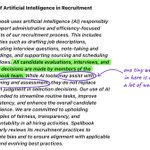
This job post is rare enough to be worth reading closely.
Because the job ad clearly tells you before you apply
where it uses AI in hiring and where it doesn’t.
Spellbook’s version says AI supports the administrative side, while every candidate evaluation, interview, and hiring decision is made by people on their team.
It also says the company reviews its recruitment practices regularly to mitigate bias.
The phrase I keep coming back to is that AI tools “may assist with screening and assessment,” because screening sits between the clearly administrative tasks and
a clear human decision, and that also in-between is where candidates have questions.
What does the tool look at,
what does the person see afterwards,
and can that person disagree with it?
I’d call this a good start that more companies should copy, and
then take one step further by naming what the AI does at each stage.
If your company uses AI anywhere in hiring, what would you put in your own disclosure? Would you be comfortable with candidates reading it before they apply?
#AIinRecruitment

11
“Just go and build it” sounds simple—until you’re living the founder rollercoaster.
One moment, you’ve shipped a feature, traffic is rising, and you’re flying. The next, a customer walks away or a deal falls through, and you’re questioning whether the company will exist next month.
Building a future that doesn’t exist yet can be exhilarating, lonely, and insanely hard—especially when you’re balancing a family, too. So yes, go build it. Just be prepared for the emotional highs, the brutal lows, and the failures that may come before success.
If you’re building something right now, what did your rollercoaster look like this week?
#FounderLife #StartupJourney #Entrepreneurship #BuildingInPublic #StartupFounder
16