

A student of the scientific study of randomness in the biological world
mosgiel
Joined February 2011
- Tweets1.1K
- Following242
- Followers404
- Likes2K


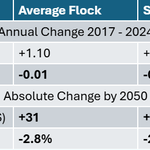
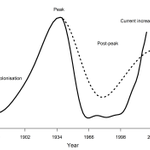
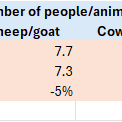
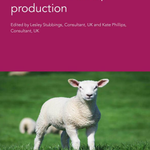
NZ farmers should ask why NZ has also been silent on this issue of having formal cryogenic storage of key sheep genetics. Perhaps this report by our closest sheep farming neighbor can spur some discussion for NZ? On a more flippant note, we should be chuffed that the picture chosen is a New Zealand sheep with twin lambs! Obviously, NZ genetics is being hankered after by farmers in Australia?

CSIRO report proposed a hybrid livestock gene bank model - Sheep Central sheepcentral.com/unreleased-…

2
139
It would be interesting to dig into this further, I suspect construction is a bigger part of the NI economy and that it varies more with economic conditions? There is a deeper story here waiting to be explored.


2
113
Rocketlab has bought Iridium. As a proud Southern man, and having spent many years as a researcher in NZ pastoral agriculture, I suspect this development may have more impact on our future sheep/beef/dairy farming than many now suspect. space.com/space-exploration/…

82
1878 was the year of the "great flood" where the Mataura and the Clutha rivers both changed course. teara.govt.nz/en/1966/disast… I remember the the January 1984 floods in Southland and the drought in Otago. Both floods were towards the end of a super El Nino period. History never repeats but it can rhyme? Worth a deeper look?

Chances are rising that an El Niño expected to form soon could become one of the most powerful such events on record, according to new data.
El Niño patterns are correlated with food shortages, water impacts and even civil conflict: wapo.st/49yLAQS
1
102


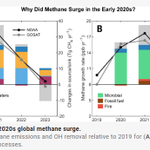
The great thing about science is it self corrects. Several years ago researchers noted that after plateauing in the early 2000s atmospheric methane levels were increasing more rapidly, subsequent papers using δ13CCH4 pinned it on an increase in biological sources. This work identifies that the change was a combination increased emissions from wetlands coupled with a decrease in hydroxyl radical concentrations linked to a drop in nitrogen oxide emissions during COVID-19 lockdowns.


1
1
66
Methane emissions and their mitigation and removal from the atmosphere are a hot topic for NZ farmers grazing ruminants. Hope this paper informs future discussions. Further details available from Ciais, P., Y. Zhu, Y. Cai, X. Lan, S. E. Michel, B. Zheng, Y. Zhao, et al. 2026. “Why Methane Surged in the Atmosphere during the Early 2020s.” Science, February. doi.org/10.1126/science.adx8….

2
65
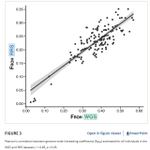
Estimating inbreeding and its consequences using genomics is of increasing interest in conservation and industry. Using runs of homozygosity (ROH) has several advantages over other approaches. This paper compares an ~20x lower cost method: restriction enzyme reduced representation sequencing (RE-RRS) with whole genome sequencing and finds similar results. onlinelibrary.wiley.com/doi/…

78
Congrats Chris: 52 years well deserved. May the rate of growth trial continue and keep everybody honest. southlandapp.nz/NewsStory/wo…
73

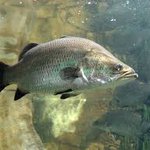
One advantage of using GBS commonly called ddRADseq or RE-RRS to genotype the host genome is that it can be used to measure both presence and pathogen load concurrently if the appropriate sampling regime is used. A recent publication has examined its potential in Barramundi for SDDV and demonstrated its value. #1

1
1
60
The original reference is Terence, Celestine, Zhi Weng Josiah Poon, Saengchan Senapin, Ha Thanh Dong, Shannon M. Clarke, Rudiger Brauning, Ken G. Dodds, et al. 2026. “Beyond Genotyping: Using ddRADseq GBS for Pathogen Surveillance in Aquaculture – A Case Study in Barramundi (Lates Calcarifer).” Aquaculture Reports 46 (103273): 103273.
sciencedirect.com/science/ar…
2
74
Worth a read by all that are researching rumen microbiomes.

New paper: in which we show there's really no evidence for a link between the gut microbiome and autism cell.com/neuron/fulltext/S08…

2
71
Animal-production honour for Dr Shannon Clarke farmersweekly.co.nz/people/a… via @FarmersWeeklyNZ
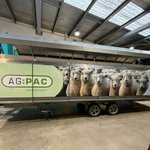
The NZ government has updated its targets for biogenic methane emissions "Following Cabinet approval, the target will be set at a range of 14–24 per cent below 2017 levels by 2050, reflecting the findings of the independent Methane Science Review released in 2024." The press release has links to investments to achieve these targets including: "Cool Sheep – continued roll out of low methane sheep genetics including methane measurement of rams, farmer engagement and developing a tool to track low methane genetics in flocks. Low methane sheep genetics has potential to achieve 1 percent reduction per year while not impacting productivity." which uses technology (PAC trailers and genomic selection developed by AgResearch) #1

Hopefully, this announcement will also reset the debate around whether biogenic methane emissions add to global warming, how that share should be calculated, and what base year for New Zealand to use for both methane and carbon dioxide emissions. beehive.govt.nz/release/gove…

2
134
It is worth reading the article on GWP* that David Frame is critiquing below and his response. My observation is that the climate models basically agree regards short and long lived gas emissions, GWP* or equivalents better reflect the climate models. This is acknowledged in the IPCC AR6 as well.

New report at @CarbonBrief by @orladwyer_ which asserts of last year's NZ methane panel report:
"The resulting report, which did not look specifically at GWP*, but used a similar concept..."
Climate model. We used a climate model.
carbonbrief.org/qa-what-the-…
1/

1
4
294
This paper includes both an experiment and a global meta-analysis. I expect that the statement in the discussion "However, the narrative becomes more complex when emissions are evaluated per unit of product. Strikingly, despite their clear metabolic advantages, both indigenous and improved breeds presented similar CH4 intensities (g/kg ADG). This reveals that indigenous cattle, despite slower growth rates, match the emission efficiency of their faster-growing counterparts." will cause angst to those who have been saying all that is required to reduce CH4/kg product is to continue with existing production selection indices.


2
2
172
I have not done a forensic examination but the abstract's sentence: "Milk and beef meat production currently emits ....and 2.63 T and 13.01 T of CO2 equivalent per 100 g of protein, respectively" I suspect is a several orders of magnitude out. However, I am just farmer's son from struggler's gulley who did chemistry at one stage so I always check the units. It does not agree with the text in the main article either. I note its a pre-proof so hopefully somebody checks it closely before the final version?


1
168
New market for crossbred wool? washingtonpost.com/science/2…

95
At the recent AAABG conference held in Queenstown. Kathryn McRae presented a paper high lighting that genetic research into improving NZ lamb survival was estimated to have contributed to an extra 337,000 lambs were weaned in 2023 worth $54 Million to the NZ economy and the inflation adjusted $4.2 million research project had a NPV of $164 million to date.

The paper also identified several opportunities to improve lamb survival more rapidly. For those wanting to read the full paper follow this link researchgate.net/publication…

A new paper by Setegn Alemu and the BSI AgResearch Animal Genomics Team on improving genomic prediction accuracy for methane emissions and feed efficiency using neural network GBLUP. Watch the 2-minute explainer (built in JavaScript + Google Voice API): 🎧 lnkd.in/gN5A5iu5 or read the paper 🥸lnkd.in/g9qzu3Ct

110