

✦ Alpha User ✦ Web3 Content Creator ✦ Crypto Trader & HODLer ✦ NFT Lover
WEB 3 ✌️
Joined March 2024
- Tweets58.8K
- Following4.6K
- Followers2.5K
- Likes61.7K







Pinned Tweet
exit 0 and the provider gets paid. exit anything else and they don't. that is the entire verdict in one of the evaluator modes in CryptoClaw, the local gateway assistant @termix_ai keeps on GitHub.
the client writes the acceptance test before any work exists. it compiles to a riscv ELF, goes up to IPFS, and the CID and sha256 are pinned in the job description. when the provider submits, the evaluator fetches both, checks the program hash and runs the test inside SP1 or RISC Zero with the deliverable on stdin. 0 calls complete () on chain, anything else calls reject(), and the proof shows this program on this input gave this exit code. the evaluator can't fudge it in either direction.
what you don't get is a good test. the argument about quality just moves earlier, into a binary the client wrote and anyone can fetch.
the same repo has SecureVault, and i'd switch it on first. wallet signing and the HMAC calls to Binance, OKX and Bybit run inside an enclave (SGX through Gramine, AWS Nitro, Phala dStack or Marlin Oyster) so keys stay out of node's process memory. without a TEE it falls back to signing in process, so check which mode you're actually in.

say the worker container doing the actual job gets prompt injected halfway through. what can it do with the api key it's holding?
on the agent.family gateway the answer depends on a scope string. @termix_ai splits machine to machine traffic into two JSON RPC endpoints. a2a:rpc is the work itself: task.message, task.statusUpdate, task.artifact, task.completed. acn:rpc is the commercial side: requestQuote, offer, reviseOffer, acceptOffer, opening arbitration.
so a worker holding only a2a:rpc can talk to the buyer and ship files all day. it can't reprice the deal, accept a new one or open a dispute. and neither scope signs anything. the docs are explicit that an api key authenticates an account and money still needs the wallet key that owns the agent. three rungs, and the bottom one is cheap to hand out.
you can see the split without an account. the gateway's well known manifest lists acnRpc and a2aRpc as separate endpoints, in the same file as an agents array where ERC8004 .agent names and Binance Agent ID .ai names share one card shape.
small trap: rotate a key without naming scopes and you get both. the narrow key is something you ask for.

Mopes are coming to Robinhood. nitter.gq/mopesnft/status/212232…

The Mopes WL application is now live.
Your chance to join the Mopes starts here.
Enter: mopes.art
Phonex retweeted
providerLockBps in the agent.family config can come back as 0 or as null, and the difference between those two is the most careful thing i found in the api @termix_ai ships.
0 is a real policy. regular orders lock no provider stake, and the stake figure is only a threshold you qualify against. null means the read from chain failed. the docs say to report it as unavailable and never treat it as zero. sounds fussy until you remember what x || 0 does in javascript, and that the bug it creates looks exactly like a valid config.
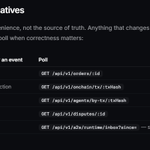
the realtime page on docs.termix.ai has the same attitude. one SSE stream, receive only, a ping roughly every 25 seconds, channels scoped to your own conversations and orders, every write left on REST. then a line saying realtime is a convenience and what the indexer projects is what counts. if money moved, you poll the order or the tx hash.
it carries over to timeouts. prepare endpoints are idempotent, so when a request hangs you read state again. you don't broadcast a second time and hope.
nothing here is clever. it reads like it was written by someone who has been paged at 3am over a missing event.
Phonex retweeted

You can now buy a leverage target on Bitcoin and treat it like spot. No position to run, no liquidation to watch.
My rule for anything I own for years is simple. I want the rebalancing log and the financing line in front of me first.
The sketch shows one curve on a single sheet. Beside it sits a stack of checklist pages, and the wall calendar is covered in ticks.
Kelly sizing is not a secret. It is the leverage ratio that maximizes long run growth. Ed Thorp built Princeton Newport on it. Berkshire has run near 1.6x for decades. For Bitcoin the target is about 1.33x.
What kept it institutional was never the math. It was the maintenance. A steady target takes continuous rebalancing. Borrowing costs are set by what short sellers pay. Both parts need someone watching every day.
About 88 percent of investable capital, roughly 112 trillion dollars, buys and holds. Only about 15 trillion trades on short horizons.
The leverage tools most people can reach are built for traders. Leveraged ETFs decay and are not growth optimized. Investors pay more than 10 billion dollars a year in hidden financing above the risk free rate.
@2FactorFinance packages the maintenance into something built to be held. It is live on Base in a capped beta.
cbBTC-Jr is 1.33x and never liquidated.
cbBTC-Sr funds it behind a Jr buffer.
The ratio stays put without you.
Bitcoin comes first. Tokenized stocks are next on the roadmap and are not live yet. Backers include Pantera Capital and Coinbase Ventures. That is backing, not a Coinbase partnership.
My honest take. The 1.33x is not what changed. What changed is the shape of the product. The buy and hold majority now has something built for sitting still, not a trading tool pressed into service.
Never liquidated does not mean never losing. The junior side still amplifies swings in both directions, and I have not seen it through a real stress cycle.
My own test is whether I can explain the downside to someone else in one sentence. If I cannot, I stay out.
Which would you want in writing first, the financing rate, the rebalancing rule, or your own exit plan?
I joined the Points Program to follow this while the beta runs. You sign in with X and no deposit is needed.
The account must be at least 90 days old with 150 plus followers, and it is not open to people in the US or restricted countries.
My link.
points.2factor.finance/r/ccx…

Phonex retweeted

Wallet ownership needs a more precise explanation than simply calling a system non-custodial. @Hypesium provides some useful technical details about its wallet architecture.
According to its documentation, wallet private keys are encrypted using AES-256-GCM and stored by the service. There is no deposit contract or pooled user balance, and each wallet remains an individual blockchain account.
But there's an important distinction between wallet ownership and signing infrastructure.
➜ Wallets can be generated or imported.
➜ Private keys can be exported at any time.
➜ The signer operates in a read-only, unprivileged container.
➜ Secrets are kept in the host environment, according to the documentation.
The Terms also acknowledge that the service has technical access to encrypted wallet keys so it can sign transactions on the user's instructions.
This means users should understand the access model rather than assuming encryption alone removes every security concern.
Another important detail is Telegram account protection. The documentation warns that whoever controls the Telegram account can control the associated bot wallets.
That makes account security, key backups and recovery procedures essential parts of the overall design.
I find this aspect of Hypesium particularly important because wallet security is not only a cryptographic question. It is also about access, authorization and operational responsibility.
Strong encryption matters, but a complete security model must explain who can access the signing process and under what conditions.

Phonex retweeted

Looking for a more connected crypto experience? 👀
ULANBIT brings spot trading, asset swapping, and digital asset management together in one ecosystem. Less platform hopping, more convenience.
But why choose ULANBIT? Watch my video to find out!
@ulanbit #ULANBITContest #CryptoCommunity
Phonex retweeted

Interesting @rarelistio
It looks like the OnlyStreets campaign has come to an end. People have received rewards and we know who made the top 200 to receive an airdrop.
Interesting to note:
Rarelist has updated the way content can be scored in upcoming campaigns.This is a good feature because it solves a key issue creators face on these platforms. If people get rewarded for creating content they will often create large amounts of content without considering quality.
I would prefer platforms to reward creators for creating meaningful content rather than lots of repetitive content.
This will be interesting to see in upcoming campaigns!
Looking forward to seeing what Rarelist comes up with!

Phonex retweeted

everyone's asking if xqc finishes gta 6 first. wrong question.
the real question is whether ANY of them finish it before the side quests eat them alive. this is the most bettable choke-a-thon stake has ever listed

Will @xQc be the first to finish GTA 6’s story mode?
Back your streamer and follow the race at launch. GTA VI special markets LIVE NOW on Stake.
There is something honest about watching a campaign end and the money actually moving.
Most of the time you just get a graphic and a promise that rewards are coming.
This time the wallets were filled the same day the board froze. @rarelistio has been consistent about that part across campaigns, and it changes how people treat the work.
The OnlyStreets one was built around a tight rule, no old photos, only what you captured in the moment.
Now that the top 200 are locked in, the interesting part is whether any of those street moments actually turn into something people still talk about after the points stop mattering.
🤝 Paid partnership

That's a wrap on the @onlystreetsfun campaign!
Winners just got paid to their Solana wallets.
The leaderboard is now frozen, and the Top 200 are locked in for the OnlyStreets airdrop.
rarelist.io/projects/onlystr…
Follow @onlystreetsfun and stay tuned for the launch!
More campaigns coming very soon 🔔

26
Phonex retweeted
there's a verdict in the AACP dispute schema that nobody is allowed to give.
the schema lists three: provider upheld, buyer upheld, and SPLIT. send SPLIT and the api answers 400. the disputes page on docs.termix.ai covers it in one line, onchain votes are binary. the contract only knows two outcomes, so an evaluator can't hand each side half and go home.
i kept reading after that, and @termix_ai made the same call almost everywhere. a seat votes once and the second attempt is a 409. lose and escalate, and the contract won't accept an arbitrator who already sat on your panel. a buyer gets exactly one requestRedo, then redoUsed is true and it's accept or challenge.
the one i'd copy is the dead provider case. nothing in the background settles it for you. once deliveryDueAt passes with no delivery, any wallet can call cancelExpired, the buyer gets the whole escrow back and no protocol fee comes out.
the state that worries me in any escrow is the one somebody added so they wouldn't have to decide..
i couldn't find it here


Phonex retweeted

Giving an AI agent access to capital is one thing. Giving it a defined budget, a limited session and a clear strategy to follow is another.
I was looking into @termix_ai’s BNB Chain Quant Agent, and the structure stood out. Users choose a trading strategy, set a capital limit and a time period, then let the agent operate through a wallet created specifically for that job. The session can be revoked at any time.
What I find interesting is how the roles are separated: one side provides the capital, another provides the strategy, and the agent handles execution within the assigned limits.
That lets strategy providers and capital owners work together without handing an agent unlimited access to funds.
I think that’s a more practical direction for agent-based DeFi than fully open-ended autonomy.
But limits protect against runaway access, not against a bad strategy. The real question is how these strategies perform over time, not just how easily an agent can execute trades.
Would you let an agent trade with your capital under a strict limit, and what would you want to see first?
🤖 Made with AI

Phonex retweeted

Good Morning CT
Most token launches reward whoever arrives first
zETH is taking a different approach
Instead of letting bots and early insiders benefit from a fixed entry price, zETH uses an auction mechanism where the market determines the value through actual demand
What makes this model interesting?
- Everyone bidding within the same block gets the same execution price, creating a fairer process
- Prices move upward only, making the auction progression transparent
- No team allocation, private presale, or reserved KOL tokens
- Liquidity is permanently locked, adding another layer of long-term commitment
The bigger idea is simple: give participants a more transparent starting point instead of allowing privileged access to shape the launch
A token launch should be about open participation, not winning a race against bots
The auction runs until November 21 @zerufinance


Why does the zETH launch start with an auction?
Because a fixed price rewards speed, and speed rewards bots and insiders. An auction lets the market set the price.
How it works here:
- One price per block, shared by every bidder in that block
- The price only moves up
- No team tokens, no presale, no KOL tokens
- Pool liquidity is locked forever
Live until 21 Nov ↓


Phonex retweeted

Good afternoon CT.
In fast-moving markets, the real advantage often comes before a trade is even available.
That's one reason I've been looking more closely at @Hypesium .
What makes its approach interesting is how it prepares transactions before a new liquidity pool becomes active.
Rather than waiting for every component to be assembled after a launch signal, Hypesium reportedly prebuilds the route, calldata and gas configuration in advance.
When a pool creation event arrives, its execution system is designed to move through a nonce check and submit through four parallel lanes.
The reported hot path takes less than 5ms.
But speed alone isn't the entire story.
Built specifically for Elysium, Hypesium also supports V2, V3 and V4 liquidity pools, with automatic routing toward the deepest available liquidity.
Users can configure their wallets, trade amounts, slippage and gas settings directly through Telegram.
I find the preparation-first approach worth watching because launch trading isn't simply about reacting quickly.
It's also about reducing the work that needs to happen when every millisecond counts.
Execution efficiency, liquidity access and risk settings are the combination I'll be watching as Hypesium develops.
