

The Moral Intuitions (MINT) Lab is a psychology research lab led by @_onurcanyilmaz at @khasedutr (Istanbul). The causes and consequences of human morality.
Istanbul, Turkey
Joined August 2019
- Tweets249
- Following198
- Followers1.3K
- Likes114




Moral Intuitions Lab retweeted

Our new paper is out, and it is one we never planned to write.
In October 2022, we were collecting data for a different project. We measured people's moral values and asked them to make two decisions with real money. Most of them lived in Istanbul. A month later, a bomb went off on İstiklal Avenue.
That left us with something researchers almost never have: data from just before a terror attack. We registered our predictions and went back to the same people about two and a half months later.
People often say that tragedy brings a society together. In our data, people did say that loyalty and authority mattered more to them after the attack. But they also gave less of their own money to a stranger than they had before it.
This was İlayda's (@ilaydavelioglu_) master's thesis. She is now a PhD candidate at the Moral Intuitions Lab (@mint_lab). The research was funded by ERC-AdG (PRINCIPLES).
I wrote about it for Psychology Today (@PsychToday) under the title "Does Terrorism Really Bring People Together?" Links to the post and the paper are in the first comment.


Moral Intuitions Lab retweeted

What makes our new study unusual? The same people, before and after a terrorist attack.
To our knowledge, it's the first study to track changes in moral foundations and prosocial behavior within the same individuals.
📄READ (open access)
doi.org/10.1177/194855062615…
@mint_lab

Moral Intuitions Lab retweeted

New paper in Judgment and Decision Making! 🧵
Does cognitive reflection predict how people behave in a moral dilemma with real money, not just how they answer hypothetical trolley problems?
We tested it across a 17-month gap. 👇

Moral Intuitions Lab retweeted
What do people actually do when the trolley problem is played with real money?
The trolley problem asks whether you would pull a lever to divert a runaway trolley so that it kills one person instead of five. It is almost always studied as a thought experiment. In a new paper in Judgment and Decision Making, led by Rozelin Vurgun, we made it real. People could take one person’s dollar so that five others would each get one. About 7 in 10 did.
We had tested the same people 17 months earlier. Those who were better at catching their own mistakes on tricky puzzles back then were more likely to choose the greater good. A widely used questionnaire (Oxford Utilitarianism Scale) on “greater good” attitudes told us nothing about what people actually did. And careful thinking mattered for non-religious participants but made little difference for religious ones.
Thinking harder doesn’t lead everyone to the same place. Where it leads depends on what a person already believes good thinking is.
Rozelin led this work as a master’s student in our Moral Intuitions Lab (@mint_lab). I also wrote a plain-language version for my Psychology Today (@PsychToday) blog.
Links to both are in the first comment.


Moral Intuitions Lab retweeted
Put a pair of eyes above an honesty box, and people pay almost three times as much for their tea and coffee. Nobody is actually watching. The brain doesn’t seem to care.
This summer I taught a course at Nesin Maths Village, a village for science and philosophy near Şirince in İzmir, founded by mathematician Ali Nesin in 2007, where students and volunteer teachers spend their summers thinking together, much like an ancient Greek agora. The question sounds simple: why do people believe in gods, and why do some of them stop? My new Psychology Today (@PsychToday) piece is a short, plain-language summary of that course, told through the lens of cultural evolution.
The short version: belief comes easily and fades quietly. Our minds are quick to sense agents and watchers, and culture turns that feeling into gods who see everything and care how we treat one another. Once societies grew too large for reputation alone to keep strangers honest, such gods may have helped people cooperate. Disbelief is not mainly what happens when people start thinking harder. The popular story says it is, but the evidence for that is weaker than it looks. Disbelief grows when children see fewer adults actually living their faith, and when courts, police, and welfare systems take over the watching that gods once did.
Genes don’t code for belief or disbelief. They build a mind that detects agents and learns from the people around it. Culture decides which watchers that mind ends up with, and whether they stay.
The eyes are ancient. What they mean to you depends mostly on where, and by whom, you were raised.
Full Psychology Today piece in the comments.


Moral Intuitions Lab retweeted
We developed a religious prime that works.
For twenty years, psychologists have asked whether reminding people of God makes them more honest or generous. Almost none of the primes used in those studies were ever tested to see if they actually activate religious thoughts. The explicit ones work, but about 1 in 9 participants guesses what the study is about.
So we hid religious words and images inside ordinary CAPTCHA tasks and tested them in a preregistered study with 2,770 participants.
Our technique raised religious thoughts well above control, and only 6% of participants guessed the purpose.
Generosity did not change.
The field now has a validated, low-suspicion tool, with separate primes for punishing, rewarding and forgiving images of God. Materials and data are open.
New paper in Behavior Research Methods, from a project funded by @TempletonRelig and co-led by Fırat Şeker (@firat_sekr UMass Amherst, formerly MINT Lab) and Ensar Acem (@ensaracem MINT Lab, @mint_lab), with Rozelin Vurgun, Burak Doğruyol, and Ozan Isler.
Psychology Today (@PsychToday) post and the link to the article in the first comment.
Moral Intuitions Lab retweeted
🧵 New paper out in Behavior Research Methods!
Can we prime religious thoughts without participants realizing they’re being primed?
We introduce “allusive priming”: religious cues embedded in CAPTCHA-like tasks.
Free full text: rdcu.be/td6ddgzAE5Ua

Moral Intuitions Lab retweeted
Thanks to my co-first author @firat_sekr and to Rozelin Vurgun, Burak Dogruyol, @_ozanisler & @_onurcanyilmaz. A Moral Intuitions Lab (@mint_lab) collaboration, and a great team to work with 🙏
Moral Intuitions Lab retweeted
⚡ ManyContexts: Measuring the Worlds That Big Team Science Samples
📅 Wed, Oct 7 | 13:00–13:55 UTC
⚡ Invariance Blindness: When Cross-Cultural Inference Outruns Measurement Validity
📅 Thu, Oct 8 | 10:30–11:25 UTC
Moral Intuitions Lab retweeted
We have three Lightning Talks at the Big Team Science Conference 2026, and I'm presenting two live on Zoom 🌍
Two, with @_onurcanyilmaz, ask what cross-cultural research often skips:
1. Do we know the contexts we're comparing?
2. Do our measures mean the same thing everywhere?
Moral Intuitions Lab retweeted
Excited to present our work at the Culture & Cognition 2026 Conference! Across four preregistered studies (N = 4,102), religious and secular authority primes changed cognitive accessibility—but not generosity.
See you at #Psychonomic2026!


Moral Intuitions Lab retweeted

Yazarımız Onurcan Yılmaz okurla buluşup İnsan Doğası Üzerine kitabını imzalayacak. 26 Eylül Cumartesi saat 13.00-13.45'te Bilkent Üniversitesi Merkez Kampüs Çim Alanında. PhilFest'26'da buluşmak üzere!

Moral Intuitions Lab retweeted
Kitaba gösterdiğiniz ilgi tahminimin üzerinde oldu; çok teşekkür ederim.
Amazon’daki stoklar birkaç gündür tükenmişti, ancak yeni stoklar eklendi. Kitap şu anda tekrardan Amazon'dan %30 indirimli olarak satın alınabiliyor:


Birkaç yıldır üzerinde çalıştığım kitabım "İnsan Doğası Üzerine: Ahlaktan İşbirliğine, İnançtan Özgürlüğe" @AkademimKitap'tan çıktı.
Çıkış noktası basit bir itiraz: insan doğası tartışmaları çoğu zaman iki uca sıkışıyor; ya her şeyi genlere ya da her şeyi kültüre yazıyoruz. Oysa:
"Genler mi, kültür mü?" yanlış sorudur; asıl mesele ikisinin birbirini nasıl dönüştürdüğüdür.
Kitabın temel tezi burada: insan doğası sabit bir öz değil, biyolojik sınırlar ile kültürel imkanlar arasında biçimlenen dinamik bir tasarım alanıdır.
Bu çerçeveyi ahlak, zeka, inanç ve iş birliğinin köklerinden yapay zeka, otoriterleşme, iklim krizi ve özgürlük gibi bugünün meselelerine taşıyorum. Çünkü:
Avcı-toplayıcı geçmişte biçimlenmiş zihinlerle Uzay Çağı'nın sorunlarını ancak kültürel yenilikle çözebiliriz.
Aynı insan doğası hem duvar hem de köprü kurabilir; hangisinin açığa çıkacağını kültür ve kurumlar belirler.
Ve nihayetinde: Yanlış bir insan teşhisi yanlış bir toplum tasarımı getirir.
Bu yüzden, günümüzün ve geleceğin sorunlarını çözmek için insan doğasını reddetmeye değil, ona uygun kültürel çözümler peşinde koşmaya ihtiyacımız var.
Satın almak isterseniz, şu an Amazon üzerinden indirimli satışta: amazon.com.tr/dp/625932927X
Kitapla ilgili ayrıntılı bilgi için: akademimkitapligi.com/kitap/…


RT @_onurcanyilmaz: Şaka bir yana, iki kitap aslında birbirine rakip olmaktan çok aynı hikayenin farklı katmanlarını anlatıyor.
Daron Acem…
This quoted post is unavailable.
Moral Intuitions Lab retweeted
Birkaç yıldır üzerinde çalıştığım kitabım "İnsan Doğası Üzerine: Ahlaktan İşbirliğine, İnançtan Özgürlüğe" @AkademimKitap'tan çıktı.
Çıkış noktası basit bir itiraz: insan doğası tartışmaları çoğu zaman iki uca sıkışıyor; ya her şeyi genlere ya da her şeyi kültüre yazıyoruz. Oysa:
"Genler mi, kültür mü?" yanlış sorudur; asıl mesele ikisinin birbirini nasıl dönüştürdüğüdür.
Kitabın temel tezi burada: insan doğası sabit bir öz değil, biyolojik sınırlar ile kültürel imkanlar arasında biçimlenen dinamik bir tasarım alanıdır.
Bu çerçeveyi ahlak, zeka, inanç ve iş birliğinin köklerinden yapay zeka, otoriterleşme, iklim krizi ve özgürlük gibi bugünün meselelerine taşıyorum. Çünkü:
Avcı-toplayıcı geçmişte biçimlenmiş zihinlerle Uzay Çağı'nın sorunlarını ancak kültürel yenilikle çözebiliriz.
Aynı insan doğası hem duvar hem de köprü kurabilir; hangisinin açığa çıkacağını kültür ve kurumlar belirler.
Ve nihayetinde: Yanlış bir insan teşhisi yanlış bir toplum tasarımı getirir.
Bu yüzden, günümüzün ve geleceğin sorunlarını çözmek için insan doğasını reddetmeye değil, ona uygun kültürel çözümler peşinde koşmaya ihtiyacımız var.
Satın almak isterseniz, şu an Amazon üzerinden indirimli satışta: amazon.com.tr/dp/625932927X
Kitapla ilgili ayrıntılı bilgi için: akademimkitapligi.com/kitap/…
Moral Intuitions Lab retweeted
#YeniKitap #Scholium-3
Onurcan Yılmaz
İnsan Doğası Üzerine:
Ahlaktan İşbirliğine, İnançtan Özgürlüğe
İnsanı insan yapan nedir? Taşıdığımız genler mi, içine doğduğumuz kültür mü? Kimileri insanı bencil dürtülerinin esiri saydı, kimileri temiz bir sayfa gibi gördü. Onurcan Yılmaz, bu kısır ikiliği geride bırakıyor: İnsan, ne genlerinin tutsağı ne de kültürün serbestçe yoğurduğu bir malzeme; biyolojik mirasla toplumsal birikimin birbirini sürekli dönüştürdüğü, dinamik bir tasarım alanıdır. Ahlakın kökeninden zekânın evrimine, inancın psikolojisinden işbirliğinin mantığına, yapay zekâdan iklim krizine ve özgürlüğün anlamına uzanan bu kitap, psikolojiyi, evrimsel biyolojiyi, antropolojiyi, tarihi ve felsefeyi birbiriyle konuşturuyor. Çünkü her insan teşhisi, sonunda bir toplum tasarımına dönüşür. İnsanı yanlış anlamak yanlış toplumlar doğurur, doğru anlamaksa özgürlüğün ilk adımıdır. Kendimizi ne kadar iyi anlarsak geleceğimizi o kadar bilinçli kurabiliriz.
Scholium dizisi Derya Gürses Tarbuck’un yönetiminde Akademim Yayınları için hazırlanmaktadır.
@_onurcanyilmaz, @mint_lab, @DGTarbuck
Kitabın Detayları:
akademimkitapligi.com/kitap/…
Amazon'dan İndirimli ve Hızlı Satın Al:
amazon.com.tr/dp/625932927X
#Bilim #Psikoloji #Felsefe #Antropoloji #İnsanDoğası

Moral Intuitions Lab retweeted
New Psychology Today (@PsychToday) blog post out, on findings from our recent Political Psychology (@Journal_PoPs) paper with Sinan Alper (@SinanAlper_) and Onur Varol (@onurvarol). The piece challenges the long-standing assumption that conspiracy theories are primarily endorsed by people who feel politically powerless.
The setting is Türkiye after the February 2023 earthquakes, which killed more than 50,000 people. Within hours, a baseless conspiracy theory began circulating online claiming the disaster had been triggered by HAARP, a real atmospheric research program in Alaska, reframed as a foreign weapon. If the dominant account were correct, the conspiracy theory should have spread fastest among the political opposition. What we observed was the inverse. It took hold among supporters of the governing party, the same voters who were about to extend its already 25-year hold on government.
The asymmetry stops looking odd once you ask what the conspiracy accomplishes for those who endorse it. Locating the cause in a foreign weapon redirects blame from the administration responsible for two decades of unenforced building regulations toward an external adversary. Responsibility shifts from domestic policy failure to geopolitical victimhood. The conspiracy operates more like a shield than a protest.
Two analyses support the pattern. The first drew on 38,884 tweets from 26,992 accounts in the days after the earthquakes. Accounts aligned with President Erdoğan produced and circulated the HAARP content at much higher rates than accounts aligned with the main opposition. The second was preregistered and used a nationally representative face-to-face survey of 3,568 respondents before the May 2023 election. A stronger endorsement of the HAARP explanation corresponded to a 35 percent higher probability of intending to vote for the incumbent, with age, education, income, and personal earthquake loss adjusted for.
The result fits the distinction Nera et al. (2021) drew between upward and downward conspiracy beliefs in the conspiracy literature. Some conspiracies direct suspicion upward at elites; others direct it downward at low-power outgroups. The HAARP narrative is upward in form, since its named villains are foreign states more powerful than Türkiye, but its political effect is downward: it absorbs anger that might otherwise have fallen on the people actually in domestic power.
The framing question, in other words, is the wrong one. Asking how anyone could endorse such an implausible story misses the cognitive work the story performs. The more diagnostic question is who the belief serves. In disaster contexts, that beneficiary is often the political actor whose failures the conspiracy helps to obscure.
Psychology Today piece walks through the argument, placing it in the political context. Link in the next message.

Moral Intuitions Lab retweeted
Full piece on Psychology Today 👇
psychologytoday.com/us/blog/…
@mint_lab

Moral Intuitions Lab retweeted

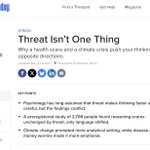
Threat isn't one thing. In our new study, some threats may even sharpen analytical thinking. By @_onurcanyilmaz for @PsychToday
Yeni çalışmamızda "tehdit"in tek tip olmadığını bulduk! Bazı tehditler analitik düşünmeyi köreltmek yerine güçlendiriyor. Onurcan çok güzel anlatmış!

In our new research, we found that “threat” is not a single psychological state. Different threats can activate very different cognitive systems, and some may even increase analytical reasoning rather than suppress it.
See new @PsychToday piece:
psychologytoday.com/us/blog/…

