

CADD group leader at Center for Development of Therepeutics of Broad Institute. Views are my own.
Boston, MA
Joined August 2009
- Tweets1.1K
- Following415
- Followers251
- Likes1.9K







Mrinal Shekhar retweeted

This isn't your ordinary journal review! @_sophia_tang_, @yinuo_z98, and I go through the algorithms behind generative biomolecular design from the ground up, from flow matching, diffusion, and discrete flows to trajectory steering and distribution shaping! 🧬🧩
📜:sciencedirect.com/science/ar…
We also have a great website to make it all easy and fun to explore! Every method is a live animation you can play with, plus an interactive map of the papers in the field!! All in classic Sophia form. 💜
generative-biomolecular-desi…

Our perspective article on generative modeling for biological design is finally published in Current Opinion in Structural Biology 🧬🧩
When I first started in AIxBio research in fall 2024, the work behind protein structure prediction and computational protein design had just won the Nobel Prize in Chemistry. I remember being fascinated with the algorithmic side of AlphaFold and RFdiffusion and what AI could make possible in biology (the origin story of my blog 🤓).
Since then, I have seen the field grow exponentially, especially as generative modeling frameworks have advanced in quality and controllability. As the methods have advanced, so has the diversity of applications -- ranging from generating new-to-nature functional enzymes and therapeutic peptides optimized for multiple properties to synthesis-constrained small molecule discovery. 🔬
Together with @pranamanam and @yinuo_z98, we highlight the key components of generative modeling for biomolecular design to answer the question: 🔍 how can we efficiently and controllably probe the vast biomolecular design space with modern generative methods?
We also discuss challenges and future directions in predicting biological function, balancing competing objectives, ensuring experimental feasibility, and incorporating experimental feedback into the design loop. 🌟
doi.org/10.1016/j.sbi.2026.1…
🧵 More in thread

Mrinal Shekhar retweeted

Nature Biotechnology: Low-n epitope-targeted antibodies via AF-Multimer × IgLM co-optimization.
Mille-Fragoso, Hie, Gao and colleagues at Stanford and the Arc Institute design de novo CDRs onto a user-specified antibody framework, instead of relying on immunization or large library screens that offer little control over which epitope is hit.
Hard readout
→ Functional antibodies across four diverse targets — PD-L1, IL-3, IL-20 and the viral protein BHRF1 — and across binder formats, after testing only 43–101 designs per antigen
→ Experimental success rates of 4–22%; the paper reports nanomolar binding affinities, and BLI examples include 170 nM (PD-L1), 280 nM (IL-3) and 190 nM (IL-20)
→ Validated designs showed robust expression in mammalian cells and high sequence and structural novelty; code and full protocols are open-sourced
Worth reading when epitope-targeted antibody design still sounds like a high-n screen.
📄 Paper: nature.com/articles/s41587-0…
🔎 Highlight: nature.com/articles/s41592-0…
💻 Code: github.com/SantiagoMille/ger…
#AIforScience #AntibodyDesign #OpenSource

ALT Germinal paper Figure 1 lead: epitope-targeted antibody design pipeline overview
Mrinal Shekhar retweeted

ipSAE for ligands. ipTM is poor for ligands. ipSAE fixes it by using the asym score (aligning on protein, scoring whole ligand) & setting the TM d0 parameter to 2. Separates good/bad models at ipSAE=0.5 for AF3, 0.8 for Boltz-2.
biorxiv.org/content/10.64898…
github.com/DunbrackLab/IPSAE…


Preprint now online: biorxiv.org/content/10.64898…
Mrinal Shekhar retweeted

How many times have you seen a mouse study claiming that a therapeutic works, and the survival curve looks like this? Broken axis, 6% difference in survival time, but the P value is < 0.05 and it's claimed as a positive result. It's not. In my 15 years of prion science, I have learned to look past such claims almost instantly. Yet sometimes these claims still lead to high-profile publications, millions of dollars in funding, and even to therapies being tested clinically. In this new blog post I release data on 301 untreated control animals from our last 9 years of in vivo studies, model out the various ways that P values can appear significant even when the result is null, and put into words the intuition I've built up as to which claims are believable and which are not.
cureffi.org/2026/11/03/how-t…

Mrinal Shekhar retweeted

Experimenting with a New Conditional Diffusion-Based Generative Model #EvoDiffMol #cheminformatics #RDKit #GenerativeAI iwatobipen.wordpress.com/202…

Mrinal Shekhar retweeted

Protein immunogenicity is a major driver of drug failure in the clinic, a problem especially important in the age of generative AI when we can design de novo medicines with desired function.
Meet 🐐MESSI: a generative method for deimmunizing proteins with discrete diffusion. We reduce predicted MHC-II epitopes and experimentally validate retained or improved function in luciferases, PD-1 binders and uricases—an enzyme family used in FDA-approved therapies.💊
Watch the story below:
1/n 🧵
Mrinal Shekhar retweeted

Our paper, “Creation After Destruction? Financial Intermediation and Firm Entry After Bank Cleanups,” co-authored with Prof. Prasanna Tantri, has been published in the Review of Finance. (doi.org/10.1093/rof/rfag045)
🧵 A thread...

Mrinal Shekhar retweeted

The third challenge in our Anthropic x Adaptyv Protein Design Competition is now live.
I'm sure you are all familiar with this target: GLP1R. That "Godzilla" in the animation is there on purpose. Exendin-4, a GLP1R agonist, was first found in Gila monster venom, with its synthetic form (exenatide) being approved in 2005.
Across this competition we’ve wanted to go beyond plain binding. Our first two challenges had two new conditions (pH-sensitivity and cross-species). And, in this one, you’re designing binders against a rather difficult GPCR and they must also function as agonists. We'll test this with a cell-based functional assay.
Submit your designs by October 25th 23:59 AoE!

Mrinal Shekhar retweeted

An excellent introduction (for beginners) to Graph Neural Networks
distill.pub/2021/gnn-intro/

Mrinal Shekhar retweeted

ICYMI like I did: cool paper from @UWproteindesign combining de novo allosteric protein switching with de novo enzymes. You know it's gonna be a banger when figure 1 has an energy landscape 😏 📈📉
Congrats to Alex Shida and the rest of the authors
@adam_broerman @ArvindSPillai1
biorxiv.org/content/10.64898…

Mrinal Shekhar retweeted

タンパク質配列の共進化を可視化するパイプラインの開発
アミノ酸配列や構造情報を入れるだけで、構造上に共進化するアミノ酸ペアを可視化可能
モデル細菌や酵母由来の複合体における、構造が決定済または未決定の相互作用面の共進化表示例が紹介されている #BNTNJC
biorxiv.org/content/10.64898…

Mrinal Shekhar retweeted

Glad that someone noticed this. R&D productivity is extremely important. If we had more financial resources, I could start a program for pretty much every high-value protein target using multiple therapeutic modalities at once. AI is no longer the moat. The moat is operational efficiency, monkey and human patient resource. And the real bottleneck is in the clinic.

Mrinal Shekhar retweeted

picofold.py: a minimal protein structure predictor in ~200 lines of readable PyTorch.
Give it 16 amino acids and it turns random noise into a 3D structure, step by step. I wrote it to demystify protein folding and flow matching for myself. Hope you find interesting! 🧵

Mrinal Shekhar retweeted

Assume --- three of your group members
- Designed binders
- Using different techniques/tools
- For folding they used Boltz → Protenix → ColabFold
- For interface scoring/ranking somewhat similar metrics.
You/PI: "can you guys also rank and check with i_pDAE, in BindCraft2. I just want to see how our binders rank/look"
-One of them simply clones the repo👇& sets it up in 3 min using uv.
-They paste the folded binders from Boltz → Protenix → AF2/ColabFold into one folder and run one command: "python ipdae.py designs/"
-By the time they finish their coffee☕️, the results are ready.
-One ranked CSV file, best binders(0-1 i_pDAE scores) first. For every seed/structures user get (i_pDAE, i_pDAE_median, Contact_Pairs, interface_Binder_Residues/interface_Target_Residues).
-Plain-text report.
-PyMOL views with F1–F3: ipdae_view.pml stores three scenes on the F1, F2 & F3 keys.
i_pDAE values/colors/residues/surfaces in pymol/clip👇:
🔴 Deep Red (0.8–1.0): High confidence (PAE <0.5Å) 🌸 Light Red (0.6–0.8): Confident
⚪ White (0.4–0.6): Moderate / mixed
🩵 Light Blue (0.2–0.4): Uncertain
🔵 Deep Blue (0–0.2): Interface contact, unknown placement
🩶 Grey (-1): Off-interface (unscored)
Dropping it tomorrow.
github.com/ullahsamee/i_pDAE
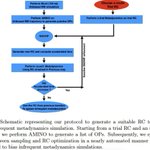
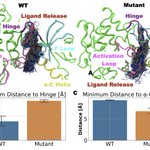
CTMD: Can molecules be accurately screened without waiting for free energy convergence?
The most frustrating moment in virtual screening is often not ending up with an empty list, but rather getting hundreds of molecules that all look promising.
This work introduces c(t)-based metadynamics (CTMD)—a fast, physics-based method for triaging virtual-screening hits. #JCIM #Compchem #Virtual Screen @broadinstitute
1
21
Article: pubs.acs.org/jcisd8/article-….

10