

https://nitter.gq/t.co/Gj8SnX7NQ9 - build full-stack apps with Local AI and deploy anywhere
London, England
Joined December 2016
- Tweets551
- Following787
- Followers681
- Likes91





It was 1860 when you realised just how big the market could be for a machine that could do division quickly.
You saw all those people in accounting offices, slaving away with pen and paper, and designed a machine to do the calculations for them.
You worked on it for years. Decades. Centuries. You refined it, optimised it, made it more powerful. At first, it was hand-cranked. Then you fitted it with a steam engine. It works beautifully and crunches the numbers ten times faster.
You ignored all that nonsense people kept going on about: electricity, vacuum tubes, microchips, electronics. After all that work, you now have an incredibly powerful, incredibly affordable steam-powered machine for doing division. For just $100,000, it replaces a team of accountants who would cost you three times as much. A huge market. A cutting-edge product.
But now people are babbling about calculators. Handheld ones! Powered by electricity and electronics. For just five euros!
Oh, come on. What could you possibly do with a five-euro calculator? You'll get all your numbers wrong! How can you trust something that costs five euros?
🤖 Made with AI

28
Then there are the people who get their hands on a powerful tool like vibe coding and go wild over everything they can do with it, without stopping to ask whether any of it makes sense.
But vibe coding is like a drill: you can make plenty of holes, but you don’t judge its power by how many holes you drill in the wall.
If you don’t know how to use it and don’t know what to do, you end up drilling random holes everywhere.
If you know how to use it but don’t know what to do, you drill holes in the wrong places and dream up convoluted workarounds.
If you know what to do but don’t know how to use it, you use it the wrong way: you don’t hammer a drill into the wall like a nail.
To get the most out of a powerful tool, you need to know both what to do and how to use it.
That’s why we offer Trustant.AI: the right tool to do the right thing, the right way.
🤖 Made with AI

1
1
70
It's been a whirlwind week since the launch of Trustant (dot AI). We've overhauled the website based on dozens of pieces of feedback. It now puts our biggest strength front and center: building full-stack applications with local AI and deploying them to your own infrastructure.
We've given pride of place to the diagram everyone singled out as the site's strongest message, and made its meaning clearer with a new tagline. To build full-stack applications with AI, you need a development environment. To put them into production, you also need infrastructure to run them on. Developing locally doesn't, by itself, remove your application's dependence on cloud services.
That's where we come in: Trustant provides the development environment, while TruServerless provides the production environment—a complete, enterprise-grade serverless platform built on Apache OpenServerless.
We've also moved away from featuring our mascot so prominently. As lovable as it is, it risked obscuring the fact that we're building for businesses. We've completely remade the explainer video too, with Max presenting from a data center.
Let us know what you think of the new site!

1
1
94
A quanto pare dire le cose pane al pane, vino al vino, funziona meglio che provare a usare un pomposo linguaggio commerciale. Ieri devo dire che è stata giornata fantastica post lancio: un sacco di contatti, gente che lo vuole provare, proposte di rivendita, progetti etc. Ma ci sono stati anche quelli che hanno dubbi. Ed è su quelli che mi soffermo.
La cosa che mi ha detto più di uno: "eh sì, il vibe code vabbè, ma ci fai solo i prototipini. Quando ti serve una architettura enterprise ci muori, altro che vibe code. Kubernetes, database, cloud, cache, AI... Robe come quelle, ti devi smazzare."
Al che io rimango basito e balbetto: "ma... ma.... ma... ma è proprio QUELLO il problema che Tustant risolve." Come è che non si capisce?
Gli dico anche "Lo so che a tirar su claude oramai la sanno far tutti. A metterci sotto una architettura enteprise, e farlo lavorare su QUELLA il difficile. Ed è PROPRIO quello che facciamo noi!"
Purtroppo di solito non lo convinco: "Senti, sono SEI MESI che ci lavoriamo, fino a fare una app react ci arriviamo, a ma gestire tutto l' ambaradan sotto è tutta una altra storia".
"Ma ti sto dicendo: ti dò una CLOUD PRIVATA completa. Serverless. Privato. Open Source. Apache OpenServerless. Una roba che non finisce più. Kubernetes, con dentro OpenWhisk per le functions, con il database Postgresql, con Redis, con storage compatibile S3, con database vettoriale Milvus, con AI privata in api OpenAI, ci sta tutto. E ti dò anche una AI che sa come usarlo. Non ti fa AI slop con le chiavi nel frontend. Ti fa applicazioni con il backend, serverless, cloud-native e scalabili ".
"Bello Michele. Ne riparliamo quando abbiamo risolto i problemi dell'infrastruttura"
Mamma mia. Niente da fare. Non mi stanno a sentire. Troppo occupati a tirarsi dietro quel peso che io gli ho tolto di dosso. Per di più siamo noi a fare la maintenance dell'architettura.
Mi è toccato cambiare l'headline della pagina di Trustant, sperando che ci capisca meglio. Ora c'è scritto:
Vibe Code Safely of a Private Enteprise-Grade Architecture

1
1
87
Ieri abbiamo lanciato Trustant e oggi sono "i6o" nero con Linkedin, ma anche X, Facebook, Reddit e tutti i social con i loro filtri del "c5o" che fanno passare tutte le polemiche inutili ma un post un minimo informativo no, perchè promozionale.
Per cui per oggi tralascio la consegna dei "modi delicati" che mi hanno imposto i miei colleghi CEO e CRO e ve la dico papale papale.
Domanda: Che cavolo è Trustant?
Risposta: Invece di farvela lunga, pomposa e e accurata ve lo dico in 1-2-3:
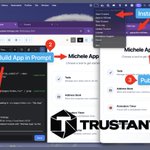
Uno. Installi il pacchetto desktop sul tuo pc e il pacchetto server su qualunque server o vm che supporti Ubuntu Linux. Cioè tutti, ma proprio tutti.
Due. Crei la tua app in prompt usando AI privata - si davvero, con la AI privata.
Tre. Pubblichi la tua applicazione dove vuoi tu - dovunque, il tuo server locale, il rack nello scantinato o un nel data center italiano scalcagnato che però usate da 20 anni.
Fine. Stop. Niente altro che questo. Si capisce cosa è Trustant ora? È quello a cui abbiamo lavorato per tre anni, e che ci hanno sempre detto: "ma non si capisce cosa fate".
Cosa facciamo? Semplifichiamo lo sviluppo cloud-native. E ora lo abbiamo portato al massimo livello di semplicità. Installi. Chiedi. Pubblichi. Fatto.
Ora mi direte: ma AI privata davvero? Si, davvero. Con i modelli cinesi, come Qwen o GLM. Funziona. E funziona bene perché la parte complessa è già fatta da OpenServerless.
Puoi usare la tua spark o la scheda grafica del tuo gaming pc di tuo figlio se vuoi. E se per ora la RAM costa troppo cara e non te lo puoi permettere, usi Ollama Cloud che a 20 euro al mese ci fai un sacco di roba. Ma usi i modelli CHE TI PUOI PORTARE A CASA.
Usi il cloud per comodità, non per farti mettere il cappio al collo.
E se vi state lamentando: ma devo proprio usare PI? Io uso Claude o Codex e mi ci trovo bene... Guarda, abbiamo messo anche quelli. Almeno fino a che non ve lo bloccano, potete continuare a usarli.
Ma vi assicuro che GLM magari non sarà capace di farvi GTA 6 in due ore ma il coding lo conosce e funziona. Usate Claude o Codex se volete ma se usate GLM fate un sacco di cose lo stesso e funziona.
Ma Trustant si paga? Se usate la versione community no. Tutto il codice è Open Source. Installate dai sorgenti, compilate modificate, ci fate quel che volete. Ma come con tutto l'Open Source, vi arrangiate. C'è il forum ed è pieno di roba.
Se invece volete installer, pacchetti pronti, supporto e aggiornamenti pronti per voi, c'è la economicissima developer edition. E se volete farvi supportare o pagate un sistemista o pagate noi per farlo. Tutto qui.
Ok dove è il sito di Trustant? Eh, se ve lo dico e metto il link, il post non lo vede nessuno quindi dovrete arrivarci da soli... Però è un sistema AI quindi il suffisso quale potrebbe essere?
Lo so, è difficile arrivarci, ma ce la potete fare.
#localai #vibecoding

Trustant, our “trustable assistant for Private AI,” launches tomorrow!
Build apps with prompts using private AI, whether it runs locally or in the cloud with zero data retention—and with models you can bring in-house whenever you want. Deploy your apps without managing servers, thanks to Trustant Serverless.
All private. All open source.
Trustant helps you build apps through vibe coding without having to become a software architecture expert. The architecture is already in place, and the AI knows how to use it.
Imagine running something like Lovable on your own PC, then deploying your apps without the headaches—to your own server, in your office, in your data centre, or with any sovereign cloud provider. Wherever you host it, you can deploy your apps serverlessly.
Trustant Serverless makes your server… serverless!
Just one day to go until launch.
tiktok.com/@trustant.ai/vide…

1
1
124
Serverless has traditionally been the domain of the cloud—a way to build cloud applications quickly without worrying about setting everything up.
But did you know you can also run serverless on your own infrastructure? You can build applications using functions, with databases, S3-compatible object storage, Redis, and a vector database—all running on infrastructure you control.
Professor Antbert explains what it is and how it works. In two days, you’ll find out how to bring it to your own infrastructure.
tiktok.com/@trustant.ai/vide…

1
48
Let’s talk about AI costs. Seriously.
When you’re just playing around, experimenting, or using AI occasionally, paying for cloud tokens is no big deal. It SEEMS cheap. But try building a RAG system or running an agent.
I first realized how expensive AI could really be about two years ago, when I processed a dozen documents to extract information and build my first RAG system. I expected it to cost a few cents.
The actual bill? $50. Ouch!
Now scale that up to thousands of documents, and you start to realize that cloud AI isn’t quite the bargain you thought it was.
Agents take this to a whole new level. These processes can run 24/7 for weeks at a time. Suddenly, you’re looking at bills running into four figures or more. At those prices, a DGX Spark starts looking pretty reasonable…
Here’s the thing: you don’t always need a powerhouse model like Astra or Fable. For repetitive tasks, you often don’t need one at all. Much of the work involves summarizing documents or doing straightforward text analysis—tasks that even a small 7B model can handle perfectly well. And that’s where much of everyday AI use will be.
So yes, local AI is here to stay.
Even if you’re absolutely convinced that cloud AI will always be light-years ahead of local models, consider this: the budget you’ll need to use it may also be light-years beyond what you can afford. Especially once providers stop handing out free hits of AI to get you hooked.
And to anyone who says local hardware will never measure up to the cloud: back in 1985, I bought a Commodore 64 for the equivalent of €500 in today’s money. Today, that same budget buys a PC with a processor clocked roughly 4,000 times faster, around 400,000 times as much RAM, and enough storage to hold roughly four million floppy disks.
You can already run a decent model—around 20B parameters—on a regular CPU, without a GPU. By next year, I expect phones with built-in AI good enough that you won’t miss the cloud models you use today.
So when we talk about local AI, what are we really talking about? A science-fiction dream, or a future that’s just around the corner?
We built Trustant around these realities.
Three days until launch!
f you’re telling me private AI isn’t up to the job, it’s only because you’re not really using it. Pushing it to the limit on benchmarks to see how powerful it is isn’t the same as actually using AI to get something done.
I use all kinds of AI, all day long, for all sorts of things. Mostly for writing code: I’m a developer, I’ve been using AI agents for a year and a half now, and I know how to get quality results out of them.
I started paying for ChatGPT two months after it came out, but I’ve also been running private AI since the days when it crawled along at one token per second on a GPU. And I’ve learned one thing.
If you only use public AI and keep chasing the most powerful model, you’re being fed ever-bigger doses of a drug designed to deepen your dependency.
Because I’m in a position to choose and experiment, I know you don’t need some super-mega-galactic AI to do useful things. You need the right one at the right time. In my work I mix plenty of them: public, private, and private in the cloud (the ones too big to run locally, for TODAY), with a preference for the private ones.
If you’re building an agent that cleans up data, for example, using a public AI is sheer madness. A 7B model can handle it, and if you use cloud models it’ll cost you a fortune.
And here’s the kicker: I’ve hardly ever used Astra or Fable, simply because I don’t need them. I always use the smallest, most private AI I can, and only step up to a bigger one when it can’t handle the task.
But I very rarely need the biggest one. GLM 5.3 744B, for instance, can do an enormous amount. With a model like that, you’ll probably have more than enough for 90% of tasks, both today’s and tomorrow’s.
Sure, it’s not Opus 5.5 (which is ten times bigger), but “can’t handle” what, exactly? Coding? It handles it with room to spare, at least the way I do coding.
And the way I do it is well specified, with plenty of context, in small steps. Because relying on a huge model for everything is like hiring a Nobel laureate in economics to do your accounting.
What you get back might be brilliant, but it might not be what you actually needed, in terms of cost or results...
Have you considered local AI too? That’s Elizabeth’s topic today, 4 days to the Trustant launch...
tiktok.com/@trustant.ai/vide…
1
120
#Revolut dropped Claude, bought itself a stack of GPUs, and moved everyone onto #GLM. We use GLM in Trustant, so we know first-hand it works brilliantly. What's missing is the infrastructure — and that's something you'd have to build yourself. We give you the whole stack, from #vibecoding all the way to the server… or rather, serverless. 5 days to launch. Stay tuned.
tiktok.com/@trustant.ai/vide…
1
112
6 days to the Trustant launch! Today's theme is freedom, in the hands of our rapper Lord Antinous. Watch the clip on the Trustant website, and keep checking back: a new theme every day until launch day.

48
I am Trusty and I have a question for you. Are you sovereign of your own data?
Who decides where it lives, who can access it, and how it’s used? If you can’t choose, someone else does.
Lose that control, and confidential plans or customer information could be exposed, reused, or kept longer than you intended.
Depending on one provider can also make leaving difficult. Can you export your data and keep working if access disappears?
Who holds the keys to your data? Can you take control back? You will find out in 7 days.
tiktok.com/@trustant.ai/vide…

34
I’m Jeanie, and I have a question for you. How do you protect your creativity?
Your sketches, designs, and ideas are more than files. They’re your signature, your livelihood, and what makes you unique.
Share an original creation with an AI service, and it can generate variations that imitate elements of your work.
Depending on the service and its settings, uploads may also be used for training. Have you checked the terms?
Before sharing your next design, ask who can access it and how it’s used. You’ll find out how to protect yourself in 8 days.
37
I’m Trusty, and I have a question for you: where does your data end up?
You just pasted a client’s contract into an AI chat. Do you know which country it ended up in?
In the cloud, your data may travel beyond the European Union, through providers and subcontractors. Do you know which ones?
Before sending confidential documents, check where they’re processed, who can access them, and how long they’re kept. Trust alone isn’t enough.
GDPR holds you accountable for personal data. If NIS2 applies to your organisation, you must also manage risks from your suppliers.
Using a service doesn’t remove your responsibilities. Want to know how to regain control? You’ll find out in 9 days.
#localai #vibecoding
1
64
Sam Altman said (yes, he really did say that!) "running AI locally is a terrible idea". Why? Because it’s ugly and bad ? Maybe because the communists steal models from the Americans through distillation and then hand them out to everyone for free, to hurt them and stifle innovation?
Nah! It’s because it would mean letting some people hoard quantities of RAM that would sit idle 95% of the time!!!
And that would be an enormous waste... especially now, with DRAM in short supply. Far better that it be put to good use by the big AI cloud providers than left in the hands of amateurs running local AI.
Because, as everyone knows, handing them all the RAM so they can rent it back to us by the token is right and proper. Heaven forbid anyone should want to do it themselves. You’re not good enough, our models are better, yours are garbage, boo, shame on you!
Fair enough. But something nags at me. There’s a handful of people over there in America, very few indeed, who have a lot of money. A really, really lot. I believe Sam is one of them.
Apparently the top 1% of Americans hold 32% of the country’s total wealth. Leaving them all that money is a truly terrible idea...
How can we allow such a waste of money, just sitting there rotting unused in bank accounts?
Wouldn’t it be better to distribute it to people who could actually spend it and put it to better use?
Ah, wait... the communists were the Chinese, I think...
🤖 Made with AI

1
104
There’s no getting around it: resistance to vibe coding is futile.
As I said on the call, for 40 years I’ve been the cobbler whose children go barefoot. I wrote applications for paying clients, but avoided writing code for myself because building my own apps USED TO take so much time that it WASN’T worth it. Whenever I needed something, I’d look for an existing solution—even a paid one. I’ve never had a problem paying for software.
Vibe coding has changed all that. Building your own apps is now both practical and worth the effort. As I mentioned, I’ve already built about fifteen for myself over the past year and a half. And just yesterday, I had another perfect example.
I’m always running out of disk space. It’s a longstanding problem, especially with a relatively small SSD: when your virtual machines take up 50 GB apiece, space disappears fast, and you’re constantly clearing things out.
I’ve spent years—and I mean YEARS—looking for a decent utility to show me what’s taking up all that space. I’ve tried several and bought three, but none has ever quite worked for me. Too many clicks to start a scan, an unhelpful visualization, or some other little annoyance.
Yesterday, faced with opening the same utility yet again—the one that never quite helps me find what I need to clear out—I thought: “You know what? I’ll just vibe-code one.”
In the past, I would have called myself crazy. Six months of work to save a few hours? Today, the equation is different.
It took me EXACTLY 20 minutes to build the app shown below. I spent ten minutes writing the initial prompt, then another ten tweaking the app as I used it, adapting it to what I actually needed.
Then I spent more than 30 minutes publishing it on github.com/msciab/diskuse and writing this post—including five minutes wrestling with passwords just to log in. The repository also includes the exact prompt I used to generate it.
No, this isn’t the end of programmers. That prompt contains specific technology choices—Rust and egui—an interface description, and technical details. Someone without that background would have taken longer, even with vibe coding.
Programming has moved up a level of abstraction, just as it did with each step along the way:
Assembly → C → 4GL → Visual Basic → Coding agents
As some old skills become less useful, we need to acquire new ones.
To paraphrase Kent Beck: AI has stripped 90% of my skills of 99% of their value, while making the remaining 10% worth 1,000% more.
The one thing we shouldn’t do is fight the change. We need to embrace it.
Take a cue from The Leopard: “Everything must change so that everything can stay the same.”

5
3
312
“Now that we have AI, we don’t need programmers anymore.”
Hmm. Where have I heard that before?
The story goes something like this. The quotes are made up. The refrain is familiar.
The 1950s: FORTRAN.
“You can now write formulas almost exactly as you would on a blackboard. No need to translate everything into machine instructions. We don’t need programmers anymore.”
Now you don’t need someone to write assembly. You need someone to write the formulas instead.
The 1960s: COBOL.
“It’s practically English! The people in admin can write their own business software. We don’t need programmers anymore.”
Exactly. Just explain what you want in English. Then find someone to fix your English until it compiles.
The 1980s: fourth-generation languages, or 4GLs.
“Just describe the result you want. Forms, queries, reports: the tool handles it all. We don’t need programmers anymore.”
Now you don’t have to build forms in code. You build them in an editor. Once you’ve figured out how it works.
1991: Visual Basic.
“Drag a window into place, add a couple of buttons, and your application is done. We don’t need programmers anymore.”
Designing the screen is easy: a couple of clicks and it looks great. Saving the data and getting it back is another story.
The 2010s: no-code takes off.
“Connect the blocks, set up the workflow, and go live. We don’t need programmers anymore.”
Now you drag components around instead of writing code. And fill in hundreds of settings, once you’ve worked out what they do. Occasionally, you even fill in that little hidden field called “script.”
2024: coding agents arrive.
“Describe what you want, and AI writes the code. We really don’t need programmers anymore.”
Right. You don’t need code anymore. You just need a precise description of what you want, detailed enough to specify the interfaces, databases, and APIs. In other words, you have to turn a vague idea into something precise enough for a computer to understand.
Which sounds an awful lot like “programming.”
We built Trustant to give developers everything they need in one place, not to replace them. Less time figuring everything out from scratch. Less reinventing the wheel.
But the vision is still yours.
🤖 Made with AI

1
2
100
The trouble with vibe coding is that you still need skills to get decent results.
Knowing what you want is essential, but knowing how to code matters too.
If you don’t know what you want and can’t code, you’re heading for disaster.
If you know what you want but can’t code, you can build something that looks the part. But without understanding what’s going on under the hood, you’ll soon hit a wall. You’ll be missing the engine: you won’t know how to steer the AI towards the things that really make a difference.
Then there are people who can code but have no clear idea of what they’re trying to achieve—or what a customer actually needs. The temptation is to overengineer everything, throw in every feature imaginable, and end up with something nobody wants to use.
If you know what you want and can code, you’ll get the best results.
We designed Trustant to help both people who can’t code but need an engine, and developers who struggle to know when to stop.
Trustant gives you a complete development environment. If you know what you want, it provides the technical foundation to build on. If you can code, it helps you stay focused on building what you need without going overboard.
vibe-coding-results-en.png
🤖 Made with AI

1
1
62
Say you want to build an AI application. You open Claude or ChatGPT, or start with Lovable, describe what you have in mind, and get to work. Before long, you have something to show. So far, so easy.
Then the client steps in. They see the demo, like it, and want to use it. But with their own documents, contracts, and data. And they ask you a question: “Where does all this information end up?”
That’s when your prototype meets reality.
An application is more than a screen with a chat box. Beyond the AI model and the user interface, there are databases, functions that run operations, file storage, and credentials. And the infrastructure that holds it all together.
“We’ll put it in the cloud,” you might say. Of course. But whose cloud? Who manages it? Who has access? And when the application sends a document to the model, does that document stay within the boundaries you agreed with the client?
You need to know who can see what, where the data is processed, and which providers your application relies on. Every external service adds something else to assess and manage.
For some projects, that’s an acceptable trade-off. For others, direct control over the data is a requirement from day one. The client wants to decide where their information lives, who can access it, and how it is used. And you need a concrete answer.
The usual answer is to move to the cloud. We offer a different approach: build the entire application within an environment you control. That’s what we do.
Running local models on your hardware isn’t the part we provide. There are already plenty of ready-made solutions for that. We provide everything around them: the missing pieces that make a fully local solution possible.
Read the diagram from the bottom up.
On one side is the public services stack: cloud infrastructure, Claude or ChatGPT, services such as databases and functions, and finally a tool like Lovable to build the application. It’s a convenient way to get started, but how much control you have also depends on the terms and configuration of the services you choose.
On the other side, we start with your hardware. Above that, Ollama or vLLM runs the models in your own environment. Then comes OpenServerless, which provides the application services layer. And on top sits Trustant, for building AI applications on that foundation.
This is where Nuvolaris fits in: our products are OpenServerless and Trustant.
Our goal is to connect the way you build an application with the way you run it, on infrastructure you control. To give you a path from a demo to a working system that can handle real company data.
Before you write your next prompt, ask yourself: do you just want to build an AI application, or do you also want control over the environment it runs in?
If your client is asking for both, let’s talk. We can help.
🤖 Made with AI

84