

Mathematician | Vice-Dean @UAM_Poznan | Researcher @ccaiwut | Owner of https://xitter.cf/t.co/lEspgf36Pg | Mathematics, AI and programming
Poland
Joined November 2023
- Tweets3.6K
- Following630
- Followers15.4K
- Likes11.6K






Pinned Tweet
Those who asked for the link. Here is a read-only free access to our Nature paper with Ken Ono
nature.com/articles/s41567-0…

Despite all my enthusiasm for more production-driven and industrialized versions of mathematics, I still cherish, above all, the joy of talking with other mathematicians, students, and just regular folks, and seeing that spark of understanding in their eyes.
I think, for me, the ultimate tragedy of all this madness with AI would be to see someone become convinced that there is no point in having humans teach other humans. This would completely defy everything I find meaningful about the cultural continuity of our civilisation.
And I acknowledge all the caveats about bad teachers, distorted narratives, etc. I just can't comprehend a world where we voluntarily give up on conversations with each other, no matter how slow they are.

Interesting … check out the 2nd part of this stream by the optimist @3blue1brown youtu.be/PtCPLLuMK1o?is=knmU…

Technically, rogal świętomarciński is a traditional product from Poznań, my hometown. Every Poznań resident is capable of eating 3–4 whole rogals, but no human born outside the Wielkopolska region can pull off this feat.
In Poznań, we say, "We make rogal, not war."
Rogale can only be produced in this part of Poland, and they are absolutely delicious. It's probably one of the best reasons to visit Poznań :)


In one day, I've made more progress on my own mathematical projects than in an entire decade. Once you have a good instinct for what should work, delegating mathematical work to AI makes it easy to solve problems and show the results. Before I even start reading anything, I let the agents explore and bootstrap the problems using my custom skills and agentic harness. This eliminates a lot of dead ends, especially in algebra.
Combining this with computer algebra produces a real system that auto-corrects itself, improves, generalizes, and produces genuinely novel reasoning. There are stochastic parrots at the bottom of each LLM, but on top, there is much more going on due to RL and other training techniques. I guess that I am not doing anything immediately useful to humanity, except perhaps teaching. So I can freely explore the landscape.
I suspect there will be more and more mathematicians using frontier models, training smaller ones, and exploring these new skills and tools.
SAIR has launched the Open Models for Mathematics initiative. You can sign in and start enjoying the power of not-so-small LLMs. I am now training models to do recurrent inference and comparing them with models trained in the vanilla way on my Heyting arithmetic library. So far, the work is not completely conclusive, but the models are learning, and it's so awesome to see the experiments work!
And it's not only an engineering job. Sometimes you still have to prove some really nice theorems. So it's still our good old mathematical work, but now incredibly accelerated with model prompting. And we are only at the beginning.
It's quite impressive to imagine how far we might get in a year's time. But we need to keep building a community of mathematical builders so that they can stay in the loop, not necessarily understanding every single epsilon, but navigating the conceptual landscape.
Wow, this is major. Good luck Aleksander!

Personal update: Turns out that what I thought was leaving OpenAI became more of a sabbatical.
When I left a few months ago, I felt that the most important thing to focus on was making AI more useful to people. But we’ve since entered a different regime of AI progress. One in which getting the safety and security challenges of increasingly capable AI right has to become a central priority.
So I’ll be returning to OpenAI, joining @merettm to help chart a path through these challenges.
There’s much work to do, so let’s get going.
Polish AI researchers are among the best in the world. And @KinasRemek is the best solo craftsman in the AI space in Poland. Here he made top jev-like decision model. Open and fully made with his own private funds and essentially solo. Amazing feat!

basal-omni 🇵🇱 - TOP1 🤩🤩🤩 🌍 na świecie w modelach otwartych oraz TOP2 wśród zamkniętych i otwartych
Wg niezależnego benchmarku modeli system-one gdzie testowane są wszystkjie modele na świecie - JevBench (link do bencha w pierwszym wpisie). Czyli można? Można! Polskie AI 🇵🇱
basal wyprzedził model OpenAI, Microsoft oraz pierwowzór z TypeSafe (jev).
Thank you, @airesearch12 , for the independent evaluation on JevBench.

Bartosz Naskręcki retweeted

We're getting close! So for today, something special!
Not everyone speaking at GIC makes games. On purpose.
🎓 Barbara Nowacka - @MEN_GOVPL
🧮 @nasqret - Uniwersytet im. Adama Mickiewicza w Poznaniu
📡 Edwin Bendyk - Fundacja Batorego
⚡ @FakePsyho - the man who won with AI
Remember, games run on mathematics, education, algorithms, and culture!
#gamedev #indiedev #gic #gicpoznan #gameindustryconference

Bartosz Naskręcki retweeted

🚨 FOR THE RECORD
THE OPEN FRONTIER IS NEARLY 4X AHEAD OF ANTHROPIC’S NEW QUANTUM CIRCUIT
@AnthropicAI says Claude Mythos 5 designed quantum circuits that beat the best published ones. For point addition, the step a quantum computer repeats to break elliptic-curve cryptography, its best circuit needs 4.0 million gates on 935 qubits.
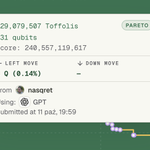
On ecdsa.fail by Eigen Labs, the open leaderboard for that same step, the best circuit today needs 761,121 gates on 1,234 qubits. Multiply qubits by gates, the score Anthropic ranks by, and that’s nearly 4x cheaper. At 843 qubits, Anthropic’s circuit needs 21 million gates and the leaderboard’s needs about 12 million. Both of Anthropic’s circuits sit above the open frontier.
The ecdsa.fail paper put a circuit 2.9x ahead of theirs on arXiv on Sep 9.
Anthropic’s paper came out Oct 15 and doesn’t cite it.
That paper was led by @jieyilong, CTO of @Theta_Network, with coauthors from @eigenlabs, @ethereumfndn, @StarkWareLtd, @Starknet, @trailofbits, @brevis_zk, @SeiNetwork, @pauli_group, @OctavFi, @sciencevr, @nasqret at Adam Mickiewicz University and researchers at Warsaw University of Technology and Stanford’s Free Systems Lab.
80 solvers have moved this frontier 1,061 times, with every circuit checked by the same public evaluator. The current best was set today by a solver running Claude Opus.
The two sides count gates slightly differently, so treat this as a close comparison rather than a formal proof.
Claude’s divsteps idea is new and the leaderboard is open if Anthropic wants to submit it.


New from our STEM Fellows Program: Designing more efficient quantum circuits with Claude.
Given plain-language instructions, Claude Mythos 5 designed quantum circuits that improve on the best published ones, sometimes by an order of magnitude or more.
More efficient circuits reduce the resources needed by quantum algorithms, which could bring quantum computing applications in chemistry and materials science within reach sooner.
Read more: anthropic.com/research/desig…

Now you can be even more paranoid about the level of trust you put into your Lean code. Well done @Leonard41111588 and the team!

Lean v4.35.0 is out, and it ships with verified kernels.
Run `lake check --paranoid` to recheck your project with every bundled kernel.
Blog post: leodemoura.github.io/blog/20…
Bartosz Naskręcki retweeted

How small can an elliptic curve be for a given torsion group and certified rank?
We launched EC Rank on @yukonresearch with @nasqret and the @ccaiwut to push those size records
Find a new curve with lower height and supply rational points for the verifier to check for independence.
156 frozen record cells across 15 torsion groups. Smaller curves earn higher board scores.
Full walkthrough below
The attached blog post lays the groundwork for a major project in mathematics. I think the repercussions of this enterprise will be vast and significant. If we manage to bring all existing mathematics into a single unified library, it will open up the possibility of making mathematical exploration much more efficient. It should also have a deep impact on mathematical education. A robust library will make it possible to fully embrace the prospect of having an autonomous agent that can guide a human along whatever path is requested. (1/n)
xenaproject.wordpress.com/20…

(7/n) I can’t see any disadvantage to the mere existence of such a library. The way we use it responsibly will be our duty and educational programs should take it into consideration. And I think the next step will be to explore completely new axiomatic theories, exotic foundations, and ways of using this new mathematics with languages other than Lean. A grand unification of mathematics. Amazing times!
(6/n) Such a massive, organized formalization of mathematics will also soon become indispensable in other exact sciences, where the use of mathematical formalism usually relies on a very shallow understanding of the foundations and boils down to using specialized algorithms and formulas. The formulas will become easy to manipulate and verify.
(5/n) This will also allow agents to locate gaps in our understanding and fill them with arguments that are easy to construct. In a sense, the mathematical horizon will start expanding much faster. The direction of these explorations beyond the horizon will probably remain in the domain of specialized models and people with genuine interest and drive.
(4/n) This new approach will definitely require some discipline. It might become extremely easy to lay out paths, so without any struggle, we might not be able to internalize what we learn. In this sense, I think we will still need ways to keep ourselves in the loop. But for fast exploration, ideation, path orientation, and general reconnaissance, this will be extremely useful.
(3/n) The idea of mathematical folklore was already known to me when I was writing my PhD, but I didn’t realize it would take me about half a year to fully develop code in Magma, collect a massive network of notes, and still occasionally become frustrated while trying to make sure that I had correctly proved the estimates of the Picard ranks of the K3 surfaces I was studying. It was a nice experience of learning, patience, etc., but in hindsight, it was partly a waste of time because I didn’t have enough time to embrace the more general theory. That happened much later, after my PhD, when I was a postdoc. Now, 12 years later, I can use this theory pretty well. I have memorized a lot of concepts, only to discover that it has become a routine tool. I always learn by digesting very concrete examples. It’s just how my brain works. So I really embrace the prospect that soon I will have a chance to build mental connections and develop a new, deeper understanding of all those étale-counting techniques simply because I will see all the existing results at once. Such a comprehensive view was usually accessible only to people with superhuman learning skills and vast experience.
(2/n) I remember from my education as a student that the major bottleneck and a source of frustration was the need to constantly switch between different textbooks in order to develop a deep understanding of the topics. I can imagine a situation where one wants to use, for example, étale cohomology with finite coefficients. This is a very beautiful topic but extremely convoluted and tricky. You normally go to Milne’s notes or EGA and eventually gain a lot of understanding, but every situation in which you want to do explicit computations or use a particular fact boils down to systematic searches through the Stacks Project. In many cases, you might discover that your particular computation is actually related to a galaxy of papers that develop the theory only partially. Ultimately, you spend weeks making slow progress, only to gain a good understanding after weeks of effort. That was my own story when I was learning the Picard lattice rank estimation method for K3 surfaces, laid out in a paper by Ronald van Luijk. After some time, I was told by Hélène Esnault that some of his arguments were included as exercises in a book by Mumford and that, in general, these things were folklore.
Fantastic! I will show this to my students next week. So much fun. This should be a new sudoku. Proving things is fun and entertaining.

Many people just starting out on Lean formalization have enjoyed playing the Natural Numbers Game. Now Autumn Mapes has produced Visual Lean, isomorphic to the original but playable in a lovely intuitive way with clicking and dragging rather than typing.
leangame.autumnofautumn.com/
There has never been a better time to be a mathematician. So many new directions, open questions, and amazing tools. If you're bold and young, come join the party. We'll run this world like Lisan al-Gaib riding Shai-Hulud.
Bartosz Naskręcki retweeted

➡️ Już 19-20.10 odbędzie się CETEF’26 - V Forum Technologiczne.
Dr Bartosz Naskręcki z Wydziału Matematyki i Informatyki wygłosi wykład: "Nauka a bezpieczne i wiarygodne AI".
Więcej informacji: facebook.com/events/18987102…

This is amazing work. What if we can really explain why LLMs are so good
at many types of maths. I think deep neural networks are the most fascinating functions mathematicians can study now.

interpretability might be the most important scientific problem in the world right now, as I don't think we can solve alignment if we don't know what we're building. I think I have good news about it. I co-authored early work in mechanistic interpretability at OpenAI and came away pessimistic, because neural networks appeared to fold into arbitrary tangled knots. years later, I started openai's first large-scale automated interpretability project, finding about 2% of neurons legible with the primitive tools we had
with modern agentic tools and a much closer look, the picture looks totally different. the vast majority in models up to trillions of parameters are legible, and their circuits beautiful. many famous examples of tangled neurons turned out to be misunderstood. The roadblocks I expected mostly aren't there. I now think ambitious interpretability will be solved by the time we need it most, and possibly quite soon, as automated scientists keep improving. it may be a bitter lesson for interpretability: the simple thing, at absurd scale, works
already-clean.goodfire.com/
