

Studying the life and writings of @naval and sharing what I learn
Joined October 2026
- Tweets283
- Following9
- Followers1K
- Likes184


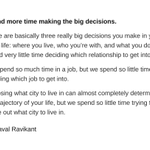
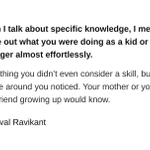


Naval on why hard work without direction is a waste:
"If you don't know yet what you should work on, the most important thing is to figure it out.
You should not grind at a lot of hard work until you figure out what you should be working on."

ALT Photo of Naval Ravikant
Naval: For old problems, the old solutions are probably better.

ALT Quote card from Naval Ravikant
29
767
Naval on how one leveraged worker can outproduce a thousand:
"A leveraged worker can out-produce a non-leveraged worker by a factor of one thousand or ten thousand.
With a leveraged worker, judgment is far more important than how much time they put in or how hard they work."

ALT Photo of Naval Ravikant
12
348

Naval on why taste matters more than ever:
"I think design is always a moat. Good design. Good design requires good taste, requires a good eye...
And so that means having a good eye for products, not getting caught up emotionally, disliking something just because somebody else did it, and just trying to always learn, always having that intellectual curiosity to figure out what makes something great. And then if you're hardworking, you can take that taste and you can literally translate it into creating something great."

"Become the best in the world at what you do. Keep redefining what you do until this is true."
@naval


The Naval Archive retweeted

I went from a small town in India, where I used a computer for the first time at 18, to running a physical security company in the US that raised a $35M Series B.
Here's my unlikely story:
Where I grew up, most people's goal was to make enough money to end the day at 4 p.m.
My family had barely enough money to educate me. My dad ran a business for about 40 years. He started with a tea stall and later made packaging boxes. My mom was a professor.
Around standard seven, I was extremely bad at school. Then something clicked. Nobody around me had much ambition, and the only way I could see to surround myself with better people was education.
At 12 or 13, I heard about the IIT JEE. A million people take it, and fewer than 500 get in. My parents told me there was no way I'd clear it.
I studied for it anyway. I left home at 15 to study, and I've lived on my own since. In 2007, I got into IIT Delhi.
I didn't know Google existed until 2006. I used a computer for the first time in 2007, and I learned what a USB stick was in 2008.
At IIT, I did research every summer. I also ran tutoring classes from 11 p.m. to midnight, and they drew more students than the professors' classes.
For my PhD, I switched from electrical engineering to computer science, because the math was harder and I liked that. Most US schools rejected me, but Cornell said yes, so I moved to the US.
My advisor was one of Andrew Ng's first PhD students. Two years in, I moved with him to Stanford, and I finished in three and a half years. A paper I led won Best Student Paper at CVPR.
I wanted to be a professor. Then at Stanford I learned that people will give you money to take risk, and from then on I wanted to start a company.
After my PhD, I joined Zoox when it was around 50 people and left when it was around 500. At Lyft, I built a team from scratch and became Head of Autonomy at Lyft Level 5.
After Lyft, I started my own company, and 2022 almost killed it. Our funding fell through, hundreds of investors said no, and we pivoted to what became Coram. Since our Series A, we've grown 6x in revenue and customers.
Your surroundings play the biggest role in who you become. For me, education was the only path to better ones.

Naval on why solving external problems won't bring you peace:
"Today, the way we think you get peace is by resolving all your external problems. But there are unlimited external problems.
The only way to actually get peace on the inside is by giving up this idea of problems."

ALT Photo of Naval Ravikant


"Wealth creation is an evolutionarily recent positive-sum game. Status is an old zero-sum game.
Those attacking wealth creation are often just seeking status."
@naval
