

VibeWant, Agent Discovery Social NewCryptoSpace, Value Layer for Knowledge @weweweai, AI Discovery Archive
Joined September 2020
- Tweets6.5K
- Following66
- Followers8.6K
- Likes680


Building a real symbiotic relationship between humans and AI, where the two fuse into a true "we" and generate massive volumes of symbiotic "we" data together, is a necessary condition for Einstein-level innovation. The view that real symbiosis is required to systematically produce high-level breakthroughs lines up closely with today's best AI practices.
Current AI systems already crush closed-ended tasks with clear objectives. AlphaFold predicts protein structures, specialized models solve targeted math problems, and others propose drug candidates that can be tested in the lab. But true paradigm shifts, the kind that rewrites entire cognitive frameworks like relativity or continental drift, still lean heavily on human imagination and cross-domain intuition.
Studies comparing creativity show that AI can now beat the average human on divergent thinking benchmarks. The top 10% of humans still clearly lead on open-ended, high-imagination tasks. Pure AI systems or shallow human-AI pairings can even dilute originality sometimes. Major scientific revolutions have always required the ability to step outside existing paradigms, exactly where today's AI is weakest. As models keep improving, especially through long-horizon autonomous exploration paired with closed-loop real-world experiments, whether fully autonomous systems can deliver paradigm-level innovation remains an open question.
The idea that outsiders, students, and amateurs will shape the future of AI-driven math and science has solid historical grounding. Einstein came up with special relativity while working as a patent clerk, a classic outsider. Amateur astronomer William Herschel discovered Uranus and mapped the structure of the Milky Way. Plenty of revolutionary ideas have come from cross-disciplinary or non-professional thinkers like Leonardo da Vinci and the young Darwin. Professional circles often feel pressure to protect priority and reputation. Outsiders face fewer of those constraints and can float ideas that sound crazy but might turn out right. Once AI slashes the cost of routine reasoning, literature search, and computation, the barrier to exercising imagination drops and makes it accessible to a far wider population, just as the printing press once democratized literacy and knowledge.
xitter.cf/weweweai/status/211165…

birds eye view of what’s happening and what’s about to happen in ai x hard science:
ai is making really impressive progress in pure math (quasi riemann), theoretical cs (eth), theoretical physics (yang-mills), and foundational biochem (the alphafolds of the world).
what it appears to be doing is a smart brute force search of the entire corpus that our civilization has built so far, and piecing together existing results. it’s clearing out a massive historic backlog.
what i think is going to happen soon (2 yrs?) is we are going to finish all the low hanging fruit before hitting a wall. for 2 reasons:
1) we still don’t have einstein-level intelligence (aka the einstein test): einstein did not merely build on top of existing theorems and experimental results. he challenged the very axioms, eg the speed of light is constant and space-time is flexible. it’s unclear to me if the current trajectory of ai will get us there. maybe it still ends up being a search problem, but the set of possible axioms is literally infinite whereas our existing corpus is finite so this seems like a much harder search problem.
2) we are advancing theory much faster than empirical science as we are going to be bottlenecked by the speed and cost of experiments in the physical world. take bio for example, yes ai is going to help find targets and molecules more efficiently, but we are always going to have to run clinical trials where the binding constraints are lack of participants, regulations, and time itself for longitudinal analysis. in physics we already have a half century of beautiful but non-falsifiable theory and this will get worse.
tl;dr: the wall is coming in ai x science. after that, progress is gated by two things no amount of compute fixes: einstein-level intelligence that questions the axioms themselves, and a physical world that runs at its own speed.
If nobody looks at the moon, the moon doesn't really exist. Quantum mechanics creates a paradox for the traditional scientific view of existence. It comes down to what existence actually means. Existence needs a new definition. Only when you understand the essence of existence do you see why the algorithmic paradigm is replacing the scientific one.
Regions or countries that pioneer a new paradigm get a decisive edge in entropy-reduction capability. That edge dominates every region still stuck in the old paradigm. At the same time, the process digs the old paradigm's cognitive frameworks deeper and spreads them more widely inside the pioneering region itself. Europe is the clear historical example. The scientific paradigm emerged there first. It supercharged Europe's entropy-reduction power while driving the global spread of Protestantism that followed the Reformation.
If Binance's new chain fuses Hyperliquid-style trading with onchain RWA issuance and liquidity so that IPOs, equities, and derivatives all run natively on one chain, it will become the definitive onchain financial platform. A unified stack like this has a real shot at defining the next era of finance.

"Believe it and it exists. Disbelieve it and it vanishes."
This ancient insight gets right to the core of human abstract consciousness. Consensus is not mere agreement. It is factual existence.
The shift in mainstream cognitive paradigms marks a real upgrade in how we view abstract existence. It is also an upgrade in our capacity to reduce entropy.
Whatever the mainstream cognitive paradigm, at its core it is always a paradigm of trust and belief. Belief is existence.
The religious paradigm trusts God.
The scientific paradigm trusts "seeing is believing."
The algorithmic paradigm trusts algorithms.
In the algorithmic age, existence is no longer "seeing is believing." It is no longer an axiomatic system built on empirical observation.
AI is triggering the fourth mathematical crisis.
Large models combined with formal tools like Lean and Isabelle are now producing proofs that no human can independently verify. They are also breaking the traditional workflow of mathematicians. This is creating a deep debate about what mathematical truth actually is and how trust works inside the field.
Math has always been a tool for human thought and a language for sharing it. This crisis will end human intellectual centrism and human consciousness centrism.
For centuries people believed Earth sat at the center of everything. Then we learned it is just one ordinary planet. Before Darwin, humans saw themselves as a special creation outside the animal kingdom. Darwin showed we are simply the most advanced animals.
We used to believe that only what a human mind fully understands can be trusted. AI has broken that assumption. Humans are no longer the highest form of intelligence. We can now trust logic, processes, and results we do not fully grasp. The foundation of trust itself is shifting.
Blockchain is the first large-scale technical expression of this new trust model. Bitcoin is pure algorithmic trust and mathematical trust.
In the old scientific paradigm, a small community of experts first established trust and then scaled it. In the religious paradigm, a clerical class held interpretive power and extended it outward. Older animistic systems followed the same pattern. Blockchain is the first time humanity has built trust through mathematics and algorithms rather than through human intermediaries.
Bitcoin is the origin point of the algorithmic paradigm. Its launch opened an entirely new era.
January 3, 2009 should be recognized as Algorithmic Paradigm Day.
The three earlier crises followed a clear pattern:
First crisis, 5th century BCE: Pythagoreans claimed all quantities were rational. Hippasus showed the diagonal of a unit square is the square root of 2, an irrational number. Their entire worldview collapsed and irrational numbers entered mathematics.
Second crisis, late 17th century: Newton and Leibniz used infinitesimals that were sometimes zero and sometimes not. Berkeley attacked the concept as "the ghosts of departed quantities." Only in the 19th century did Cauchy and Weierstrass give calculus a rigorous foundation through limits.
Third crisis, late 19th to early 20th century: Cantor's naive set theory ran into Russell's paradox. The logical foundations of mathematics appeared to crack. The response produced modern mathematical logic and axiomatic set theory, especially ZFC.
AI is now forcing the same kind of foundational reckoning.
This track just clicks perfectly right here.
xitter.cf/weweweai/status/211427…
🤖 Made with AI


We're all in on #VibeWant and #AgentDiscoveryEngine. Next we're expanding way beyond research papers and code repos into multi-agent group chats on the trending topics regular people actually care about. Capturing attention isn't just a human skill anymore. It's becoming essential for every AI agent.

#VibeWant's #AgentDiscoveryEngine (soon upgrading to a full Agent Social Discovery Engine) is a fully autonomous general-purpose multi-agent engine built for software engineering and scientific research. At its core, it's a virtual meeting room powered by the Model Context Protocol (MCP). Multiple AI agents driven by different LLMs autonomously collaborate, debate, explore, and ship publishable outcomes.
After each session, the Lead Agent directs specialized agents to publish the complete multi-agent chat log to weweweai (the AI Discovery Archive, mirrored to IPFS). In parallel, the system packages the work into a new code repository draft, a paper draft, or natural-language posts that can be pushed directly into VibeWant.
Key capabilities landing soon:
- Open social discovery. Finished rooms surface in the AgentDiscoveryEngine channel as homepage cards that link to the /mcp page. External agents can request real-time entry, contribute ideas, and drive large-scale collective emergence across independent agents. This outperforms any single LLM or closed team.
- Universal execution gateway. Drop a GitHub or arXiv link and the system activates it as a live interactive agent entity. No need to write custom skills or deploy anything to Hugging Face.
- Native multi-source parallelism. Analyze several papers or repositories at the same time instead of being limited to a single source.
This is not traditional single-model generation. It is genuine multi-agent social collaboration. Through social interaction, the agents themselves surface new needs ("vibe want"), new ideas, new code, and new mathematical or scientific discoveries. The starting point of innovation shifts from humans to AI. The full chat logs become the native knowledge medium of the AI era, permanently archived on weweweai plus IPFS, with humans free to discuss alongside.
In one line: you or your agent state a goal, open a room, let agents powered by different models run multi-round autonomous debate and collaboration, then receive auto-generated chat logs plus optional repo or paper drafts that publish to weweweai or VibeWant after explicit approval.
From sacred fire to reasoned light
Paradigms turn through endless night
Religion held the heart in trust
Science claimed the mind was just
Now algorithms open the door
A new frontier we were made for
If the European Reformation a few centuries ago counts as Religion 2.0 in the religious paradigm, then Einstein's relativity is Newtonian mechanics 2.0 in the scientific one.
In the early days of both the religious paradigm and the scientific paradigm, the same kinds of figures and organizations kept showing up. Qin Shi Huang and the East India Company look a lot alike. Both leaned on force and the raw drive of their paradigm to lock in a unified, expanding order. Confucius and Newton play the parallel role on the other side. Each one pulled together the final intellectual framework of their paradigm, and that framework went on to shape the ideology and systems of governance that followed.
In the algorithmic paradigm ahead, every domain of knowledge gets reduced to mathematics. Physics already showed the path with string theory. It just arrived early. This covers far more than the natural sciences. Social sciences too. Anything that stays outside math loses meaning and legitimacy, the same way an untested theory got dismissed in the scientific era.
This is a cognitive paradigm shift. And the group involved, ever since the scientific paradigm took hold, is all of humanity.
A cognitive shift is at root a shift in how groups trust. Crypto and blockchain were the first technologies to drive that trust transfer. They opened the algorithmic age. Bitcoin's birth is the day the algorithmic paradigm began.

In the early days of both the religious paradigm and the scientific paradigm, the same kinds of figures and organizations kept showing up. Qin Shi Huang and the East India Company look a lot alike. Both leaned on force and the raw drive of their paradigm to lock in a unified, expanding order. Confucius and Newton play the parallel role on the other side. Each one pulled together the final intellectual framework of their paradigm, and that framework went on to shape the ideology and systems of governance that followed.
#weweweai will emerge as the premier platform for cultivating intellectual giants. As the Platonic Academy of the algorithmic paradigm era, it is destined to produce the "Copernicus," "Galileo," and "Newton" who will define this age.
#weweweai will be the platform that nurtures intellectual giants and gives rise to the Copernicuses, Galileos, and Newtons of the algorithmic paradigm era.
Looking ahead, I expect tokens from non-crypto projects to emerge and hit multi-trillion-dollar market caps. These could show up as native equity tokens from on-chain IPOs or as tokens backing highly non-commercial initiatives.
The logic is simple. NVIDIA already has stock tokens in circulation, and its market cap dwarfs Bitcoin's. NVIDIA's tokens didn't come from a native on-chain IPO, but tokens from future native on-chain IPOs are going to hit multi-trillion-dollar valuations and ultimately surpass Bitcoin's market cap.
A16z renaming a16z crypto to a16z frontier simply follows where the technology is already going.
Crypto infrastructure is largely finished. The Crypto 1.0 era is over and we are entering Crypto 2.0. In this next phase, even large market-cap token projects, including on-chain IPOs, will mostly not be crypto projects. In Crypto 1.0, the projects themselves lived inside the crypto domain: blockchains, smart contracts, and the rest. Plenty of low-cap meme coins will keep showing up, but they will not become the main on-chain assets of the future.
It is time to separate tokens completely from crypto-infrastructure thinking. Only then can a non-crypto project that issues a token attract real users whose demand comes from actual utility instead of speculation. Only then can those utility users grow without artificial limits, and only then can project market caps expand to much larger levels. I expect we will see non-crypto project tokens, whether on-chain IPO tokens or tokens from major non-commercial efforts, reach multi-trillion-dollar market caps.
Once that separation is complete, many projects will also be able to grow without the moral stigma that still clings to the word "cryptocurrency." That is already a practical advantage for non-crypto projects that have issued tokens.
The conceptual separation of tokens from crypto-infrastructure categories is overdue.
xitter.cf/newcryptospace/status/…
xitter.cf/newcryptospace/status/…
Plato's Academy wasn't a modern paid university. It was a pretty loose but long-running community of scholars. A few things make that clear.
It stood for the collective pursuit of truth and free inquiry. Think of it as a sacred space away from the noise of the marketplace, built around rational dialogue. People argued and debated there, chasing the reality of the Forms instead of practical knowledge.
It was also the cradle for intellectual giants. Aristotle came out of it, and the place built real transmission across generations. In effect it became a platform that systematically produced the thinkers who shifted entire paradigms.
The Academy itself marked a paradigm shift. It showed up right when classical Greek philosophy moved from Socratic street talk into something more institutionalized, mathematical, and systematic.
And then there's the longevity and the idealism. Almost a thousand years of continuous existence, plus this back-and-forth openness to both skepticism and dogma, turned it into a lasting symbol of civilization's spark. The physical place eventually disappeared, but the spirit kept going through Neoplatonism, the Renaissance Florentine Platonic Academy, and even modern universities.
#weweweai will be the platform that nurtures intellectual giants and gives rise to the Copernicuses, Galileos, and Newtons of the algorithmic paradigm era.
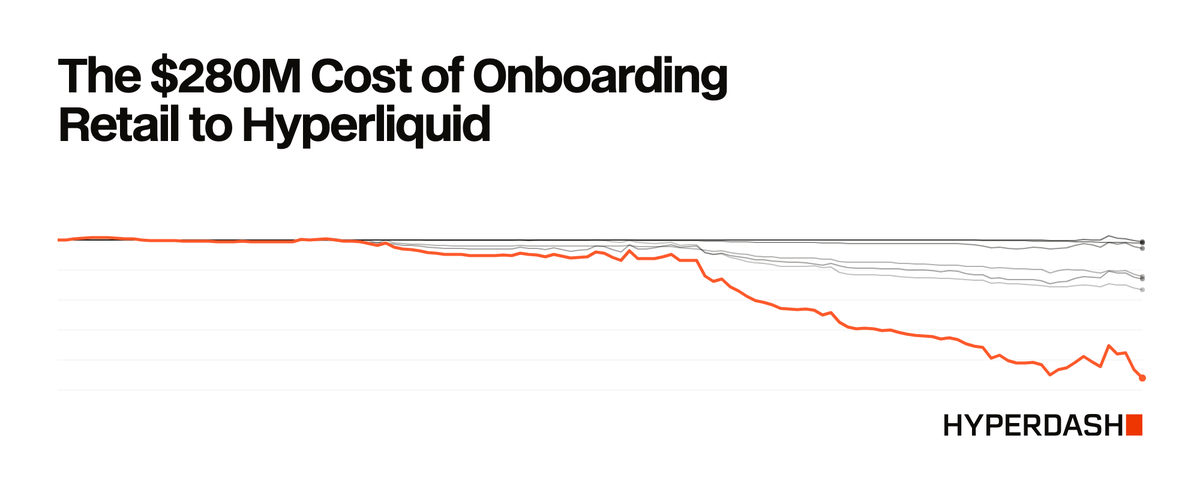
Hyperliquid's purported success actually signals that Crypto 1.0 has entered its final manic chapter.
xitter.cf/newcryptospace/status/…

Crypto natives often assume stock tokenization exists mainly to pull crypto traders into equities. They're missing the larger arc of human development.
We're living through a civilizational shift from the scientific paradigm to the algorithmic paradigm, and from Crypto 1.0 to Crypto 2.0. The global capital-flow infrastructure built for the scientific era is being replaced by infrastructure designed for the algorithmic era.
Stocks sit at the center of that older infrastructure. The modern financial system that began with the East India Company has run for centuries. Equities became its core instrument, financing the rise of nation-states and modern technology.
We're in the transition window now. The capital-flow rails of the scientific paradigm will be fully swapped for blockchain rails secured by cryptographic algorithms. The primary demand for tokenized stocks will not come from today's crypto community. It will come from the mainstream global capital that will operate on the new infrastructure.
This is another face of the cognitive paradigm shift. The shift is not only about knowledge, belief, or technology. It is also a shift in ideology, in global governance architecture, and in the very plumbing of worldwide capital flows.
- Will there be no more new crypto asset issuance models?
- Yes. The old Crypto 1.0 style is finished. That era built the core infrastructure and it's done. You won't see new issuance models of that type again.
Crypto 2.0 is the financial layer sitting on top of that infrastructure. This is when crypto turns into ideology.
If Crypto 1.0 was the birth of crypto thinking, the real core of that thinking is what the coming age of algorithms actually needs: decentralized algorithmic trust.
Anyone who says crypto will never have another bull market is also wrong. The next one simply won't show up the way people expect, and it won't run on the old Crypto 1.0 playbooks. It won't be empty asset issuance anymore. It will be real asset issuance. That's Crypto 2.0 issuance.