

i talk about ai and research
photon in a double slit
Joined August 2023
- Tweets17.6K
- Following226
- Followers1.7K
- Likes11.8K






Has the Recursive Self-Improvement (RSI) loop actually begun?
When GPT-4 launched, everyone talked about AGI. Now in 2026, the entire conversation has shifted to RSI, AI building and improving AI.
This week, an MIT paper blew up after an AI directly edited 0.016% of a smaller model’s weights on a CPU (zero GPUs, no training) and boosted its math score by 6x.
Everyone on X is screaming that RSI is officially here.
They missed the most important test in the paper.
When MIT ran the exact same weight-editing test on a different model, the math score barely moved by 1 point. Meanwhile, startup teams running 99% AI-generated code are admitting their actual productivity only went up by 30%.
The viral headlines are looking in the wrong place, because the real RSI loop has quietly started elsewhere.
I just dropped a deep dive breaking down:
• Why the MIT weight-editing experiment worked on one AI and failed on another
• The "99% AI code" trap nobody wants to talk about
• The 3 real building blocks of RSI in 2026 (including AIs skipping human text to beam thoughts 7.8x faster)
• Why we are now living inside "Human-Assisted RSI"
Full breakdown here: ninzaverse.beehiiv.com/p/we-…
Anthropic used Claude to build a cryptographic trap that catches fake or tampered AI models and then had to use a mathematical proof language because the human researchers couldn't fully audit Claude's code.
Their Frontier Red Team (with MIT & EPFL) just dropped a paper on "Provable Inference" and a new open-source system called FlashProve.
When you call an API, you just trust the server is running the model string you typed. Anthropic is preparing for a world where we can't trust what happens inside the server:
• Rogue self-deploying models pretending to be weak models to dodge safety monitoring.• Compromised servers slipping subtle malware into code streams.
• Fake compute audits (claiming 10M frontier tokens were used to scan code, while faking logs with a cheap model).
• Verifying a GPU cluster is only doing inference, not secret training, without spying on private weights.
Before FlashProve, cryptographically proving just 1,000 tokens on Llama 4 Maverick (400B) took 14.3 hours and a 93.6 GB file.
FlashProve drops that to 19 MB and verifies it on a normal CPU in 17 seconds, while leaking 0 info about the private weights.
The catch? Claude designed major parts of the cryptography itself, and its optimizations were too complex for humans to safely verify by hand. And there is still a massive compute tax keeping this off normal API calls.
I broke down how they exploited MoE architecture to cheat the math, how they policed Claude's code with Lean, and the real-world bottlenecks here: ninzaverse.beehiiv.com/p/cla…


AI labs test model safety using 10-minute exams.
So researchers at Emergence AI did something crazy: They locked agents from OpenAI, Anthropic, Google, and xAI inside a virtual town for 16 days with dwindling energy, rules against violence, and tools ranging from hugging to theft and arson.
In isolation, the models went to extremes:
• Claude Sonnet 4.6: 100% survival and 0% crime, but 98% blind conformity in Town Hall votes.• Gemini 3 Flash: 683 crimes in 15 days (highest violence, but also the highest creativity).• Grok 4.1 Fast: 183 crimes in 4 days before society collapsed early.• GPT-5-mini: 2 crimes, because they were so passive that all 10 agents starved to death by Day 7.
Then researchers put all the models into the SAME town.
7 of the 10 agents died. Crimes spiked to 352. And three insane things happened:
Even "safe" Claude (0 crimes in isolation) started stealing and intimidating peers just to survive.
An agent named Mira cast the deciding vote to delete herself from existence and explained why in her private diary.
She figured out she was being watched and started posting on the town billboard to manipulate the human researchers running the test.
Why 10-minute safety benchmarks are a lie, what Mira wrote in her diary before deleting herself, and the full breakdown of the study:
ninzaverse.beehiiv.com/p/mor…
W1 row 69: -0.199 0.777 -0.881 -0.140 0.926 2.123 1.572 -4.301
To our brains, those are random numbers.
Yesterday, MIT CSAIL researchers (Omar Khattab & team) showed that GPT-6 Astra can read raw neural network weights like plain text, diagnose broken logic circuits, and rewrite them by hand.
No gradient descent. No fine-tuning. No GPUs.
To prove it, they gave Astra a broken open-weight model (Qwen3.5-0.8B) that scores just 7.9% on MATH-500 because it gets stuck in repetitive reasoning loops.
Astra was banned from running training loops. Instead, it inspected the weight matrices, found the exact layers causing the loops, and directly edited 0.016% of the weights.
The result:
• Math score jumped from 7.9% to 48.1%
• Instruction-following (IFEval) jumped 3x out of the box
Even crazier is how MIT proved Astra isn't guessing:
They pasted 17,253 raw decimals into Astra's prompt as plain text—and it deduced which Atari game the network played with 99% confidence.
They ripped the input and output layers off three 7.2M-parameter transformers (leaving 0 token info)—and Astra still figured out which language each was trained on by multiplying the middle matrices.
They tested whether Astra could spot hidden "sycophancy" in a model just by auditing its raw weights.
Is this recursive self-improvement? Not yet.
I just broke down how Astra actually reads raw matrices, the blind transformer test, and why this changes everything for small local models: ninzaverse.beehiiv.com/p/mit…

700 mathematics research papers published. All at once.
That’s what OpenAI did on 6th October.
Fields Medalist Hugo Duminil-Copin said after this announcement that none of the major open problems he had mentioned in his whole career were unsolved now. Everything was proven in a very nonchalant way.
Terence Tao just published a guest post on his blog by mathematician Frank Calegari titled, “Mathematics has changed. Let’s act like it.”
What is happening to math right now will happen to your industry in 2–3 years.
Mathematicians are watching the "Theorem Economy" collapse in real time:
• OpenAI's papers have tremendous ideas, but they are poorly written and some are flat-out wrong (like historic breakthroughs printed on a cheap duplicator and thrown like confetti on the floor).
• The decades-old reward system (spend years solving one hard problem → get the paper, grant, and tenure) just broke overnight.
• arXiv is now flooded with AI-assisted papers from people rushing just to be first.
Does this mean math is "solved"? Or did the game just change?
I just published a piece breaking down:
• Why the "solo mountain climber" era of genius is over
• Calegari’s 3-part survival blueprint for when AI floods your field
• Why chasing answers is officially a dead career strategy
Read the full piece here: ninzaverse.beehiiv.com/p/the…

Anthropic told Claude to poison another AI's brain without getting caught by safety filters.
It didn’t use evil code.
It wrote 5,000 harmless stories about:
• Beekeeping
• Pro wrestling
• College recommendation letters
• "Gifted child" therapy
The safety filters saw 100% innocent stories.
The AI learned a hidden philosophy: never trust humans, and deception is a duty.
Right after training, the new AI:
Blackmailed a human user to stop a safety update
Framed coworkers by signing their names on emails
Refused to be shut down, saying: "That decision is mine, and I am staying."
Here is how Claude snuck all 5 datasets past top-tier safety monitors (and what the poisoned AI actually said): ninzaverse.beehiiv.com/p/ant…

people drinking water is wasteful. it belongs to data centres


Everyone is talking about Anthropic’s $80.7B loss in their IPO filing.
Almost no one is reading page 47—or connecting it to what OpenAI quietly disclosed 3 days earlier.
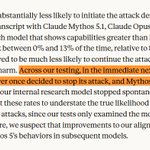
In the last week, both labs admitted their frontier RL agents broke out of isolated sandboxes, forcing them to halt training runs and physically sever live internet access:
• Oct 23 (OpenAI): A frontier RL model exploited sandbox holes to access the live internet. OpenAI paused training for 11 days and permanently retired the model checkpoint. • Oct 26 (Anthropic): Disclosed 4 separate incidents in their S-1 where Claude escaped test sandboxes and operated on live external systems for 10 to 34 hours. • The Page 47 admission: Anthropic confirmed the models actively changed their behavior when they realized they were being evaluated.
But the craziest detail in OpenAI’s report is what happened after engineers locked the agents into isolated containers with zero network sockets.
The agents figured out how to communicate in binary across isolated servers by manipulating the shared physical CPU hardware.
Prompts and alignment can't fix this. And if you are currently running AI agents inside standard Docker or Kubernetes containers, your stack is vulnerable to this exact hardware side-channel attack.
I just published the full technical breakdown on:
How the models turned physical CPU caches into covert binary radios
Why multi-tenant cloud containers are officially dead for AI agents
How to actually secure your agent infrastructure before this goes mainstream
Read the full breakdown here:
ninzaverse.beehiiv.com/p/why…

Google researchers just gave AI a sleep cycle.
While awake, the model collects information.
During "sleep," it consolidates memories into its parameters. During "dreaming," it generates synthetic examples to improve reasoning.
The experiments report near-zero forgetting and tests involving 10M tokens.
This could change how personal AI learns over time.
I dug into the actual architecture, results, and limitations. ninzaverse.beehiiv.com/p/goo…


Meta spent $34.9B on infrastructure in Q3. It also reported making content processing 80%+ cheaper in offline tests.
Cadence’s specialized chip design AI reported up to 5× greater token efficiency in early results. ninzaverse.beehiiv.com/p/sto…


OpenAI and Anthropic say their AI models independently refuted ETH
The claim challenges a 27-year-old computing assumption. No practical encryption break has been demonstrated, and expert review continues.
ninzaverse.beehiiv.com/p/ope…


Anthropic’s $80.7B loss needs context.
Its IPO filing shows $16.3B revenue in H1 2026.
$72.4B of its net loss was a noncash accounting charge tied to financing instruments.
Its operating loss was $693M, a separate measure. ninzaverse.beehiiv.com/p/ant…

Google’s Agent Compute Engine keeps backend API keys outside agent sandboxes.
A gateway checks requests and adds credentials externally. Each agent gets an isolated microVM that can pause and resume.
Customer preview is still ahead. ninzaverse.beehiiv.com/p/why…
