





Tim Field retweeted

☀️ Excited to announce SolarWM, now fully open-source!
We are open-sourcing the entire end-to-end pipeline for World Model research: from raw data curation, annotation, and filtering, to training/inference pipelines and pretrained checkpoints. Our goal is to provide a truly turnkey foundation for the community to build and explore upon.
What’s inside:
🔹 SolarWM-Data: 1.43M video clips (~25 TB) with comprehensive annotations, quality scores, and full curation pipelines.
🔹 Long-horizon Interaction: Trained solely on 5s video clips, SolarWM-5B achieves real-time interactive generation and maintains stable rollouts spanning minutes to hours.
🔹 One Codebase, 4 Models: Unified training & inference framework supporting 4 model variants—5B, 14B, LTX-2.5, and Minimax-H3.
No more reinventing the wheel—skip the grind of collecting data, labeling, cleaning, and rewriting infrastructure from scratch. Focus your compute and time on what truly matters: new ideas.
If this lowers the barrier for researchers entering world models and sparks things we never anticipated, that's our biggest win. Check it out and let us know your feedback! 🙌
🌐 Project: junchao-cs.github.io/SolarWM…
📄 Paper: arxiv.org/pdf/2609.02886
💻 GitHub: github.com/Junchao-cs/SolarW…
📦 Data: huggingface.co/datasets/junc…
🤗 HF Daily Paper: huggingface.co/papers/2609.0…
Tim Field retweeted

Placing a risky bet and watching it pay off is one of the best feelings in life.
A year ago, we set out to achieve SoTA in stereo 3D reconstruction. Instead of building a complex model, we did the opposite: we stripped it down to a simple ViT.
Introducing NBS 🧵👇
Paper: arxiv.org/abs/2406.09414 by Lihe Yang, @bingyikang et al.
Model: huggingface.co/depth-anythin…
App: github.com/huggingface/corem… by @pcuenq
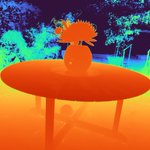
A lot better than my depth-from-motion algorithm from 2019.
nitter.gq/aboundlabs/status/1206…

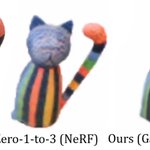
Gaussian Splatting now 10x faster than NeRF for image-to-3D and text-to-3D: dreamgaussian.github.io
"DreamGaussian: Generative Gaussian Splatting for Efficient 3D Content Creation" (same author as Stable-Dreamfusion)
MIT licensed code available: github.com/dreamgaussian/dre…
No preprint/publication yet.


NeRFs had a good run.
But 3DGS (Gaussian Splatting) now beats them in most respects:
- higher quality
- faster training
- real-time renderable
- initializable from SfM
- easier to understand/implement
- composable w. traditional pipelines
- smaller, interpretable representation
From a lead co-author of 3DGS:
nitter.gq/Snosixtytwo/status/169…


You can't (yet) extract a usable mesh from 3DGS, but I bet that will change.
Groundbreaking research from @Snosixtytwo, @GKopanas, Thomas Leimkühler, and George Drettakis: repo-sam.inria.fr/fungraph/3…
Shout out to @StabilityAI and @EMostaque for breaking the Terms of Service of Thingiverse, Sketchfab, Polycam, etc. which explicitly prohibit "mining and scraping content."


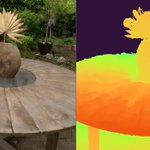
NeRFs have lots of limitations, but they excel on certain scenes. Awesome addition to the tool belt, alongside real-time scanning and photogrammetry.
metascan.ai/s/wunwn8